


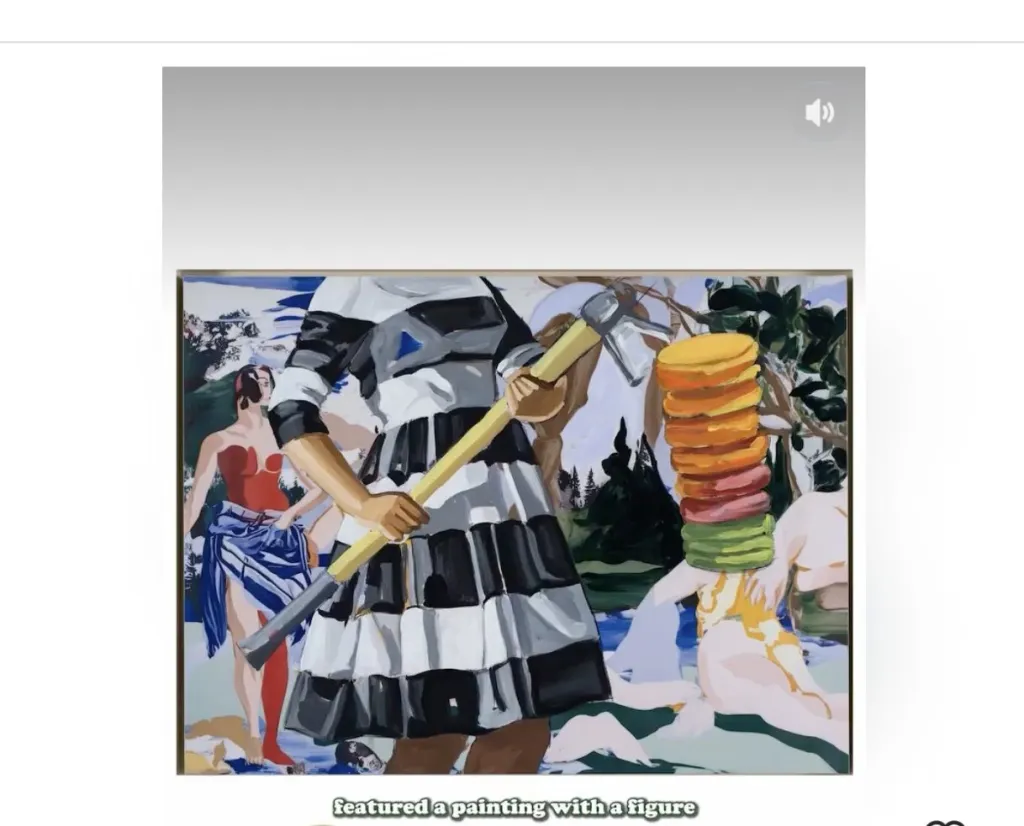
A painting in David Salle’s new exhibition at Sprüth Magers in Los Angeles has been removed from view after critics questioned whether the painter copied another artist’s work.
Salle’s painting, Hatchet (2025), features as its primary subject a woman in a black-and-white dress—her face cropped by the edge of the canvas—brandishing a sledgehammer. The exhibition, titled “My Frankenstein,” opened on February 24, and social media chatter quickly picked up on the resemblance to Kelly Reemsten’s painting Impact (2021).
In a video that has since drawn nearly 10,000 views, the Minneapolis-based artist Josie Lewis asked: “Did Salle steal this woman’s idea, or is it just harmless appropriation?” Reemtsen later shared the video on her Instagram page. She declined to comment to ARTnews.
Salle is commonly associated with the Pictures Generation, a group of American artists who emerged in the mid-1970s and early ’80s, among them Cindy Sherman, Louise Lawler, Robert Longo, and Richard Prince, whose work probed the vast amount of images available for mass consumption. These artists often produced photography, painting, and graphic design that incorporated images from films, videos, television, and advertising—and even other artists’ work. Salle is one of the few painters who has been aligned with the group by critics.
This kind of work, often known as appropriation art, has periodically courted controversy. Prince, for example, has faced a years-long legal battle over his Canal Zone paintings (2008), which incorporated photographs by French photographer Patrick Cariou. Cariou ultimately sued Prince, as well as Gagosian Gallery and Rizzoli, for copyright infringement.
In an emailed statement to ARTnews, dealers Monika Sprüth and Philomene Magers drew attention to Salle’s appropriations of the past, noting that he “has historically borrowed images from popular culture, advertising, art, his own photographs, and other sources to create his own interpretations on canvas, continuing a long tradition of artists drawing from the past and from one another. In turn, his works have been used by other artists without his permission.”
They continued: “For his latest exhibition, ‘My Frankenstein,’ Salle has continued to mine a variety of images from physical and online domains, some of which may be recognizable or attributable to other sources. He acknowledges that his use of Kelly Reemtsen’s image has restarted a decades-long dialogue about authorship for new audiences. While both Salle and the gallery feel this is an important conversation to have, in consultation with David Salle, and out of respect to both artists, this work has been removed from view.”
Salle declined to comment.
The oil-and-acrylic paintings in Salle’s latest exhibition were created with artificial intelligence. In recent years, Salle has collaborated with an engineer on a generative AI model trained on his own oeuvre, feeding it curated selections of past works and prompting it to produce new image configurations.
Amy Adler, a legal professor at New York University specializing in art and law, told ARTnews: “If this went to litigation, I think Salle would have a tough time defending this under fair use,” given the likeness and fact both are practicing fine artists. “[Salle] is one of the pioneers in this conversation about borrowing in art, and I respect that taking the image down was a gesture toward [Reemtsen]. Nonetheless, that it was taken down would not be legally relevant under a copyright lawsuit.”
She added that his defense would likely hinge on several key pressure points: whether the message or meaning of the original image was sufficiently transformed; whether the two works serve different purposes; and whether the disparity in the artists’ price ranges effectively places them in isolated markets.
“Since the Supreme Court’s decision in Warhol Foundation v. Goldsmith, there has been a greater emphasis on purpose [in fair use disputes]. So a defendant like Salle would have a hard time in court because he and Reemsten appear to have the same purpose, making fine art,” said Adler.
According to the exhibition’s website, the project “reflects the artist’s recognition of the conflict inherent in [Salle’s] embrace of this new, still-evolving technology.” The text adds that the works also function as a “potent metaphor for the unintended consequences of scientific ambition,” invoking Mary Shelley’s novel Frankenstein.
Speaking to The Art Newspaper in April 2025, on the occasion of his show “Some Versions of Pastoral”, David Salle described training his AI to produce digital images as “lengthy trial and error” but ultimately “so rewarding … [and] inviting [of] my intervention” as an artist. He added that the experience sharpened his own “ability to respond with a brush” alongside “the machine imagery evolving.”
Salle added that the process grew more complex, “when I fed the machine dozens of paintings I made that were essentially thick-brush sketches of figures in space and domestic settings of household objects, of things in nature. But the subject was not important; what was important was the creation of an edge with a brush—that’s a meaningful mark and/or shape.”
