


The loss of a family member can have a remarkable impact on the life of an artist. A case in point: Stacey Gillian Abe was deeply inspired by her late grandmother. In Namirimu (2025), the artist depicts her own experiences of grief and loneliness: A figure sleeps against a pale background, almost empty except for some ghostly strands of wild grass. But most of all, it is her beloved grandmother’s “comfort and warmth” that Abe wanted to capture in these paintings. “Although she didn’t walk much, her presence was invaluable,” Abe said. “She was a sociable and kind woman. If you were new to the area, you would assume she was the chairlady of the local council. People came to see her every day just to spend time with her.”
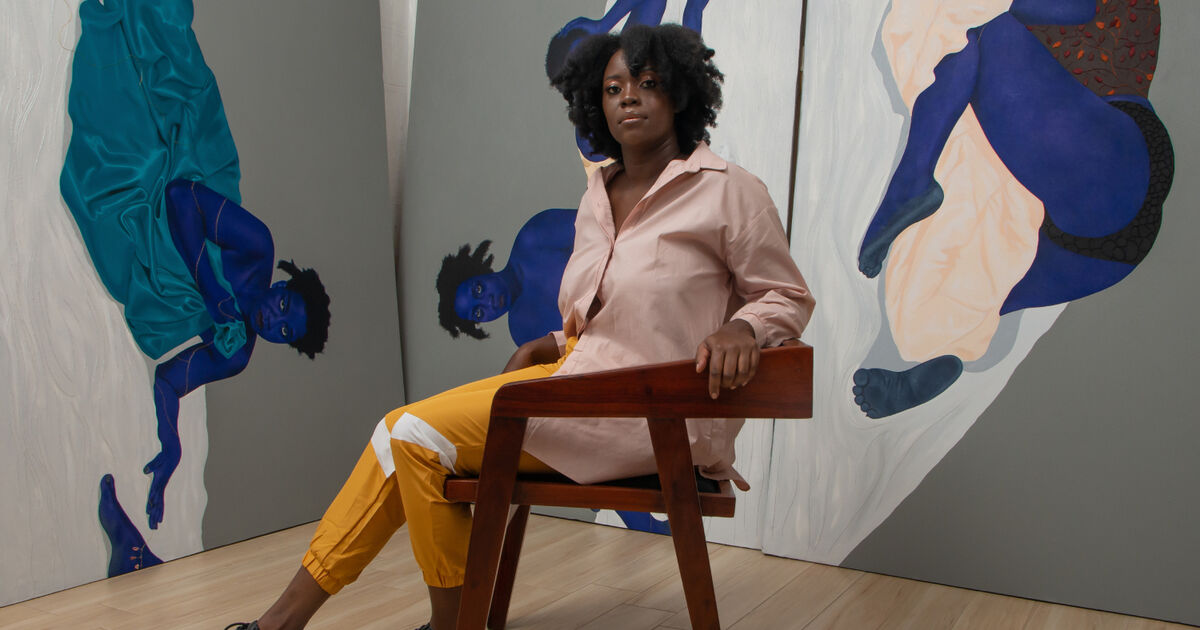
Abe was born in the West Nile region of Uganda and graduated from Kyambogo University in 2014. She has since worked across painting and photography while showing at galleries including Lévy Gorvy Dayan and Jeffrey Deitch. Her peaceful and sumptuous paintings are now on view at a new show at Unit in London called “Garden of Blue Whispers.” Portrait of My Grandmother 1 (2025), for example, shows the family matriarch gazing powerfully, one hand softly clutching golden material that hangs over her shoulder. In The Garden 1 (2024), a nude figure with cloven hooves lounges across a silky expanse of fabric. Dry Season 2 (2025) depicts a woman’s face close up. With fine foliage growing over her features, she turns to the viewer with eyes drowsily half closed. In this, Abe’s second show in London with Unit, the artist continues her practice of depicting women with indigo-blue skin, while widening her interest to the nature that she grew up with.
The paintings are intended to summon Abe’s memories of the seasonal changes in her home village. As strong winds and rain activate the parched land, they bring new scents and sounds, from grasshopper rhythms to the smell of damp earth. “The scent of soil when the first rains of the wet season hit the ground; the process of gathering white ants from termite mounds after a long night of rain; and those extremely cold nights following an extended dry season are just a few examples of the small pleasures of life,” says the artist, who is now based in Kampala, Uganda. “I am certain that I will never be able to find or experience these things in the city.”
Birth of Vanessa (2025), for instance, contrasts a bare and sand-colored landscape with a few flowers that burst through the earth around her central figure, while Dry Season 1 (2025) depicts a few intricate green threads beginning to grow from an otherwise featureless ground. Across the paintings, her figures are nude or dressed in delicate summer clothes, suggestive of a heated atmosphere as they lie in open natural space.
Elsewhere in her paintings, there are subtle moments capturing the deep connection between human and animal lives in her village. For example, in The Garden 3 (2025), the figure’s hooves and furry lower legs meet with fleshy thighs. This surreal aspect of the body is intended to evoke her memory of seeing cow hoofprints in wet soil.
Throughout her practice, Abe’s figures are depicted with their skin an indigo blue, an ongoing motif following a 2020 photo self-portrait series titled “Indigogo.” In this series, the artist painted herself head-to-toe in the color, a response to the historical link between the valuable dye and the slave trade. “My curiosity was sparked by the discovery of indigo dye and its importance as one of the currencies used to buy and sell Black slaves,” she said. In her paintings, her subjects’ skin is rich and deep, this historically loaded color tapping into the artist’s desire to liberate the Black body. In works such as The Garden 2 (2023), the women she depicts seem utterly at peace, serene, and almost asleep in their natural surroundings.
The artist avoids controlling the exact shade of her subjects’ bodies, which imbues them with individuality. “It is a hue that lies in the middle of the color spectrum, and I’ve not nailed a layering technique to achieve the indigo you see at the end of each finished painting. The skin tone of each subject feels distinct to them.” She also integrates hand-embroidery into her work, a technique passed down through three generations. Termite Mound (2025), for example, includes delicate embroidered gold leaves and pink flowers that seem to glow from the surface. They wrap around the shoulders of her protagonist, a delicate addition to the painting that connects the natural with the ethereal.
By directly depicting her grandmother, summoning the environment that surrounded her, and including techniques passed down, Abe creates a tender image of the experiences that have shaped her. “Writing this love letter to my grandma and honoring her as a matriarch in my family just makes me miss her more,” she says. “But even in that emptiness, I can cling to the countless memories I have of her.”
