


Earlier this week, staff at the Los Angeles County Museum of Art (Lacma) voted by an overwhelming margin to unionise, with 96% of eligible employees voting in favour. The vote on 15 and 16 December followed the museum’s decision earlier this month to decline workers’ request for voluntary recognition, despite organisers’ assertion that they had already secured support from a clear majority of eligible staff.
The new union, Lacma United, is part of the American Federation of State, County and Municipal Employees (AFSCME) District Council 36 and represents more than 300 employees across departments including curatorial, education, preparators and administration.
“An independent election to determine whether staff would be represented by AFSCME Cultural Workers United, District Council 36, has concluded,” a spokesperson for Lacma said in a statement to the Beverly Press Park LaBrea News. “The results confirm that DC 36 will be certified as the bargaining representative for staff. The museum is committed to working collaboratively with DC 36 and staff in a spirit of mutual respect, open dialogue and shared dedication to the museum’s mission, honouring the will of the majority of voters.”
Workers publicly announced their intention to unionise in late October, citing persistent concerns related to transparency, limited avenues for staff input, high turnover and compensation that has not kept pace with the rising cost of living in Los Angeles. In an open letter circulated internally and addressed to senior leadership, employees also pointed to the contrast between these conditions and the museum’s ongoing campus redevelopment project, including the new $720m David Geffen Galleries. The letter argued that institutional investment in expansion and infrastructure should be matched by commitments to workforce stability and long-term sustainability.
“I’m looking forward to having a stronger camaraderie with my fellow colleagues and having a seat at the table where we can have an open and honest dialogue with upper management,” Ryan Baker, a visitor services associate, said in a statement. Baker added that for front-of-house staff in particular, union recognition creates a formal structure through which concerns about day-to-day working conditions can be raised and addressed.
The election was conducted electronically and overseen by the American Arbitration Association. According to organisers, Lacma leadership declined to grant voluntary recognition, a mechanism approved by the National Labor Relations Board and commonly used in public-sector workplaces, opting instead to proceed with a formal election. Organisers said that in the period leading up to the vote, the museum adopted strategies they viewed as intended to discourage unionisation. Those efforts, they added, ended after Los Angeles County supervisor Hilda Solis sent a letter to the museum expressing support for staff’s right to organise.
“Now that we have union recognition, I look forward to collaborating with leadership to usher in a healthier, more sustainable culture for our dedicated staff,” Jayne Manuel, a programme administrator for collections management, said in a statement. She added that unionisation offers museum workers an opportunity to help reshape labour conditions across the cultural sector, which has long been associated with instability and low pay.
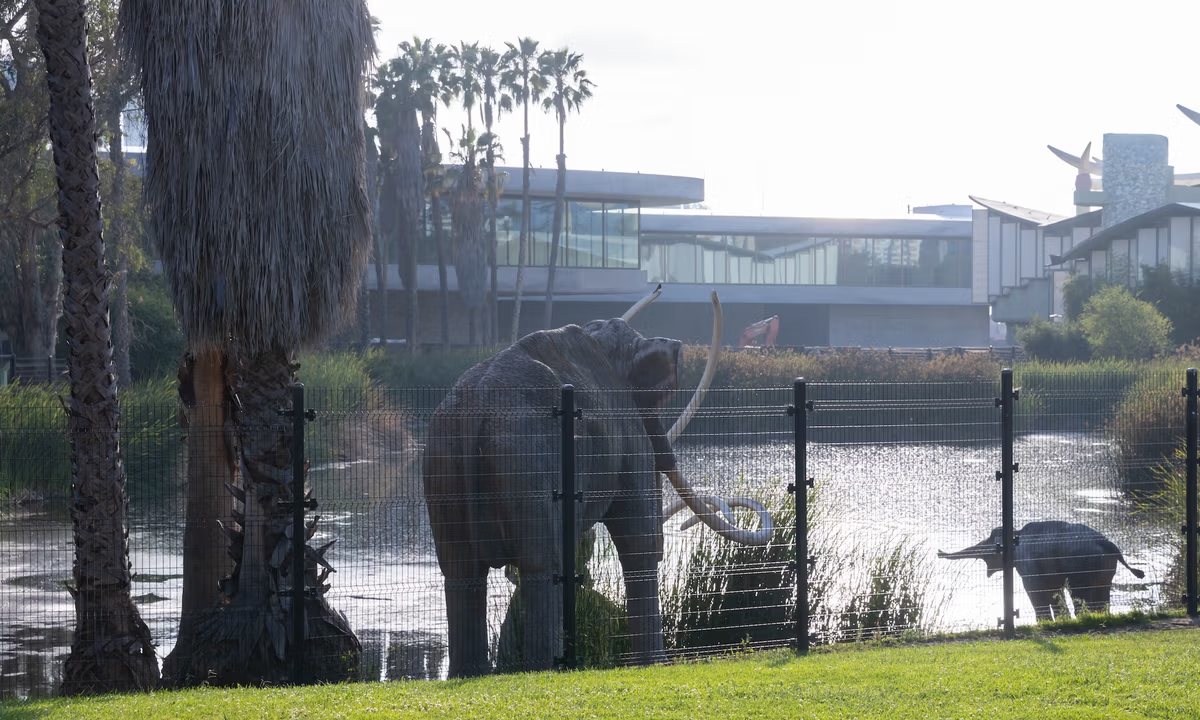
With the vote, Lacma joins a growing group of museums in California whose staff have organised in recent years, as cultural workers across the state increasingly respond to rising living costs and precarious employment conditions. In Los Angeles, staff at institutions including the Museum of Contemporary Art, the Academy Museum of Motion Pictures and the Natural History Museum of Los Angeles County and La Brea Tar Pits have unionised.
The Lacma vote is also part of a nationwide wave of museum unionisation over the past five years. From large institutions to contemporary art spaces, workers have frequently framed organising efforts as a response to what they describe as a widening gap between institutional growth, capital investment and the conditions under which cultural labour is done.
Union representatives will now prepare to negotiate their first contract with Lacma’s leadership. Their priorities are expected to include wages, job security, transparency and formal mechanisms for worker input.
