


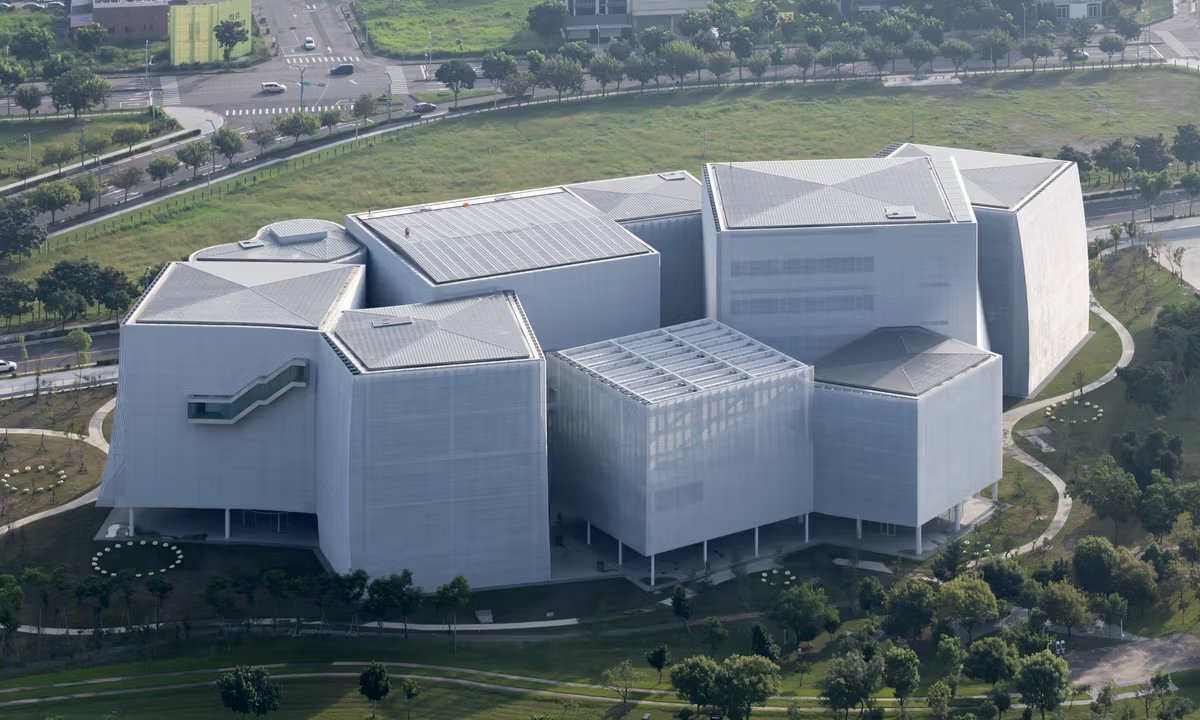
A new art museum fused with a library is scheduled to open tomorrow in Taichung, the biggest city in inland Taiwan, in a building designed by the prize-winning Japanese architecture practice SANAA.
Known as the Taichung Green Museumbrary, the pairing is an ensemble of airy white boxes of varying heights. It consists of eight interconnected structures: three for the Taichung Art Museum, four housing the Taichung Public Library, and one that will be used as offices. The sprawling 58,000 sq. m project is located in the city’s 67-hectare Central Park, within a decommissioned military airport.
“We are two institutions that are very much equal partners,” says Yi-Hsin Lai, the inaugural director of the Taichung Art Museum. The new institution “aims to foster dialogue between art, knowledge and nature, creating a new kind of cross-disciplinary cultural experience”.
The library will hold 460,000 physical books, about 40,000 of them art-related; it will also offer access to around half a million digital books. The art books will be found on the fifth floor of the library, which is connected to the museum through a roof garden called the Culture Forest. “This integrated design reflects the museum and library’s vision of learning as a shared, living practice,” Lai says.
The Museumbrary is the second major city museum opening this year in Taiwan—evidence of enthusiasm beyond the capital, Taipei, for building new cultural infrastructure. The New Taipei City Art Museum, located in a municipality in northern Taiwan that surrounds the capital but is administratively separate from it, opened in April.
Like the New Taipei City Art Museum, the Museumbrary is funded by its municipal government. “Its construction and operations are part of the city’s cultural infrastructure plan, emphasising accessibility and civic engagement,” Lai says.
The Museumbrary’s opening will include the unveiling of site-specific commissions by the Brussels-based Taiwanese-American artist Michael Lin and the Berlin and Seoul-based Korean artist Haegue Yang. Lin, whose family has roots in Taichung, has created a massive painting installation referencing traditional Taiwanese textiles. Yang’s installation, Liquid Votive—Tree Shade Triad, fills the museum’s 27-metre-high atrium and references Asian traditions of venerating ancient trees.
Inaugural show
The opening exhibition, A Call of All Beings: See You Tomorrow, Same Time, Same Place, combines Taiwanese masters with Modern and contemporary artists as well as international artists including Joseph Beuys, Joan Jonas and Myrlande Constant. The show is jointly curated by the museum’s team, Ling-Chih Chow of Taiwan, the American curator Alaina Claire Feldman, and the Korea-based Romanian curator Anca Mihuleţ-Kim. Around a quarter of the 32 participating artists and groups—including Huo-Cheng Yeh, Melmel Chen, Hsia-Yu Chen and the art magazine White Fungus—are either from Taichung or based in the city.
The show, Lai says, “explores Taichung’s historical and ecological identity”, reflecting how the institution “aims to become a cultural landmark, an international hub for cross-disciplinary exchange, and a driver of urban sustainability through art”.
The new museum’s collection will focus on works that document and reflect the artistic development of central Taiwan, Lai says, with a particular focus on “artworks across diverse media that embody the site’s interdisciplinary spirit”. Some international artists’ works will also be incorporated to help bring local art into global dialogues.
Long a cluster site for artists’ studios, Taichung offers a cheaper and roomier alternative to Taipei, albeit with fewer opportunities for exposure. It is home to the National Taiwan Museum of Fine Arts (formerly called the Taiwan Museum of Art), which was one of the nation’s first art museums when it opened in 1988. Since 2007, Taichung has hosted the Asian Art Biennale. A summertime fair organised by the Taiwan Art Gallery Association, Art Taichung, has been held in the city every year since 2013.
“Taichung has a strong foundation of senior artists as well as an active generation of emerging talents,” Lai says. “The art scene has deep historical roots, dating back to the early 20th century when many artists studied abroad in Japan or France, developing distinct approaches to gouache and Western oil painting.”
The National Taiwan Museum of Fine Arts and Tunghai University’s fine arts department have brought more contemporary art to the city, Lai says. “Today, the city’s art scene reflects a balance between tradition and innovation, supported by its educational and cultural institutions.”
