


I meet Talia Chetrit on one of those exalted September days that seem to taunt us for failing to make the best possible use of our lives. In the nervy hush of a home in thrall to a sleeping newborn, she leads me up to her top-floor studio. Her family’s Brooklyn house as I glimpse it is bright and bare, the stairs up to the studio painted a darkly resonant menstrual red. Chetrit’s studio is all crisp white, as is her collared shirt, despite the fact that she’s recently given birth, and our conversation is sometimes punctuated by her son’s plaintive cry in the background. We sit beside her latest picture: a human-sized print of her spread legs, her vagina obscured by the bowing contortions of a plastic water bottle.
When I was first approached to write about Chetrit, I protested that my inexperience in writing about fine art might constitute a form of disrespect. Does any artist want to be someone’s first—subject to the fumbling, the presumption, the promise of a furtive place in a writer’s personal nostalgia? Primarily a writer of fiction, I’d never approached a body of photographs with the intention of writing about them before. Chetrit’s books, in my apartment, had the allure of missives from a familiar world, the world of mutable female life, yet they were suffused with some other mysterious force. I felt like a teenager, excited and overeager to feel expert.
I don’t think that feeling was merely the product of my own innocence. Chetrit’s pictures have something of that big, unnerving thrill of a world in which what appears familiar to us—a room, a belly, a boot—abruptly reveals its own confident, preexisting depths. Not unlike herself, Chetrit’s work is brisk, textural, self-possessed, arresting. If I could walk into her pictures they would draw a little blood, like a finger pinprick test at the clinic, a sharp clarifying sting so brief it doesn’t stain. The person in charge catches and cleans and binds you right away in immaculate cotton gauze.
Vagina/Vase, 2011.
Photo Roberto Marossi/Courtesy kaufmann repetto, Milan and New York
CHETRIT (b. 1982, Washington, D.C.) is an eclectic photographer whose work ranges across striking fashion editorial, melancholic street photography, and abrupt still lifes and portraits. A sculptural precision recognizable in her art pictures survives glisteningly intact in her fashion work, which includes recent campaigns for Phoebe Philo, Proenza Schouler, Loewe, Acne, and Celine; a friend of mine in the fashion world told me Chetrit shows up “on every mood board.” Earlier this year, she photographed Lorde for the cover of “What Was That,” the lead single off her latest album, Virgin. She shot a piercing, misleadingly surreal portrait of Lorde’s wet face with one perfect dewdrop dangling from her chin, as well as a picture slipped into the vinyl edition of the album featuring Lorde’s pelvis in nothing but clear plastic pants, an image now known across the internet as “Lordussy.”
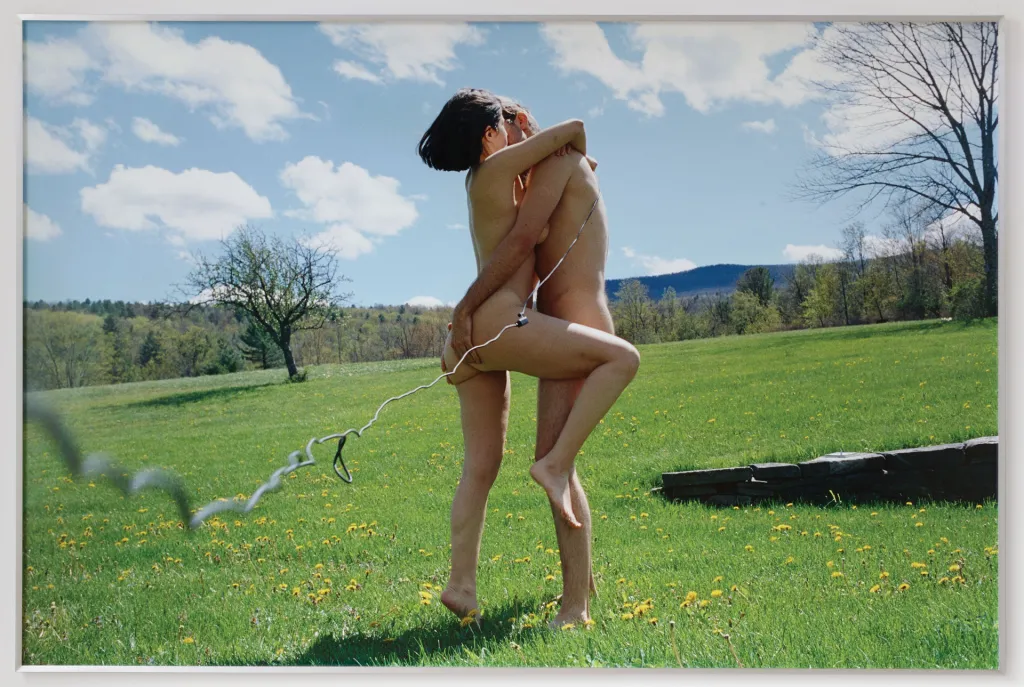
This instantly iconic image is recognizable in the lineage of Chetrit’s varied, choreographed images of her own body and, more recently, that of her partner, Denis, perhaps the pictures for which she’s best known. These intimate pictures began in 2015 with a series of “bottomless” photos, as Chetrit calls them, in which she photographed herself pantsless but otherwise clothed in her studio, often seated obliquely on a white space heater and framed by the limitations of a mirror—tender, unflinching portraits of her vagina. By 2016 she began photographing her body half-obscured by transparent objects such as plastic clothing, glass vases, mesh fabric, broken mirror shards, and water bottles. Later projects include a set of pictures of herself and Denis having sex in a sun-drenched field (2018); a long-term, campy, penetrating series of pictures of Denis and their infant son, Roman, playing half-nude dress-up in Gucci harnesses and a flouncing Molly Goddard dress in a bucolic Upstate house (2020–22); and some meticulously framed, profoundly beautiful nudes captured during and directly following her pregnancies, her first in 2019 and her second, this year.

Model/Family, 2020–22.
Photos Simon Vogel/Courtesy kaufmann repetto, Milan and New York, and Sies + Höke, Düsseldorf
For Chetrit, all this work is principally psychological. The notice people take of its apparently provocative content and unflinching nudity are side effects. Each picture is the result of and constitutes a story about an emotional process, often a troubled, fecund interpersonal relationship. About the pictures of her and Denis having sex, which she took in the early days of their relationship, she emphasizes that what was interesting about the image-making process—and the residue that remains most interesting to her in the pictures—is the tangled romantic dynamic they produced. Collaborating on these photos was a test of where the relationship could go and how much Chetrit could challenge Denis. These pictures aren’t about sexuality itself but rather about the flavor of intimacy Chetrit could create with Denis under these specific, triangulating circumstances, “a throuple with the camera,” as Chetrit winkingly puts it. This summer, Chetrit and Denis began working together on a new series of photos set, inevitably, around the recent birth of her second child. Chetrit photographs herself in the midst of the most challenging transformations with cold curiosity; when she was admitted to the hospital to give birth this past spring, she brought all her gear and deputized Denis to arrange the pictures she wanted. When it comes to making these images, Chetrit and Denis descend—or ascend, I imagine, watching Chetrit’s face flicker with interest—into a begrudging, bickering power struggle, an inverse of the general truce between equals that characterizes their family life. “We’re at odds, we’re fighting for power in the situation, and yet the photographer’s always in power, that’s built in,” Chetrit says. “We feel very close to each other after.”
Chetrit’s inexorable dominance over her images radiates from them, especially those that include Denis. In Seated Portrait (2019), the buoyant, fragile tip of Denis’s penis staring from the center of the frame is as much her directed plaything as the black cable-release in her right hand.
The visual trace of the hyper-pressured dynamic that comes about while Chetrit works is at the core of her fascination. Each picture we discuss prompts less a story than a discussion of the situation that produced it, each vivid and quickly available to her, some stilted, some tender, some awkward or humiliating.
Self-portrait (Downward), 2019.
Photo Gregory Carideo/Courtesy kaufmann repetto, Milan and New York
BEYOND DENIS, Chetrit has often used the situation of photographing to notice or engender a new version of a relationship. Once, many years ago, she invited the ex-girlfriend of a lover, a woman she’d never met, to her studio. “I needed to see her interact and hear her speak,” Chetrit says, with that same almost affectless curiosity that I feel sharpening the corners of her pictures. It was just the two women in the studio; there was “no dirty laundry,” no explicit getting to know each other, but, as Chetrit put it, they got to know each other in ways she won’t know anyone else. Together they made Headstand (2012).
All this work is sometimes called diaristic, to Chetrit’s chagrin. The implication is too simple, too domestic. “My work is sort of following me along, because I’m always using the subject matter I have,” she says. “It’s an in-between space, because it sort of uses a reality to create a fiction, and uses fiction to create a reality.” In some of Chetrit’s pictures with props—one in which Denis feeds infant Roman while wearing a bondage harness, for example—her playful impulse to use reality to make fiction is in colorful force.
But the pictures that touch me more are those in which I can feel a kind of yearning wish to use fiction to create a reality. Chetrit has long photographed her parents, a pair whose faces strike me with a kind of gentle, rugged erudition, though from the time she stopped being interested in her parents as a teenager, it took nearly 15 years for her to return to them as subjects. The psychological dynamic produced in these shoots is unlike the pleasantly embattled dynamic between her and Denis, or the deference of a commercial shoot; her parents are used to the power position. “They’re willing to give me some time,” Chetrit says, “but then the phone rings.”
When she began to photograph them as an adult, in 2014, she was surprised by the drama they played out in front of her camera. Her father was flirtatious, her mother coy. She felt like she was seeing an intimation of the best version of their relationship, present, sensual, and unencumbered by the logistical demands of family life.
As she continued to shoot them periodically over the course of the following year, Chetrit recorded these sessions surreptitiously with a video camera. It was one of the first digital cameras that would record without showing a red light. Sometimes she’d pick it up and take a couple of stills with it, as if it were just like the others. She wanted to make sure her parents weren’t too self-conscious. Chetrit didn’t imagine she’d ever show this video; she just wanted to preserve a window into their dynamic.
When she studied the footage after about a year, she found that as it went on it was increasingly crippled by her own stifling self-consciousness—which she had so studiously avoided passing on to her parents—but she loved the very first recording, in which there was a poignant trace of the rapport between the three of them. The video, which she showed at Kaufman Repetto in Milan in 2014, depicts her parents making themselves available to her in an affectionate, unimpressed way; when Chetrit fixes her father’s collar, her mother is skeptical. As they pose for portraits together, her father is so determinedly coquettish that he finally laughs at himself and says, “Maybe this is all a ploy from Talia.” From off-camera, Chetrit jokes, “Yes, saving your marriage.”
Chetrit was so impressed by the vulnerability her parents had offered her—they eventually came to view this video, which had been recorded without their knowledge, in a gallery space—that she wanted to challenge herself to take a similar risk. She began by taking off her clothes in her studio for what would become her first nude self-portraits. “I felt I needed to throw myself under the bus, too,” Chetrit says, “that there shouldn’t be something I wouldn’t do for the camera. The bottomless pictures were: I’m going to take pictures of my vagina, basically to be as exposed and to humiliate myself alongside what I felt my parents felt.”
New, 2019.
Photo Andrea Rossetti/Courtesy kaufmann repetto, Milan and New York
THE FICTION CHETRIT IS MAKING is protracted and ambitious,rhetorical, conscious of its cyclical themes and the deepening power of time. The latest picture on display in her studio, the vagina/water bottle picture, is a clear reference to a photo she made 14 years ago, now in the Whitney Museum’s collection, in which her vagina is seen through a ribbed glass vase. On her laptop she shows me a picture she made this summer, in which her torso emerges through a large hole cut in a cream-colored T-shirt, her belly decorated by the bandaged teeth of a new C-section scar and held loosely together by the contrast of the fabric, as if the T-shirt is an oval frame.
It’s immediately my favorite photo of hers, combining what feels lush, demanding, somehow matter-of-factly mythical about her displayed body with a decontextualized texture that turns her simultaneously more human and more sculptural. I feel how it calls back to two earlier images made during and after her first pregnancy, Self-Portrait (Downward), 2019, in which Chetrit poses acrobatically over a mirror with her breasts and belly hanging with impossible, floating balance toward the viewer—a consummate framing not unlike the new portrait of her immediately post C-section—and a photo taken a little while after another C-section, New (2019), in which the curved line of the bandage plays against the perpendicular poppy-red string-ties of a shirt.
Boys, 2019.
Photos Simon Vogel/Courtesy kaufmann repetto, Milan and New York, and Sies + Höke, Düsseldorf
When I ask about how her first son, Roman, now 6, relates to being photographed, she tells me he’s already nostalgic for it, because she photographed him so much as a baby; he likes that this summer they began making photographs as a family again. “We’re evolving the characters,” Chetrit says. She’s keenly aware of the possibilities for her works that are only coming into being now and those she’s lost. About a picture I love, Girls (Bed), 1996/2017—in which two teen friends of hers lounge naked in her bedroom, in positions of self-conscious ennui—she admits that she could never make it today, because she’s an adult in a power position. At the time, she was one of those teenage girls.
She tells me she considers PEN15, the 2019 comedy series in which the adults Maya Erskine and Anna Konkle play middle-schoolers, a masterpiece. “You could never capture how crazy it feels at that age, sexually, you just couldn’t capture it unless the actors are in their thirties,” Chetrit says, with reverence. “They’re really able to get into all the dynamics you can meditate on which you could never do if your actors were fifteen.” It’s the inverse of her position as a photographer and her sense of what relationships she can focus on now. The present is her constant, exceptional, fleeting opportunity.
Inevitably, her work produces extreme online reactions, from the lewd to the puritanical; she’s simultaneously frustrated by the distraction and interested in what these reactions betray. The first time she received serious pushback was on a picture of a family friend, Ever, whom she photographed throughout Ever’s adolescence. In Chetrit’s 2017 picture, Ever has a winning, punky stare, the brazen limbs of a girl who relishes playing dress-up. Instagram commenters seethed with concern that Chetrit’s image sexualized Ever. This confessional anxiety of viewers who see adult sexuality in a fearless adolescent reminds Chetrit of other reactions to pictures of hers that include nudity not as a form of abasement, but simply based on the innate nudity of their subject matter: pictures of breastfeeding, for example.
Sexuality moves through all these pictures—adolescents have their own proprietary sexuality; infancy and early motherhood are brimming with a delirious, mad version—but we don’t have the language to discuss it without tumbling into perversion. Chetrit is interested in that razor’s edge.
The concept of fiction, Chetrit’s developing of a cast of characters, allows her to bring us into contact with these knotty states. She uses her life, but when she was teaching photography students, it became obvious to her that she could make her own work from anyone’s negatives. She’d look at the students’ final crits, then back at their negatives, and wish she’d gotten to edit them. Even the boring work had an edge that attracted her, if only she could get her hands on it. The material needn’t be costumed or distorted into theater in order to constitute an artistic fiction; it needs only—and is the better if it relies on only—a vision that divides, transforms, and reconstitutes reality.
Chetrit interrupts our conversation to remark on my watch: It turns out her mother has worn the same model for decades. “That’s my mom’s wrist you’re showing me,” she says—the wrist I’ve noticed her mother check, with mild impatience, in the portrait video. I try to answer her with some joke or interrogation, but I sort of glitch. It strikes me as somehow inappropriate to say anything about my own relationship to this watch, a token I bought to commemorate the publication of my first novel. My wrist as she holds it no longer has much to do with me; I’ve been brought into the intimidating auspices of her direction and transformed into a purely material subject. I don’t pretend to struggle for power, but, as I suspect Denis does, I find myself relishing that brief window as her subject, surrendered and bandaged in fresh gauze.
