


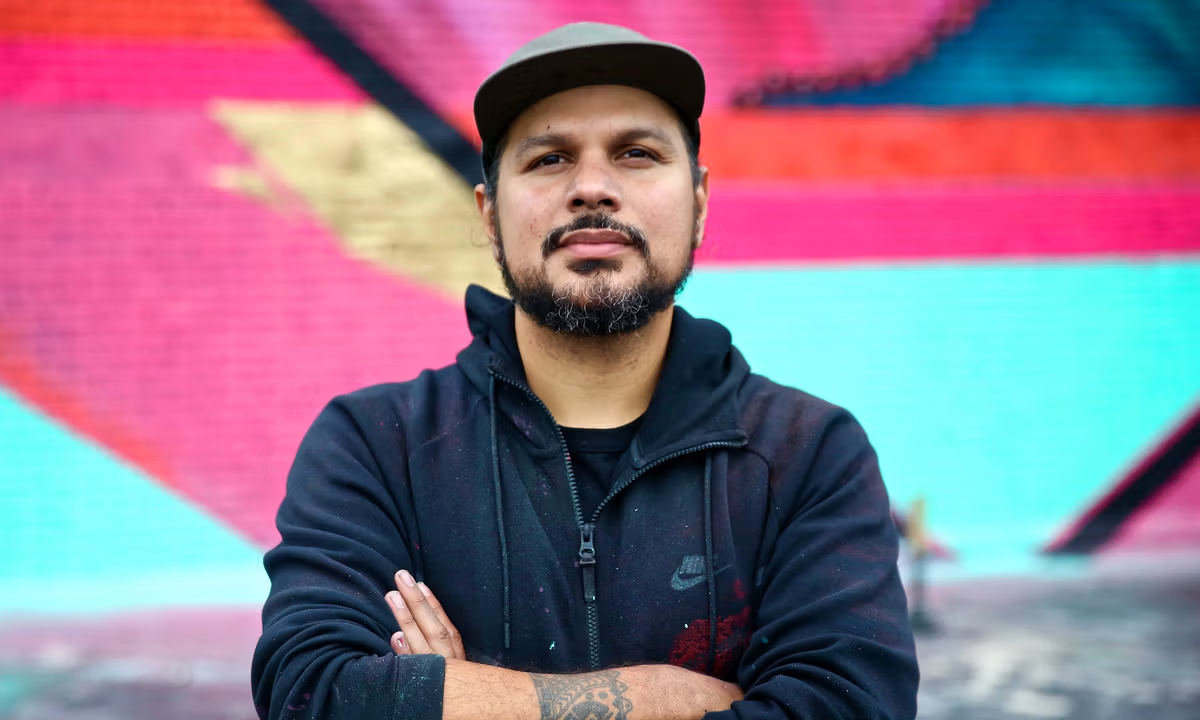
Last month the University of North Texas in Denton cancelled a solo exhibition by the Brooklyn-based artist Victor Quiñonez nine days after it opened at the College of Visual Art & Design (CVAD) Gallery. The exhibition, Ni de Acquí, originated at the Boston University Art Galleries in September 2025 and featured sculptures and mixed-media works from Quiñonez’s I.C.E. Scream series, which include large sculptural paletas (Mexican popsicles) and implicitly critique the violent enforcement activities of US Immigration and Customs Enforcement (Ice).
According to the artist and faculty members, the exhibition was closed without advance notice, and its street-facing windows were covered with brown paper. In an email cited by Glasstire, CVAD leadership confirmed that UNT had terminated its loan agreement with Boston University and was making arrangements to return the works. No detailed public explanation has been issued, but UNT students have staged protests and local and national organisations have raised concerns about the exhibition’s apparent censorship.
The exhibition included large-scale translucent paleta sculptures embedded with handcuffs and firearms, an illuminated paleta cart bearing the phrase “U.S. Department of Stolen Land Security” and paintings juxtaposing Indigenous iconography, pop cultural imagery and references to contemporary border politics. A public reception had been scheduled for 19 February and the exhibition was to remain on view until early May.
An example of one of Victor Quiñonez’s Paleta works Courtesy of Marka27 Design Studios
The UNT faculty response to the show’s cancellation was swift. Members of the CVAD issued an open letter addressed to UNT’s president Harrison Keller and university leadership, expressing concern about what they characterised as a lack of transparency and the potential erosion of academic standards, according to Glasstire. Graduate students at UNT followed with their own statement, warning that the cancellation has created uncertainty for future thesis exhibitions. “It is deeply disheartening that we must consider relocating our culminating academic work due to concerns about institutional censorship,” the letter stated, urging the university’s leadership to recommit to allowing freedom of speech and artistic expression.
In the days following the exhibition’s closure, students organised a candlelit gathering outside the shuttered gallery. Flowers, electric candles and handwritten notes were placed on the floor beneath the papered-over windows. University officials have not publicly cited a policy violation, an external complaint or a legislative directive as the reason for the cancellation. However, some speculated that the decision was related to the shifting political landscape for public higher education in Texas. Since the 2023 passage of Senate Bill 17, diversity, equity and inclusion offices and programming at public universities have been targeted as administrators across the state have navigated heightened scrutiny over campus events and exhibitions.
According to transcripts obtained by Glasstire and other outlets, in meetings on 10 and 11 February, Karen Hutzel, the dean of CVAD, said that the exhibition’s cancellation was the result of an “institutional directive”that came from higher-ups. She reportedly said that while CVAD has its own policies, these are ultimately superseded by the university’s authority. And, she added, amid growing scrutiny of activities at public universities from state and federal officials, rules and regulations are “changing daily”.
In response to the exhibition’s closure, the National Coalition Against Censorship and the American Civil Liberties Union of Texas sent a letter to Keller and the secretary of UNT’s board of regents calling on the university to admit its wrongdoing. “In closing the exhibition, UNT has betrayed the principles of academic freedom, trampled upon artistic freedom and very likely violated the First Amendment,” the letter reads in part. “We urge UNT to demonstrate its recommitment to its mission and policies that explicitly protect and support artists’ and curators’ rights to explore political subject matter and engage in social commentary in on-campus programming.”
Spokespersons for UNT and the CVAD have not responded to requests for comment from The Art Newspaper or other outlets.
