


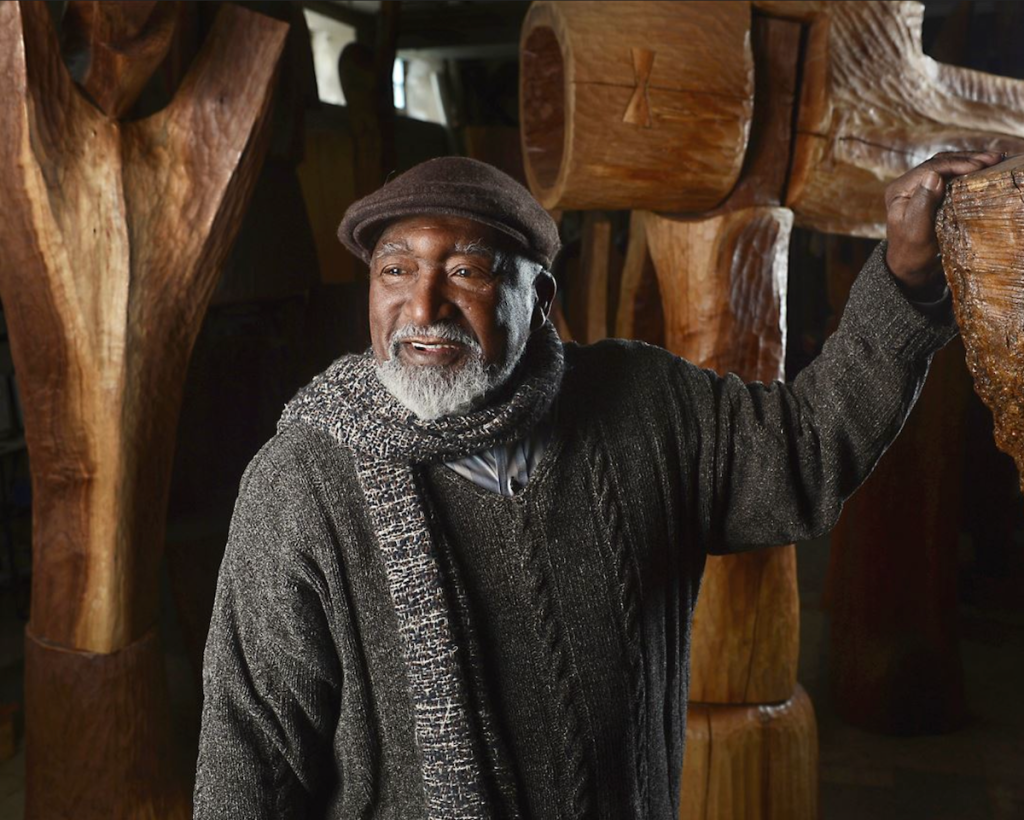
Thaddeus Mosley, a sculptor whose abstractions formed from reused wood earned him a significant, fervent following in the late stages of his career, died in Pittsburgh, Pennsylvania, on Friday at 99. His family announced his passing, with his son, Pittsburgh City Councilman Khari Mosley, calling him “a dedicated family man, ubiquitous community pillar, and an inimitable creative force.”
Many of Mosley’s sculptures are made using salvaged hunks of walnut, sycamore, and cherry wood that he transported to his Pittsburgh studio. Carving these materials using variously sized gouges, he made his wood sleek and curvaceous, often allowing his wood’s grain to dictate the movement of the tools he used to sculpt it.
The resulting sculptures frequently weighed hundreds of pounds, but in Mosley’s hands, they looked light and airy. Speaking to ARTnews last year, he said his process was a lot like judo, adding, “You learn where the center of gravity is. A lot of the idea is based on the concept of weight in space.”
These sculptures gained Mosley a loyal fan base. He has long been considered a legend in Pittsburgh, and a range of Black artists have sung his praises. The painter Sam Gilliam once termed him the “keeper of the trees.”
But it was not until 2018, the year that Mosley appeared in the Carnegie Museum of Art’s Carnegie International exhibition, that he started to attract the attention of a mainstream audience. The Whitney Museum, the Brooklyn Museum, the Guggenheim Museum, the Seattle Art Museum, the Baltimore Museum of Art, and other institutions have since gone on to acquire his work.
Critics have recently lavished acclaim upon him. “Largely promoted by a community of Black writers, artists, and musicians, Mosley’s work more than holds its own with his celebrated peers,” wrote John Yau in a 2020 Hyperallergic review. “He did not need the art world’s approval to keep going, but the art world certainly needs him for more reasons than I can count.”
Unlike other sculptors who make work at a monumental scale, Mosley labored alone for much of his career, without the help of studio assistants, utilizing a small crane as necessary to transport his materials. His process was meditative and slow, allowing him to commune with the wood he used for his art. A 2025 exhibition at Karma, the New York gallery that represents him, featured just 12 sculptures—the entirety of his output from the two and a half years that preceded the show.
During the 1950s, at the start of his artistic career, Mosley sourced his wood from fallen trees instead of buying it. “Early on, I didn’t think much about how the tree grows; I was rather thinking of it as a raw material,” he told Bomb. It wasn’t until much later that he began to purchase the wood from local sawmills.
Works by Thaddeus Mosley at the 2018 Carnegie International.
Photo Bryan Conley/Carnegie Museum of Art, Pittsburgh
He said his overall approach to his materials remained the same, no matter where I got them. “I still try to yield the original idea, the original shape,” he said in the Bomb interview. “Keep in mind that this is not a painting, so you can change a sculpture only so much. Even when certain segments resist fitting together, I have to find the center of gravity.”
Thaddeus G. Mosley, Jr. was born in 1926 in New Castle, Pennsylvania. His father was a coal miner; his mother, a seamstress. His father’s demanding job required the future artist’s family to move regularly, and Mosley began school while living in Grove City. But that small town proved alienating, so Mosley’s mother moved back to New Castle with the future artist and his four siblings. The separation put a strain on the marriage, and eventually, when Mosley was 8, his parents divorced.
Realizing that “the mines just weren’t for me,” as Mosley once told Pittsburgh Quarterly, he committed himself to academics in high school. After graduating, he enlisted in the US Navy, then moved to New York before relocating to Pittsburgh, where he attended the University of Pittsburgh’s programs for English and journalism. He recalled that he was one of the few Black students in any of his classes. “Sure, this bothered me,” he said in the Quarterly interview.
In 1948, during an assignment for a course on world history, he read a book that included images of work by Constantin Brâncuși, the Romanian-born modernist whose sculptures conjure flying birds and kissing couples from spare, elegantly hewn pieces of metal and stone. While he didn’t know at the time that Brâncuși—like many other European modernists—was inspired by African art, Mosley intuited a connection, noting that his Brâncuși’s arcing forms shared an affinity with Senufo birds.
As Mosley’s career continued, he would continue exploring an interest in African art, purchasing tribal masks and the like. He also developed an appreciation of just how much African art had contributed to the development of European modernism. “Without West Africa,” he once said, “there would be no Cubism.”

Thaddeus Mosley, Gate III, 2022.
Courtesy Public Art Fund
Upon graduating college, Mosley took a part-time job at the Pittsburgh Courier, writing sports journalism. Not long afterward, Mosley started on his artistic career. During the 1950s, he visited a Kaufmann’s department store and saw wooden Scandinavian design objects that looked like birds. Figuring that he could probably do that, too, he also began carving his own wood sculptures.
But for the vast majority of his career, being an artist was not a full-time job. He spent 40 years working at the US Postal Service, retiring in 1992. The stability of the occupation provided him with time to mull ideas the art he made outside office hours. “I could save all my energy, all my thinking power for my work,” he told ARTnews. He said he didn’t make money off his art until his first Karma show, in 2020.
Mosley’s big entrée into the broader art world came during the 2018 edition of the Carnegie International, the Carnegie Museum of Art’s prestigious global art survey that the artist himself had regularly attended. Curator Ingrid Schaffner included Mosley, then 92, among a group of art stars that included El Anatsui, Lynette Yiadom-Boakye, and Alex Da Corte.
Mosley’s star only ascended from there, allowing him to take on larger commissions. He cast his wood sculptures in bronze and showed them in locations such as City Hall Park in New York, where, for one 2025 show organized by the Public Art Fund, he exhibited Gate III, a 15-foot-tall portal that looked like a portal made of bones.
He also continued working at a small scale. His current show at Karma in New York features little sculptures made from chunks of glass that are precariously balanced against one another. At the slightest touch, these objects might fall apart. Against all odds, the elements hold together.
