


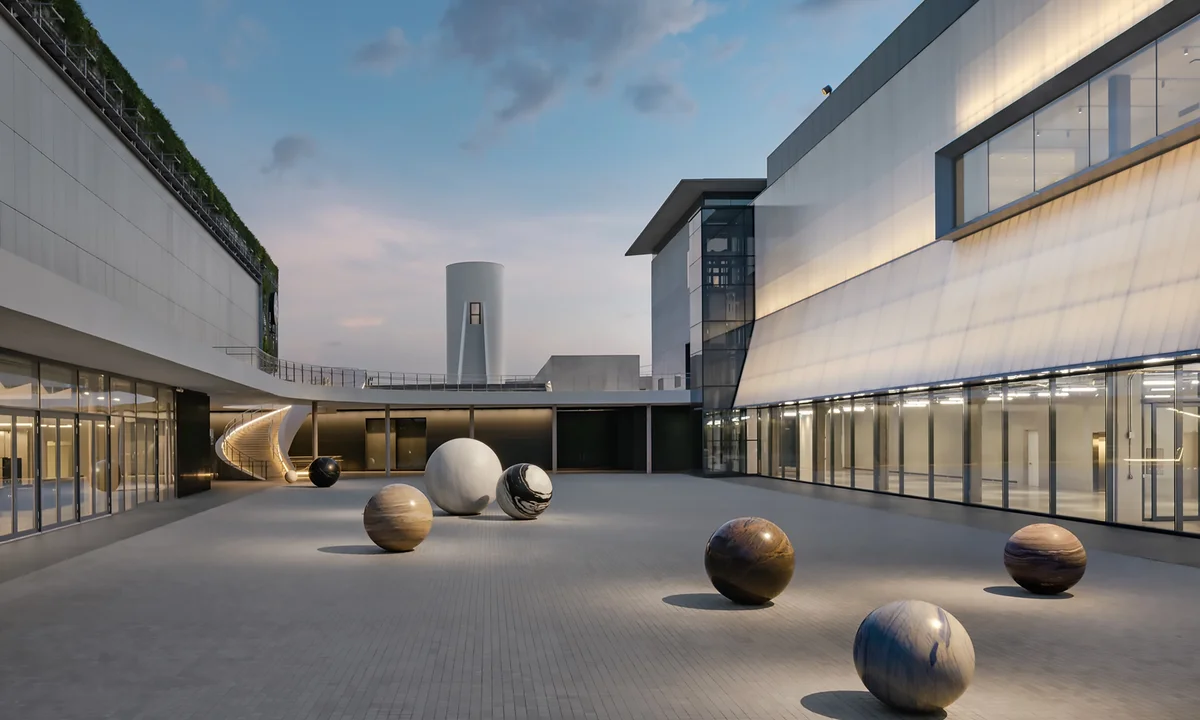
The debut this month of the long anticipated Dib Bangkok museum in the Thai capital brings a vast family collection to the public in a converted 1980s warehouse, adding to the country’s growing contemporary art scene.
It also posthumously fulfils a long held dream of Petch Osathanugrah, a Thai businessman and musician. After his death in 2023, the project has been brought to fruition by his son Purat ‘Chang’ Osathanugrah, who is the president of Bangkok University, the chief executive of the property company Zipcode and a partner at the private equity firm Arc 9, which he co-founded.
“Petch was building his collection over a few decades, always with the idea that eventually he would share his collection,” says Miwako Tezuka, Dib’s inaugural director and a former curator at New York’s Asia Society Museum. “Unfortunately, he passed away before seeing his dream come true.”
Purat ‘Chang’ Osathanugrah has brought his father’s museum dream to fruition
Courtesy of Dib Bangkok
Tezuka describes Bangkok’s art scene as “nearing a tipping point to become a destination for art for the global audience”. Since 2018, the Bangkok Art Biennale and the Thailand Biennale have built “considerable energy” in Thailand, she says. The private Maiiam Contemporary Art Museum was established in 2016 in Chiang Mai, a northern Thai city with a number of art schools and studios, and in 2020, the trailblazing gallery 100 Tonson in Bangkok was converted into a foundation.
Last year brought the opening of the twin non-profit institutions Bangkok Kunsthalle and Khao Yai Art Forest. Another non-profit space, deCentral, is due to open in the coming years. Galleries including Bangkok CityCity, Nova and a branch of Richard Koh, along with high-profile artists such as Mit Jai Inn and Rirkrit Tiravanija, have kept the local art scene internationally visible during the troubled years following the Thai military’s 2014 coup and amid the subsequent political meddling that has seen several elected governments suspended.
“Dib Bangkok as an idea of a museum has been in the making for the past 30-plus years, but I think the timing of our launch this December is perfectly aligned with this growing collective energy,” Tezuka says. “We are, therefore, part of the fabric of the expanding art scene here, and we hope to become an institutional springboard for emerging voices, and at the same time a long-lasting foundational space for people to have direct and genuine encounters with global art.”
Dib, which means raw in Thai, is situated in a residential neighborhood close to Bangkok’s main port of Khlong Toei. Once chiefly an industrial district, it has gradually transformed since the 1962 establishment of the first campus of Bangkok University there—by Petch’s father, Surat Osathanugrah. Though the campus later relocated to a large site in the city’s north, the area has continued to evolve, Tezuka says.
From warehouse to white cube
Dib Bangkok is situated across the street from the former campus. The 7,000 sq. m, three-storey building was converted into 11 galleries plus a 1,400 sq. m courtyard, sculpture garden and penthouse for events by WHY Architecture’s Thailand-born, Japan-raised and US-based Kulapat Yantrasast, who has undertaken projects for the Metropolitan Museum of Art in New York and the Louvre in Paris.
A conical building is intended for chapel-like contemplation, and a succession of triangles along the roof evoke sails. The building’s original Thai-Chinese window frames and ceilings have been retained.
A satellite project space—which has been given the name Dib26 after the narrow street in which it is located, Soi Sukhumvit 26—is about a 15-minute drive away. “It will be less ‘institutional’—i.e. more experimental and quick moving—and will also offer educational and community-focused programmes,” Tezuka says. Designed by the Bangkok architecture firm Supermachine Studio, Dib26 is housed in another converted warehouse and opened this summer with an arts management programme in collaboration with Bangkok University’s School of Fine and Applied Arts.
The opening exhibition (In)visible Presence explores memory, mortality and grief in tribute to Dib Bangkok’s late founder. The 80 works in the show mostly draw from the museum’s collection, and include large sculptures by Lee Bul, Anselm Kiefer and Pinaree Sanpitak, installations by Montien Boonma and Somboon Hormtientong, and paintings by artists including Yuree Kensaku, Alex Katz and Jessie Homer French. Many of the 40 featured artists—who include Sho Shibuya, Finnegan Shannon and Hugh Hayden—have never been shown before in Thailand.
Internationality
“Our long-term vision is to inspire connection, reflection and shared human values across generations through art,” Tezuka says. Exhibitions will be thematic rather than geographic or time-focused to help engage a diverse breadth of artists.
The museum draws from and will build on the Osathanugrahs’ existing collection of more than 1,000 works across a range of media, mostly dating from the 1990s onwards, by over 200 artists from around the world.
The Osathanugrahs first came to prominence as the Pae family, who in 1891 founded the Bangkok pharmacy Teck Heng Yoo, producer of the Thai-
Chinese stomach medicine Krisnaklan Trakilane. One satisfied customer was the Thai monarch, who awarded the family the new name of Osathanugrah in 1931. The company rebranded as Osotspa in 1949, as it expanded into a full range of pharmaceuticals and beverages. Surat, who died in 2008, was an avid collector and street photographer as well as the manager of the family business.
“The collection Petch began is the core of our museum’s growing collection of global contemporary art,” Tezuka says. “Our curatorial team is continuously conducting collection research and identifying what areas need enhancement for us to be a future-oriented institution dedicated to knowledge-building and public education. We are currently interested in how artists experiment with new technology and new media of our time.”
