


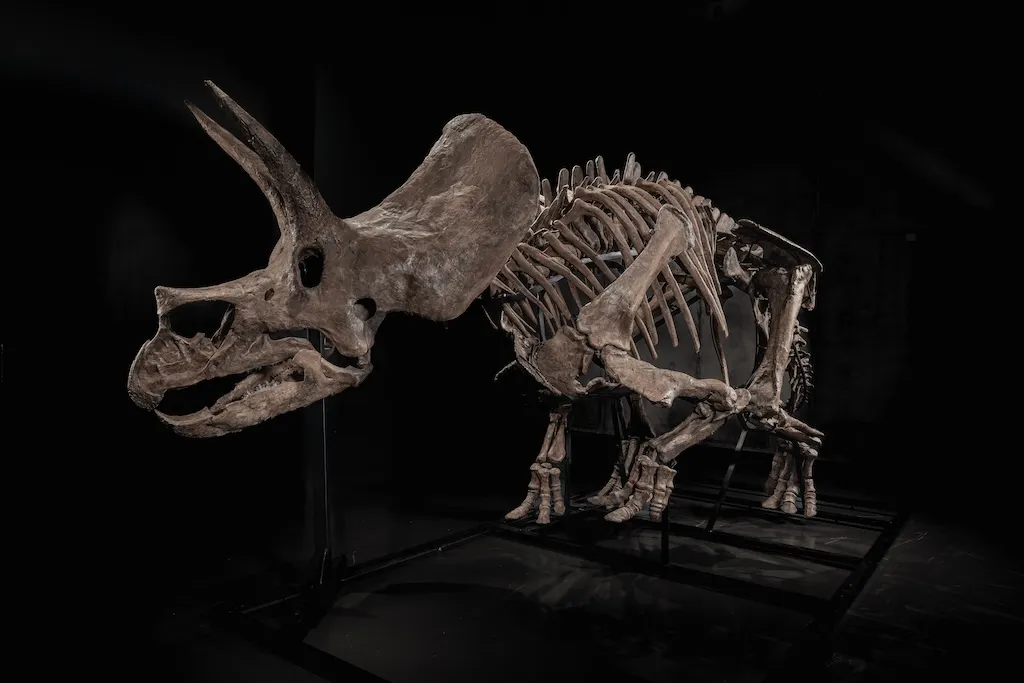
A triceratops sold online for $5.5 million on Tuesday on musician and designer Pharrell Williams’s auction platform Joopiter.
The result set a record for a dinosaur sold in an online-only sale, the Art Newspaper reported Wednesday. The sale of the 66-million-year-old skeleton known as “Trey” is further evidence of a larger trend in the auction market: fossils and dinosaur skeletons are increasingly moving out of the siloed category of natural history and being traded like any other high-end collectible. At Joopiter, that also meant an accompanying merch drop, including a $695 fiberglass replica of the skull and a $100 tote bag.
Excavated in Wyoming in 1993 during the so-called “Bone Rush,” Trey is a sub-adult triceratops measuring more than five meters long and composed of over 70 percent original material. It spent nearly three decades on public view at the Wyoming Dinosaur Center before coming to market, complete with documentation tracing its excavation and ownership.
The estimate, $4.5 million to $5.5 million, was well calibrated. The sale hit the top of its range without the theater of a live evening auction, suggesting that demand for these objects no longer depends on the spectacle that once helped legitimize them.
That spectacle, however, did its job. Over the past five years, auction houses have quietly repositioned dinosaur skeletons as serious assets. Christie’s helped set the tone in 2020 with the $31.8 million sale of the Tyrannosaurus rex known as “Stan,” a result that positioned fossils as trophy objects on par with major works of art. (The lot appeared in an auction of Impressionist and Modern art.) Sotheby’s has since pushed the category further, including a $30.5 million sale of a juvenile Ceratosaurus in 2025 that blew past its estimate after a multi-bidder contest, and the record-breaking 2024 sale of a dinosaur named “Apex,” which brought in $44.6 million against a $7.4 million high estimate.
What has changed is not just the ceiling but the infrastructure around it. Fossils are now catalogued, marketed, and staged like sculpture. Condition reports emphasize completeness and restoration. Provenance files are treated like those of a painting. The language has shifted, and with it the audience.
Joopiter’s role is telling. The platform, launched in 2022, has built its identity on design, fashion, and cultural ephemera. Bringing a $5.5 million dinosaur into that mix suggests that fossils are no longer a specialist category — they are becoming legible to a broader class of buyers who collect across disciplines and platforms.
That expansion comes with familiar trade-offs, The Art Newspaper notes. As prices rise, so do the stakes around access and research. Commercial excavation has long sat uneasily alongside academic paleontology, and record-breaking sales have only intensified concerns that significant specimens are being diverted into private hands.
The direction, though, is clear. A $5.5 million triceratops sold online is not a stunt—it is what a mid-market transaction looks like once a category has been fully absorbed into the auction ecosystem. The headline numbers may belong to Sotheby’s and Christie’s, but the next phase of the market is being tested elsewhere.
