


When I learned that Gisela Colón was having a retrospective at Museo de Arte Contemporáneo de Puerto Rico (MAC), I leapt at the chance to check it out. I knew that I felt deeply conflicted about her work, and thought the survey would offer a chance to sort out my thoughts.
Before arriving in San Juan, I’d only seen her glittering, monumental obelisks shown in isolation, one at a time. It’s easy to see why they get shown that way: they have this commanding presence and can really hold their own. At the Great Pyramids of Giza, her arched, golden globule sat near a sphinx similar in size and color, and recently, her silvery, iridescent spire towered over the Arabian desert.
These “monoliths,” as she calls them, are undeniably stunning; she’s been making them since 1996. I find that, when I’m around one, it’s hard to look at anything else. Their colors change as you move around them to a degree that her Minimalist, phenomenology-pilled predecessors could have never achieved: The 50-year-old artist works with advanced pigment technology, mixing aerospace carbon fiber with custom pigments she concocts from organic matter, often minerals and materials specific to a given site. The results have a unique way of both absorbing and reflecting their surroundings—sometimes, the very landscapes they are made from. MONOLITO PARABÓLICA HEMATITA (Tierra de Substrato, Arecibo, Puerto Rico), 2024, for instance, is made from hematite, an iron oxide mineral that turns soil and rocks red. It was sourced from her family’s plot of land in Arecibo, but the mineral is also found on Mars and on the moon.
Gisela Colón: The Future Is Now (Parabolic Monolith Iridium), 2020.
That shift in scale—from home to the cosmos, from the specific to the universal—is at the core of her work. Or so I came to realize visiting the exhibition, which occupies three cave-like galleries that grow darker as you get deeper into her world.
Colón’s monoliths are certainly sublime, but they are also a little Burning Man, a little manicure. Their sparkly, smooth, almond shapes look exactly like big, beautiful fingernails. I was itching to figure out why that bothered me and if it should. After all, I do love a sparkly manicure; I am typing with one right now.
Pages from Rosalind Galt’s book Pretty went flashing through my mind. The book had already done the work of making me distrust that reflex — the one that assumes prettiness is a symptom of shallowness. That logic, Galt convinced me, is misogynistic.
Of course, pretty things can still certainly be shallow. But happily, in Colón’s case, looking deeper proves rewarding. Like many abstract artists before her, Colón, who was born in Canada to a Puerto Rican father and now lives in Los Angeles, is enamored of picturing the world in its most fundamental form, and maybe even evoking something like the universal. Her materials include those most basic elements of the earth—geology—and her forms borrow from totems, obelisks, prehistoric megaliths, and Indigenous Caribbean zeniths. They feel both of the future and of the past.

Gisela Colón: Eternity Now, 2021.
Photo Ammar Abd Rabbo
But here is where the latter day Light and Space artist diverges most decisively from her forebears: she never falls for the fallacy that her materials are actually abstract. They have histories, and these histories play a role in her meaning making. In our Anthropocene era where nature and culture can no longer be neatly cleaved, she knows that sublime beauty and terrible violence too often go hand-in-hand.
In fact, an early experience with gun violence is also part of what drew Colón to her signature shape—which juts firmly and decisively into the air—as well as to materials only possible by way of the Military Industrial Complex. Light and Space was always caught up in said complex too, as a recent show at the Palm Springs Art Museum memorably explicated. But it rarely acknowledged this entanglement as fraught; Colón brings self-consciousness to the dilemma.
View of a 2026 Gisela Colón retrospective at Museo de Arte Contemporáneo de Puerto Rico in San Juan.
For the most part, Colón’s tensions come to life on the wall labels, upon reading the titles and materials. But one work stands as an exception: ESTRUCTURA TOTÉMICA (PIEDRAS CONTRA BALLAS, BAYAMÓN INCANDESCENTE), 2022, is a smooth, shiny, sparkly curve perched Brancusi-like on a slender column. Made of clear Plexiglass, the column is filled with layers of pulverized materials that were also used to make the curved form—red earth and desert sand, but also ground up bullets. Striated in raw form, they’re still beautiful, but there is something more rugged about them. The title, translated as “rocks against bullets,” drives the point home.
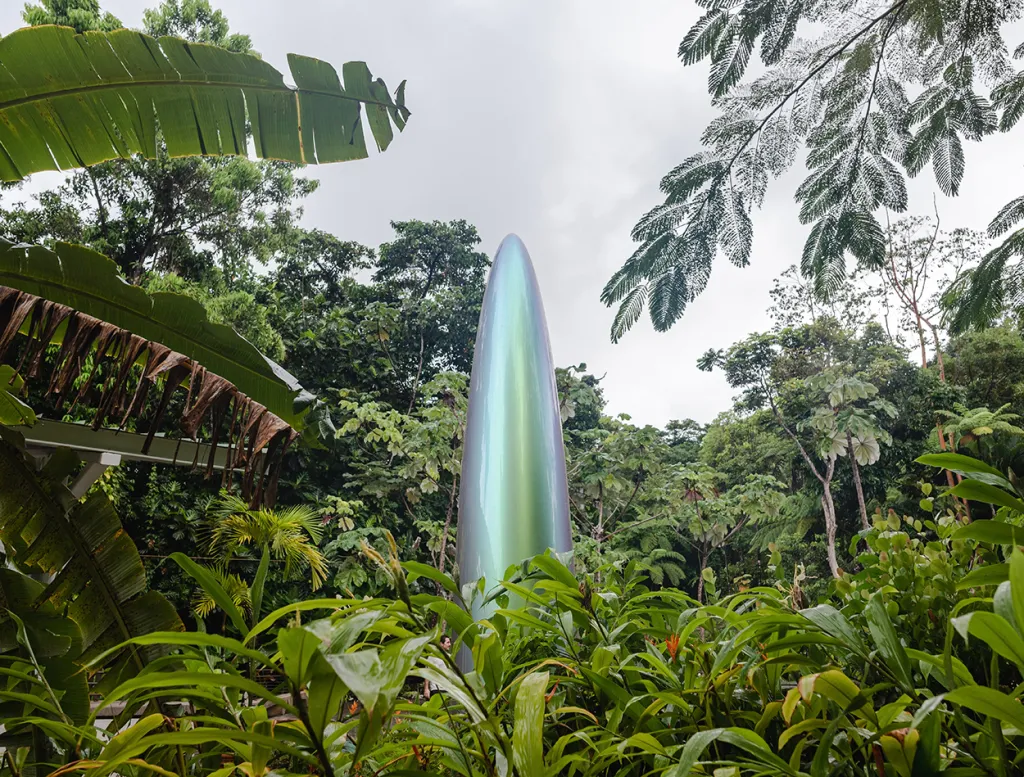
On view concurrently with the MAC exhibition is a sculpture Colón made for El Junque, the Puerto Rican rain forest—a natural wonder that was also a testing site for Agent Orange. It was also the muse for her very first monolith, in 1996. A spire that appears as both mountain and missile greets visitors to the verdant forest. It boasts a surprisingly smooth gradient from lime green all the way to deep periwinkle—amplified reflections of the plants and the sky. Somehow, the lime parts manage to follow you as you move around. And it matters that these more golden parts haunt you: the title, Rivers of Gold and Dust (Parabolic Monolith Aurus Pulvum), 2017–25, refers to the violence Indigenous people experienced on the archipelago as the Spanish extracted gold from Puerto Rico’s rivers. Some of the minerals in its pigments come from Saharan sands that blow their way to the Caribbean every year, where they nourish the forest’s soils.
In Colón’s hands, the spiritual and the scientific—but also abstraction’s long held tensions between the analytical and the spiritual—fold in on one another. Sometimes though, the folding feels fluid where friction ought to be. At times, I found myself craving more visible traces of some of the work’s central tensions. But then I realized, the smoothness is the friction. The glamor never went down easily for me because it shouldn’t, because violence and beauty should not sit together as seamlessly as they do in Colón’s sculptures. But of course, they go down just as seamlessly in the world—as visitors to El Junque well know. The horrors under the monoliths’ shimmering surfaces remind us to look at the land, then look deeper.
