


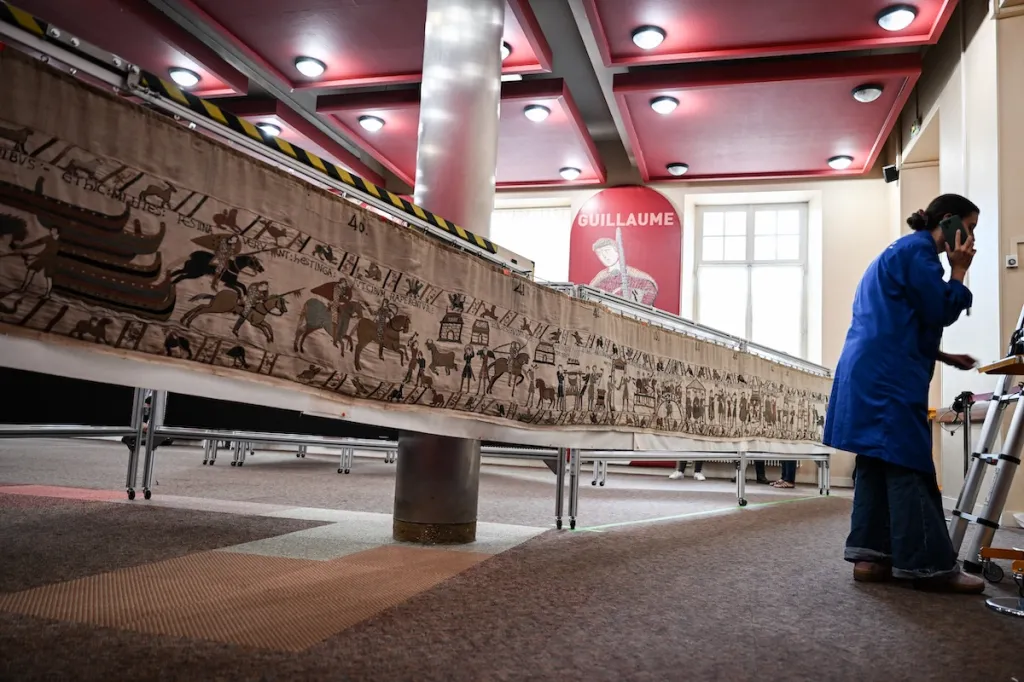
For almost a millennium, a spectacular visual chronicle of British history has remained on the far side of the English Channel, in Normandy. The Bayeux Tapestry—a Romanesque-style textile artwork that is 230 feet long and populated with 58 scenes, 626 characters, and 202 horses—is a masterwork long studied by scholars and even British schoolchildren, but it hasn’t been in England since it was made.
That changed earlier this month, when it traveled to the British Museum on July 10 as part of a historic loan. While the exhibition is set to open Sept. 10, tickets to see the tapestry are already sold out through December. More tickets will go on sale in October and January.
But What Is the Bayeux Tapestry?
It is a scroll-like panel of linen cloth—despite its name, it’s not actually a tapestry—that tells the story of the 1066 Norman invasion and conquest of England. Central to the narrative is the Battle of Hastings, an epic clash, but also a moralistic tale about punishment for a wrongful act. This tale is woven together in 75 scenes with Latin inscriptions (tituli) that narrate the events leading up to the battle and after.
How big is the Bayeux Tapestry?
Weighing roughly 770 pounds, it is embroidered with wool yarn tinted in a concentrated palette of 10 colors. It features four types of stitches: stem stitch, chain stitch, split stitch, and “Bayeux stitch” (the last one used to fill in colored areas). Compositionally, the Bayeux Tapestry is divided into three horizontal strips: a central row with the main narrative, and narrower friezes above and below filled with images of animals, Aesop’s fables, hunting, and toward the end, wounded soldiers.
Who made the Bayeux Tapestry?
Historians are more certain about who commissioned the Bayeux Tapestry than about who actually made it. Most agree that the monumental textile work was commissioned by Odo, the Bishop of Bayeux, for the nave of a newly constructed Notre Dame of Bayeux cathedral, which was consecrated in 1077. Legend once spread that the tapestry was made by Queen Matilda (wife of William the Conqueror) and her ladies-in-waiting, but historians now believe that to be untrue.
It most likely was made in Canterbury by female Anglo-Saxon embroiderers since the embroidery resembles Anglo-Saxon drawings, the names on the tapestry are anglicized, and Anglo-Saxon women were considered the best embroiderers at that time.
France’s Culture Minister Catherine Pégard listens to Michael Lewis, lead curator of the exhibition, as she inspects the Bayeux Tapestry during a visit to the British Museum in London on July 17.
AFP via Getty Images
What story does the Bayeux Tapestry tell?
The narrative of the Bayeux Tapestry begins in 1064 when English King Edward the Confessor asks his brother-in-law, Harold Godwinson, to go to Normandy to offer succession to the throne to his cousin William, Duke of Normandy. When Edward dies, however, Harold crowns himself instead. This spurs William to cross the English Channel in 1066 and try to reclaim his rightful place as king.
A few hundred ships sailed from Normandy to England on a September night in 1066, carrying 7,000 men and around 2,000 horses. The Bayeux Tapestry illustrates this in extraordinary detail, including longships crossing the sea, shields, coats of arms, and fantastical creatures. William’s fleet landed in Sussex and his army set up in Hastings for a battle that began on October 14, 1066. Many soldiers were killed or wounded, and images of them fill the lower frieze toward the end of the scroll. After Harold was shot in the eye by an arrow (another scene stitched into this scroll) and died on the battlefield, the Anglo-Saxon troops fled.
This made William—who was then dubbed William the Conqueror—the first Norman king of England and one of the most powerful Western European monarchs of the Middle Ages. The Normans ruled England for nearly a century, until 1154. Mysteriously missing from the tapestry now (and for centuries) is a section believed to show his coronation at Westminster Abbey on December 25, 1066.
While the Bayeux Tapestry is filled mostly with men, there are three women who appear: Queen Edith (widow of King Edward the Confessor and sister of Harold Godwinson), an anonymous woman standing with a child outside a burning house, representing the victims of war, and a mysterious woman named Aelfgyva whose face is being touched by a cleric. (Historians are still not sure who she was.)
Why is the Bayeux Tapestry so important?
The Bayeux Tapestry, made within a generation of the dramatic events that it depicts, provides rich historic details about civil and military architecture as well as everyday life in the 11th century. It is also rare in its sweeping dimensions and ability to convey detail and movement with limited means. For these reasons and more, it has been classified a UNESCO Memory of the World heritage item.
The work’s approach to storytelling influenced history paintings for centuries afterwards, and its impact has continued among contemporary artists. A young Roy Lichtenstein, for example, was inspired by the Bayeux Tapestry early in his career and went through a phase of drawing equestrian and sword-wielding figures. In hindsight, this source of inspiration was an apt choice for the comic-inspired Pop artist, since the tapestry has been described as an early precursor of the comic strip.
David Hockney has also looked to the tapestry and in 2022 the Bayeux Museum hosted a show of his largest-ever work, A Year in Normandie, a continuous 314-foot-long frieze with 220 pictures stitched together. And as recently as October 2024, the Municipality of Normandy and the French Ministry of Culture commissioned French artist Hélène Delprat to create a version of the missing section. (The panel will be produced at Paris’s Gobelins Manufactory, a historic state-owned tapestry factory that has been used by French rulers dating back to Louis XIV.)

Lord Peter Ricketts, Helene Duchene, French Ambassador to the United Kingdom, Director of the British Museum, Dr. Nicholas Cullinan and Chair of Trustees at the British Museum, George Osborne, stand in front of Piccadilly Circus, London as the British Museum announces the date tickets to the Bayeux Tapestry exhibition will go on sale.
PA Images via Getty Images
The tapestry is known far beyond the opposing coasts of the English Channel that it represents, despite the fact that it has only left Bayeux twice. The first time was in 1803, when Napoleon’s interior minister had it sent via stagecoach to the Napoleon Museum (now the Louvre) in Paris. It was displayed there in the Apollo Gallery for a few months, maybe as a sort of propaganda tool, given that Napoleon was planning to invade England.
The second time the tapestry left Bayeux was during the German occupation of France during World War II. Originally put into underground storage for safekeeping by the French in 1939, the Gestapo took it to the Louvre in June 1944, planning to transfer it to Germany, but Paris was liberated before they were able to do so. Meanwhile, associations were made between the tapestry and the Allied forces storming the beaches of Normandy in June 1944. The front cover of the July 15, 1944 issue of the New Yorker depicted the D-Day landings in the canonical format and style of the medieval artwork.
The tapestry’s recent journey to London marks that the third time it has left Bayeux—and for this delicate artistic artifact, possibly its last.
When is the Bayeux Tapestry coming to the British Museum?
The tapestry is set to go on view at the British Museum from September 2026 to July 2027, as part of a historic loan from France. Tickets to see the tapestry through December are already sold out, with additional tickets set to go on sale in October and January. The British Museum has said it anticipates it will be one of the most visited exhibitions in the institution’s two-and-a-half-century history.
