


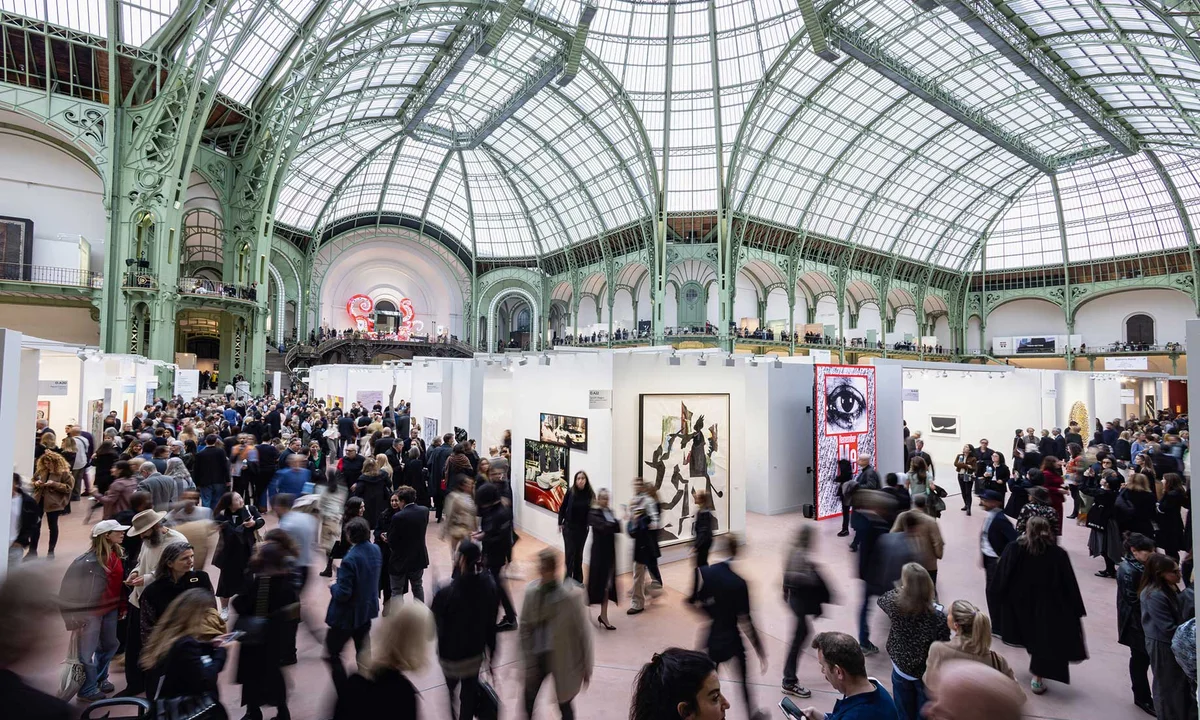
A new positive mood at Frieze London. Impressive eight-figure sales at Art Basel Paris. Auctions 30% up at Christie’s in London. A record-breaking €90m sale at Sotheby’s in Paris. Maurizio Cattelan’s $10m gold toilet headlining a much-improved offering at November’s marquee sales in New York.
For many involved in the business of selling art, this autumn’s key trading moments represented a long-awaited upturn in a market that for more than two years has seen sales stifled by geopolitical volatility.
“It’s great to be riding a wave. The challenge will be to sustain it,” said Freddie Powell, the founder of the on-trend London contemporary gallery Ginny on Frederick, after it was announced that the Arts Council Collection had bought the 2025 mixed-media sculpture Accounts by Alex Margo Arden for between £20,000 and £30,000 at Frieze London. The talk of the October fair, Arden’s work, consisting of a rope-bound bundle of defunct mannequins of tradesmen from a historic motor museum, was a telling metaphor for backward-looking Britain’s struggle to adapt to new realities. “We’re looking behind now. Looking forward is too horrific,” added Powell.
Ginny on Frederick is one of a group of emerging galleries (Rose Easton, A. Squire, Brunette Coleman and Union Pacific are others) that over the last five years, despite the challenges post-Brexit Britain presents, have reinvigorated London’s grass-roots art scene. They have also breathed new life into Frieze London, which in recent years has struggled to maintain the international allure it had in the early 2000s when the Young British Artists (YBAs) were such a force in the market. Frieze London now places younger dealers with new works at lower price points at the front of its temporary venue in Regents Park. This creates a clear distinction between itself and its more upscale rival Art Basel Paris in the formidable setting of the Grand Palais.
“There’s a lot more energy at Frieze and it’s a bit more adventurous. But there are hardly any videos or installations. It’s mostly paintings to keep people happy,” said Luc Haenen, an Antwerp-based collector who was in London for the fair, adding, “And I hear artists keep complaining about the lack of funding here and how difficult it is to find studio spaces.”
Much has been said about a post-Brexit exodus of tax-averse international wealth diminishing London’s art scene. Yet during Frieze week Christie’s managed to raise £107m from its evening auction of 20th- and 21st-century art, a 30% increase on the previous October.
And then there is the harmful effect of the UK parliament voting in 2010 to nearly treble England’s domestic university fees to £9,000 a year, thereby discouraging students from less affluent backgrounds. Damien Hirst, Tracey Emin and the rest of the YBAs benefited from a free art school education.
“Art schools are now dominated by those who can afford to go through personal or familial wealth,” says Matthew Holman, an art critic and postgraduate fellow at the Courtauld Institute. “They make art that caters to the tastes of those collectors who can still afford to collect in this economic environment.”
With higher-paying international students now forming the overwhelming majority of most classes, and domestic tuition fees increased to £9,535 a year, England’s much-vaunted but funding-strapped art schools are struggling to produce the next Hirst or Emin.
Paris awash with wealth
Meanwhile, the Paris art scene is awash with money, much of it privately provided by France’s multibillion-euro luxury houses. This October, the Fondation Cartier opened its vast Jean Nouvel-designed museum of contemporary art opposite the Louvre and the Fondation Louis Vuitton staged a blockbuster Gerhard Richter retrospective. The latter helped the international dealers Lévy Gorvy Dayan and Hauser & Wirth sell Richter abstract paintings from the 1980s for $25.5m and $23m respectively at the inaugural Avant Première VVIP preview of the Art Basel Paris fair. Richter enhances the value of the Louis Vuitton luxury brand, Louis Vuitton enhances the value of brand Richter.
Last autumn Knight Frank published a survey of 700 high net worth individuals across the world, asking where in Europe they would like to relocate. Paris topped the poll. London came seventh. Paris has acquired the status of Europe’s playground city of choice for the wealthiest 0.1%, particularly for art-loving Americans.
Since taking over France’s flagship October fair devoted to Modern and contemporary art in 2022, Art Basel has built the prestige of the event to the point where the group’s participating dealers now offer their most expensive works in Paris, rather than in Basel in June, where the world’s top collectors have traditionally convened.
“The quality is high. The dealers seem satisfied. There’s lots of fear in the art world right now,” said the Berlin-based collector Axel Haubrok, speaking at Art Basel Paris. Like several other visitors, Haubrok wondered how the success of this French event would affect the fortunes of the organisers’ mothership fair in Switzerland. “There’s just the fair and three museums in Basel. It can’t compete with Paris. That’s why they bought this one,” Haubrok added.
This year Art Basel Paris came up with the idea of a super-exclusive afternoon Avant Première pre-preview of the fair to reduce overcrowding at the customary two-day vernissage. The resultant gathering of exhibitors’ most valued clients and distinguished collectors from Art Basel’s Global Patrons Council produced an impressive rush of big-ticket sales (albeit mostly confirming reserved pre-fair offers). Dealer David Zwirner said he had his best-ever Paris fair, selling more than $25m at Avant Première.
With dozens of ultra-wealthy collectors such as Leon Black (US, private equity), J. Tomilson Hill (US, hedge funds), Maja Hoffmann (Switzerland, pharmaceuticals) and Dakis Joannou (Cyprus, construction) in town, it was hardly surprising that Sotheby’s Paris posted a record total of €89.7m for its double-header auction of Modern and Surrealist art during the fair week. Modigliani’s half-length nude, Elvire en buste (around 1918), unseen under the hammer since 1974, soared to €27m, an auction high for the artist in France.
So the view seems to look brighter at the very top of the market for certain older and dead artists, and down at the lower end for certain younger artists. But the middle market remains stubbornly problematic.
Bonhams, which, like Christie’s South Kensington, epitomised the market for mid-level “professional class” collecting, has been sold by its private equity owners to one of its corporate lenders, having failed to find a buyer for the company in 2023 for a reported price of $1bn.
Maurizio Cattelan’s infamous America was up for auction with a $10m estimate
Courtesy Sotheby’s
And contemporary art dealerships keep closing. Almine Rech has recently shuttered her London space (and reopened in a smaller gallery), Sean Kelly has done the same in Los Angeles. Project Native Informant is another London casualty. San Francisco-based Altman Siegel has also closed. Claudia Altman-Siegel’s explanation for the closure of her eponymous gallery, published in an interview with Artnet News in October, has become a familiar refrain.
When Altman-Siegel opened in 2009, she had “an amazing group of collectors who were really supportive”. But now these collectors have grown older and are no longer buying. “They’re working on their estate planning now,” she said. “And I think the younger generation is not really following in those same footsteps.” Just one bad fair can sink a gallery, according to Altman-Siegel.
An ageing collecting class
The fact of the matter is that the international art market has for years been supported by a concerningly small core—or rather, club—of wealthy collectors who are now ageing out. It seems that their numbers and hunger for acquisition are not being replenished by enough new buyers, making it difficult for the art trade to flourish in its current form.
“The market is getting more and more concentrated. Some top galleries are active worldwide, two, maybe three auction houses and two big fair providers. But what happens to the middle segment? The lower segment? Can we really infer from high results at the November auctions in New York that the art market is back on track?” asks Roman Kraussl, a professor of finance at Bayes Business School in London, who has published extensively on art as an asset class. “I am not sure whether the current ecosystem will survive as it is.”
The art market, like most financial markets, is obsessed with growth. But after 14 years during which global sales have broadly flatlined (according to Art Basel and UBS’s annual art market reports) and art has become increasingly perceived as something that just rich people do, should the art market give up on growth and worry more about whether all this can be sustained?
