


In February 1959, amid a series of government crackdowns in Egypt, the artist and activist Inji Efflatoun realised that her own arrest was imminent. Rather than give up her political activities in support of feminist and communist causes, she went into hiding.
She took a one-bedroom flat in Cairo, telling her landlords she was on the run from an abusive husband. Trading her bourgeois clothes for those of a fellaha, or a country girl, she lined her eyes with kohl and adopted a different dialect. The ruse worked for a while but by June the authorities had found her. The officers were so taken aback by her appearance that they photographed her costume “from all angles”, she writes, and refused her soap so that she could not wash off her make-up. Addressing her in French, the intelligence officer asked her why someone from such a prominent family would make so much trouble.
Boycotts and demonstrations
Now considered one of Egypt’s most significant Modernist artists, the fascinating Efflatoun was born in 1924 in Cairo, where she attended the city’s European schools and mixed with its elites. While still a student she became involved with feminist, nationalist and socialist causes, organising boycotts and demonstrations, and attending international conferences. Her politics and art informed each other: her first major exhibition in 1952 featured fellaha women, and was seen as a victory for Egyptian feminism, with students taking pictures of the paintings and reproducing them as political flyers. And she did not just play at being the revolutionary; she was imprisoned for four and a half years, during which time she continued to paint.
She was imprisoned for four and a half years, during which time she continued to paint
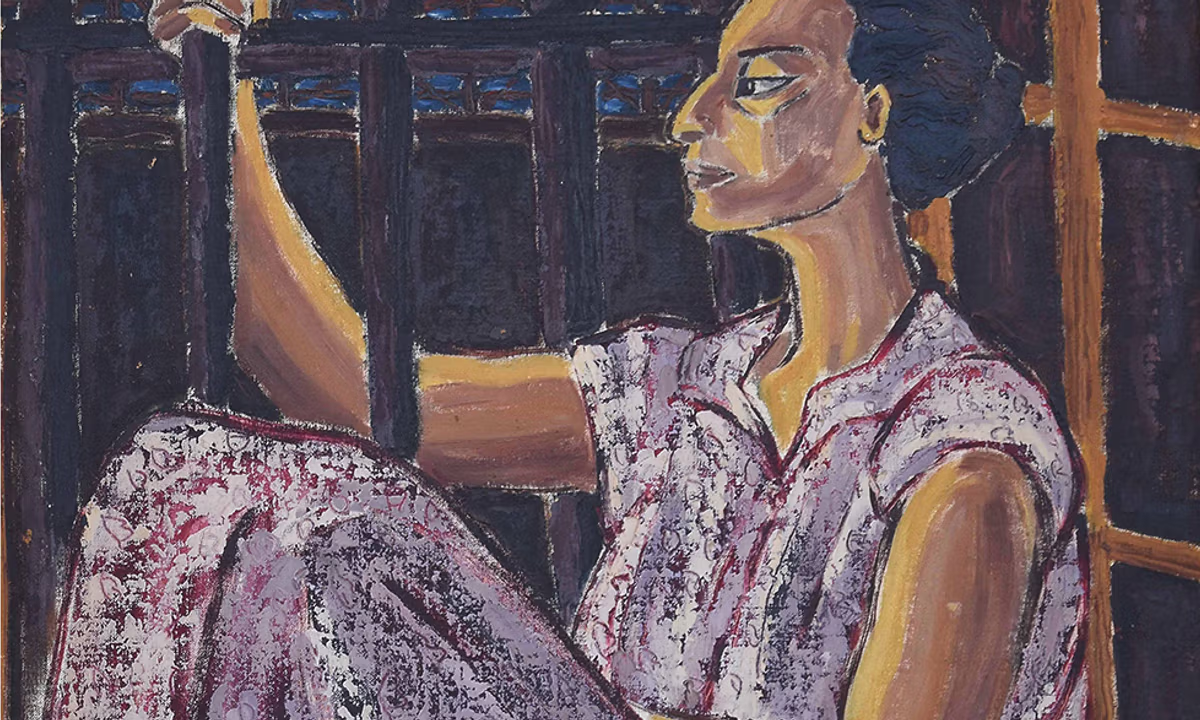
Efflatoun’s paintings address the hardships and oppressive conditions against which she agitated: images of textile workers at the loom; a hanged man, his hands bound behind him with rope; a mother at home with her newborn child; prisoners during visiting hours. After she was freed from the women’s prison, Efflatoun’s work became less explicitly political and looked increasingly towards nature and rural life, such as images of farming women sitting among crates of fresh oranges. Throughout her career, the work is either dark or light and does not seem to have an in-between: it is the bright patterns of women’s clothing and sunlit rural landscapes, particularly in her later, almost textile-like incorporation of unpainted space; or it is moody canvases of menacing trees, cramped indoor spaces and the moon seen through barbed wire.
Untitled (1977) © Inji Efflatoun; collection of Salwa Mikdadi.
As the title of this comprehensive volume suggests, The Life and Work of Inji Efflatoun is weighted equally towards her life and art and is a riveting introduction to each. The first half of the book comprises her private diaries, which Efflatoun recorded onto cassette tapes, then transcribed into notebooks, and later gave to her friend Said Khayal before she died. Khayal edited them and they appeared in Arabic in 1993. They are here translated into English for the first time. Known as her memoirs, they cover the time between Efflatoun’s childhood and her incarceration—after that, she enigmatically said, life was private. The second half of the volume is a series of essays commissioned by the book’s editors, Sultan Sooud Al Qassemi and Suheyla Takesh of Sharjah’s Barjeel Art Foundation, which explore Efflatoun’s work in the context of Egypt’s political movements and its postcolonial art history.
Privilege and revolution
Efflatoun’s memoirs provide a glimpse into the life of both privileged Egyptians and revolutionary politics under Gamal Abdel Nasser, who aggressively pursued the leftists of the country. It is such rich material that scholars can barely ignore it, which—in addition to the dramatic narrative of the class traitor—is likely one of the reasons Efflatoun’s biography has always dominated the writing around her work. And it might also be why some of the most illuminating essays in this book are those that ignore Efflatoun’s own account and bring in other voices, or look to the canvases themselves. Nadine Atallah establishes a chronology of Efflatoun’s exhibitions throughout the Soviet Bloc in the late 1960s and 1970s, developing a sense of the multiple identities she assumed in an international context; Takesh looks to Efflatoun’s repeated motifs of labour to unpack struggle as a metaphor for both inner turmoil and political alignment.
These reminders of the diversity of Efflatoun’s practice are underscored by the book’s substantial reproductions—to date, the only chance for most of the public to see her output. The works included here are mostly drawn from the Mathaf museum’s significant collection in Doha, along with paintings and drawings from the Barjeel Art Foundation and several Egyptian private collections. But Efflatoun’s paintings will soon get new exposure: at last, major international exhibitions are planned for her work, starting with a retrospective at London’s Whitechapel Gallery in October 2026.
• Sultan Sooud Al Qassemi and Suheyla Takesh (eds), The Life and Work of Inji Efflatoun, Skira/Barjeel Art Foundation, 320pp, 115 col. illus., £50 (hb), published 28 August 2025
• Melissa Gronlund is a writer based in London
