


For centuries, drawings and prints were collected and exhibited together, with the blurry distinction between the two sometimes dissolving altogether. The upcoming IFPDA Print Fair at the Park Avenue Armory (April 9–12) will offer an illuminating exploration of this relationship, with 80 exhibitors from Singapore to Stockholm (including blue chip galleries Hauser & Wirth, Pace Prints, and David Zwirner) presenting 500 years of drawings, prints, and editions to train your eye and, perhaps, tempt your wallet.
This year marks a milestone for the IFPDA, which recently rebranded itself as the International Fine Prints & Drawings Association. Longtime members like Hill-Stone, David Tunick, Inc., and William Shearburn Gallery will be expanding their presentations to include more master drawings. New exhibitors include drawing dealers Mireille Mosler and Jill Newhouse Gallery, who will be bringing an intimate charcoal by Edward Hopper, High Noon (Study), 1949, one of only five known drawings for his iconic canvas, High Noon, painted the same year.

Edward Hopper, High Noon (Study), 1949.
The relationship between prints and drawings evolved in the 19th century, with the rise of technologies like lithography. Illustrated newspapers flooded the public with images, and readers gained a new visual familiarity with artists and their work.
Ironically, it was the advancement of prints and printmaking that contributed to the Romantic fetish for “original” works and the aura of the artist’s hand, placing prints lower in the spurious new hierarchy of art. If an image could be endlessly copied, what distinguished a unique object? Collectors began to privilege works that seemed to bear the direct, physical presence of the artist through brushwork, line, or touch that could seemingly not be replicated.
Francoise Gilot: Opera (Red), 1996.
This tension is what Walter Benjamin would later theorize as the “aura” of the artwork in The Work of Art in the Age of Mechanical Reproduction. Although Benjamin wrote in the 20th century, he was diagnosing a condition that began in the 19th: the more images circulated mechanically, the more the singular object acquired a mystical authority as the site of authenticity.
But printmaking complicates this narrative. Prints are sometimes multiples, but just as often they are unique, as in SOLO Impression’s unique lithograph, Opera (Red), by French painter and Picasso muse, Françoise Gilot. Equally confounding to this false narrative of prints not possessing the “aura” of the artist are the many works which are hybrids, equal parts drawing and print.
Edgar Degas, Dancers in rehearsal. ca. 1874–78.
Monotypes—drawings that have been printed, usually just once, ergo ‘mono’—are foundational for understanding the blurred line between prints and drawings. Edgar Degas’s moody monotype Dancers in Rehearsal (ca. 1874–76), from Galerie Martinez D., is an exceptional example. To make it, Degas drew with ink on a metal plate and ran it through a press, creating a single painterly impression of evocative, impressionistic figures that still remain recognizable as the artist’s iconic dancers. He was so obsessed with this messy medium that his friend Marcellin Desboutin famously described Degas’s fascination for monoprints as “swallowing him completely!”
Another spectacular example of a hybrid work, equal parts drawing and print, will be on view in the booth of new exhibitor Mireille Mosler. The Gatteaux Family (1850), by Jean Auguste Dominique Ingres, was his last—and largest—work on paper. In it, the artist created a time-traveling composition that incorporated engravings after earlier drawings collaged onto a larger sheet and extensively reworked by hand in graphite. Ingres depicted his close friend Édouard Gatteaux, aged 62, as a dapper young man, based on a portrait drawn in 1834. His parents, meanwhile, appear posthumously: his mother having died three years earlier and his father 18 years before the drawing was made. The drawn portraits of their granddaughter Paméla and her cousin Eugénie represent the living generation.
Ingres created only three other large multi-figure portrait drawings: The Forestier Family (1806) and The Stamaty Family (1818), both in the Louvre Museum, and The Family of Lucien Bonaparte (1815), at the Harvard Art Museums, making The Gatteaux Family a museum-worthy acquisition.
Edward Hopper, High Noon (Study), 1949.
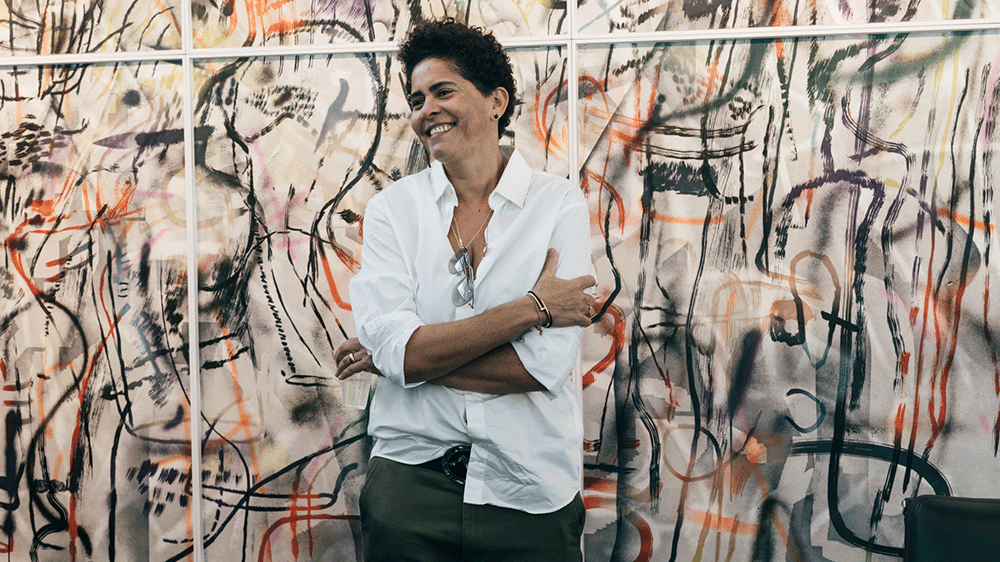
Julie Mehretu has said, “[It’s] in the printmaking that new things are invented, which I then bring into the painting and drawing.” The technical parallels between printmaking and the way Mehretu builds her drawings and paintings through a stratum of imagery that is blurred and transformed underscores the symbiotic relationship between the mediums. Mehretu’s work will be on view in the booth of Gemini G.E.L at Joni Moisant Weyl, and the artist will be in conversation with curator Susan Dackerman at the Park Avenue Armory on Saturday, April 11th.
On Sunday, April 12th, the final day of the fair, a talk by Edina Adam (J. Paul Getty Museum) and Jamie Gabbarelli (Art Institute of Chicago), authors Lines of Connection: Drawing and Printmaking, 1400-1850, which wonthe 2026 IFPDA Book Award, should dispel any lingering doubts about the false narrative of drawings supremacy over prints, with a focus on the artistic practices of Dürer, Parmigianino, Rembrandt, and William Blake.
The IFPDA Print Fair will be held at the Park Avenue Armory in New York City, April 9–12.
