


With the last half-millennium in mind, Raphael has arguably been the most important artist of the western canon, casting his harmonious spell everywhere from the frescoed walls of the Vatican’s Apostolic Palace to centuries of seminars in provincial art academies. But over the past 150 years or so, he has begun to run a distant third to his mononymous rivals, Michelangelo and Leonardo, whose personal biographies, professional dramas, and artistic excesses and eccentricities have made them far better suited to a post-Romantic idea of an artist.
This has begun to change in recent years though, with major exhibitions reframing the artist at Rome’s Scuderie del Quirinale in 2020 and the National Gallery in London in 2022. Now, it is the turn of the Metropolitan Museum of Art in New York to get US audiences to look at him afresh.
Raphael: Sublime Poetry is the Met’s—and indeed, America’s—first comprehensive show about the Urbino-born artist (1483-1520). Gathering 237 works in total, including 33 paintings and 142 drawings by the artist, the show spans the whole of his career, establishing his artistic and intellectual origins in the courtly world of Renaissance Urbino and culminating in his supreme place in Papal Rome.
Raphael, The Virgin and Child with Infant Saint John the; Baptist in a Landscape (The Alba Madonna) (around 1509-11
Courtesy National Gallery of Art, Washington
The number of major loans is eye-popping. The National Gallery of Art in Washington, DC, has lent The Alba Madonna (around 1509-11); the Musée du Louvre in Paris is loaning Portrait of Baldassare Castiglione (1514-16); and the Gallerie degli Uffizi in Florence has sent a number of red-chalk studies. Furthermore, the Albertina in Vienna, Oxford’s Ashmolean Museum, the Rijksmuseum in Amsterdam, and the Devonshire Collections at Chatsworth have sent their superb studies for The Transfiguration, Raphael’s enormous final painting.
A priceless gathering
The challenge in doing a Raphael show can seem chiefly organisational. How, for instance, did the Met manage to get so many museums and collections to part with so many priceless works? By sheer persistence, says the show’s curator Carmen C. Bambach. “I never took ‘no’ at face value,” she says, adding that she went back so many times with repeated requests that it just “became easier to say yes”. Then a larger challenge began to kick in: how could the Met make the case for Raphael to a museum-going public in the 2020s?
For centuries, Raphael was best known, and most loved, for his idealised depictions of the Madonna and Christ Child, leading to countless imitations. Bambach calls the phenomenon “an oversaturation” that “severely tarnished” the motif to such an extent that she herself concedes it can be now viewed as “saccharine”. Her solution? Present a much wider “social and historical context” of motherhood and childhood mortality. Before viewers experience the full flowering of Raphael’s sublime Madonnas, they will encounter objects and images that attest to the agony and sheer danger of childbirth. Bambach is exhibiting the so-called Book of Wax, an account book on loan from a convent in Urbino that catalogues funeral expenses of Raphael’s own mother and newborn sister in 1491. And Florence’s Museo Nazionale del Bargello is loaning Verrocchio’s Death of Francesca Pitti Tornabuoni (around 1480), a harrowing marble relief dramatising the death of both a mother and her newborn.
Although Bambach had been thinking about the show for some time, she got the final go-ahead in 2018 after Max Hollein became the museum’s director. Hollein’s instinct, he now says, was to go all-in. “I said to Carmen, ‘let’s think about this in a really ambitious way’.” That meant broadly including both paintings and drawings, and confining the venue to the Met alone—resulting in “a major financial commitment”, he says, “because you can’t divide up costs”.
The eight-year lead-up to the show has been a period of intensive travel for Bambach, as well as Rachel Mustalish, conservator in charge of the Met’s paper conservation team.
Research leads to reattribution
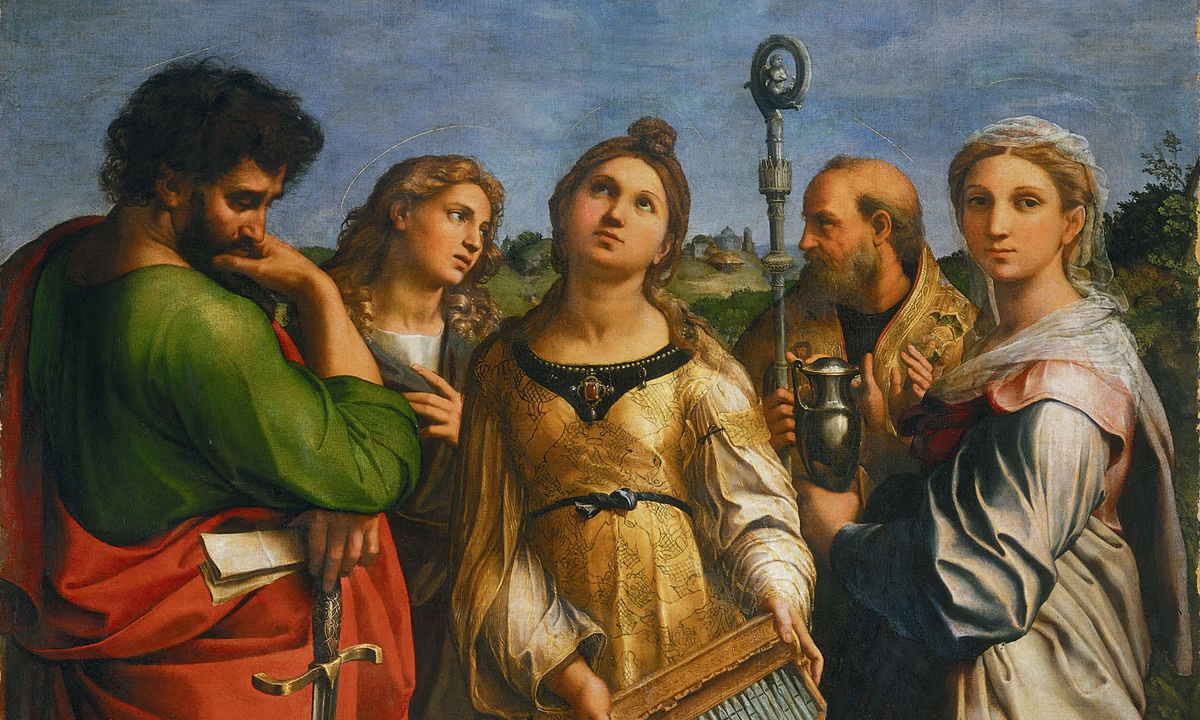
Bambach’s examination of the Modello Drawing for the Altarpiece of the Ecstasy of Saint Cecilia in Paris led to a reattribution of the work from Raphael’s assistant Gianfrancesco Penni to the master himself. In New York, that work will be joined by the 2.5m-tall painting itself (around 1515-16), on loan from the Pinacoteca Nazionale di Bologna. “I’m just ecstatic to have it,”Bambach says.
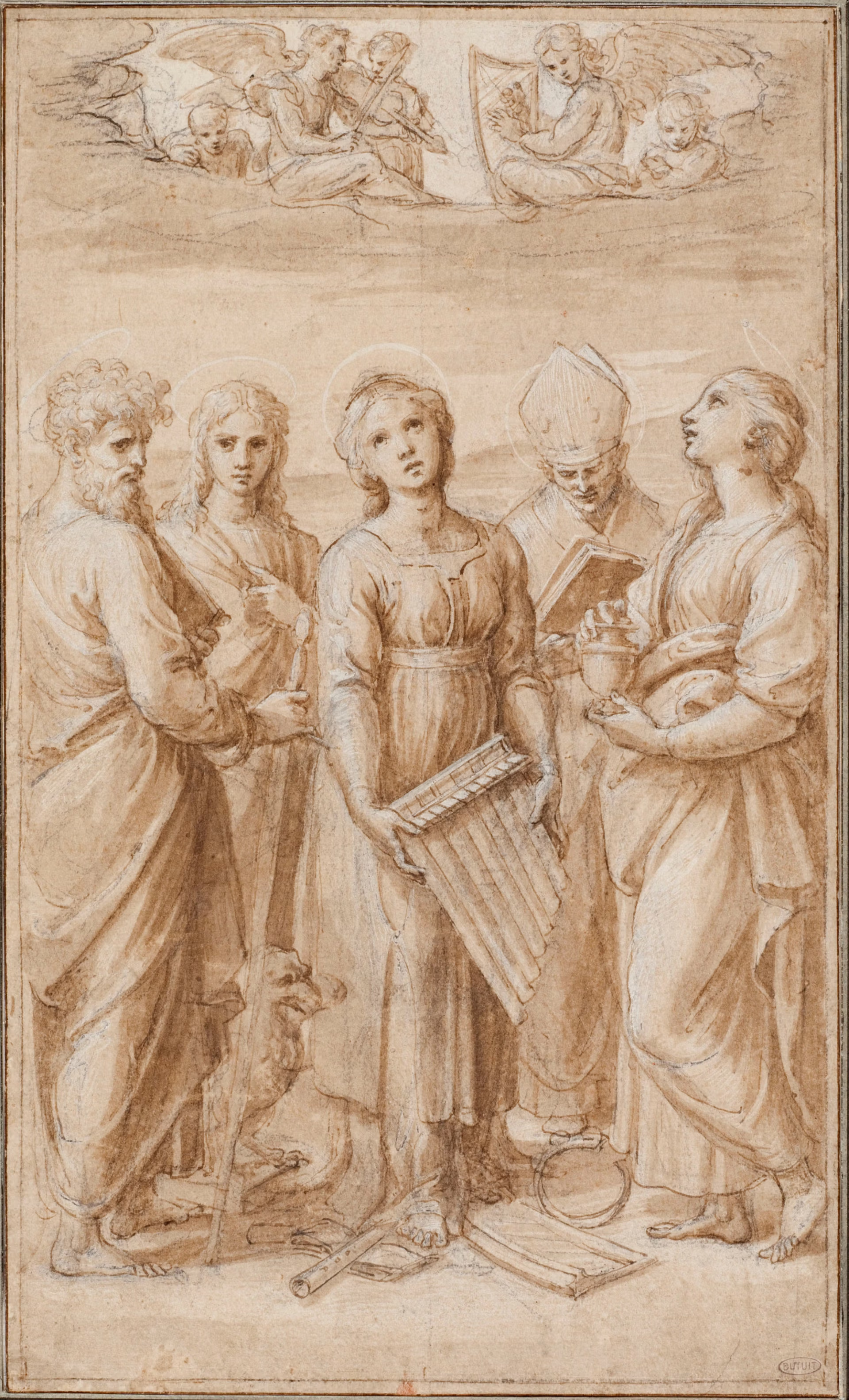
The Modello Drawing for the altarpiece painting The Ecstasy of Saint Cecilia (around 1515-16). The drawing has now been reattributed to Raphael
Paris Musées / Musée des Beaux-Arts de la Ville de Paris, Petit Palais
Meanwhile, Mustalish and her team have been travelling to a number of British collections, equipment in hand, to examine Raphael drawings on site. Back in New York, Mustalish has been working wonders on the Met’s own Raphael drawings, including almost entirely removing a mysterious stain from a red-chalk drawing (around 1506-07). The stain had marred the baby belly of Saint John the Baptist, lower left, and is now scarcely visible to the naked eye.
Hollein admits that he is anxious about “delivering something really interesting” to a world’s worth of Renaissance experts. But in the short-term he has another concern—the weather. Having gone through New York’s two major winter storms this year, he says, speaking in late February, “I’m more focused on not having snow that might delay shipments.”
- Raphael: Sublime Poetry, Metropolitan Museum of Art, New York, 29 March-28 June
