


She is the subject of a current exhibition at the Museum of Modern Art and an upcoming one at the Tate Modern. Netflix is planning an adaptation of her life. Her unibrowed face stares out from tote bags, murals, notebooks, enamel pins, refrigerator magnets, and dorm-room posters across the globe. A recent auction of The Dream (The Bed), 1940, helped send her market value into yet a higher strata. I speak, of course, of Frida Kahlo.
Add to the list a new opera. El Último Sueño de Frida y Diego, which recently opened at the Met, stages an oneiric reckoning with two famed painters. The premise is deceptively simple: on a November day in 1957, Frida returns from the underworld during Día de los Muertos for a brief reunion with her husband, who is himself not long for the world of the living.
Carlos Álvarez as Diego and Isabel Leonard as Frida in a scene from Gabriela Lena Frank’s “El Último Sueño de Frida y Diego.”
Photo Marty Sohl. Courtesy Met Opera
The evening opens as villagers in Mexico City hold vigils for their dearly departed. “They are coming back / as if they were angels / angels escaped from heaven / They are faithful to the call / Let the dead awaken!” sings the chorus. Shrines to lost souls are aglow with candles and fringed with marigolds. Lines draped with multicolored garments stretch overhead. Most striking of all: a mirrored panel the width of the stage hovers at the top of Jon Bausor’s handsome set, reflecting the movement of people below. It evokes the mirror mounted above Frida’s bed during her long convalescences, which she consulted for some of her most beloved paintings.
Not long after Diego entreats the dead Frida to come back to him, the set shifts to the underworld, which is presided over by the mocking, imperious Catrina (Gabriella Reyes), dressed in a regal black dress. Catrina asks the deity Mictlan to resurrect Frida, and the painter is duly summoned from a crack in the floor that recalls the jagged chasms in Kahlo’s Tree of Hope, Remain Strong (1946). Skeletal figures ascend from underground alongside Frida, her face framed by pale blossoms. (Wilberth Gonzalez designed the gala-worthy costumes.) At the center of the stage stands a crimson tree whose leafless limbs resemble circulatory systems.

Isabel Leonard as Frida in a scene from Gabriela Lena Frank’s “El Último Sueño de Frida y Diego.”
Photo Marty Sohl. Courtesy Met Opera
Frida, played by mezzo-soprano Isabel Leonard, remembers too vividly the agonies of earthly existence—the shattered spine, the amputated leg, the matrimonial strife. While Rivera wants the dead to rise again, Frida hesitates at the threshold, suspicious of the prospect of reuniting with a man who was a “demon” in her life.
Amid this tension, Deborah Colker’s kinetic choreography introduces a pleasant note of whimsy. The skeletal creatures populating the underworld pop their joints, do backflips, and move in synchronized motion. The opera grants Kahlo forms of physical freedom denied to her after a trolly accident left her disabled at age 18. Onstage, she twists, lunges, and undulates with fluidity. The production doesn’t ignore her pain—agony is a key theme even for the antipodean Frida—but it does suggest her disability fueled her creative process.
Rivera, played by Carlos Álvarez, cuts a more muted figure, both vocally and dramatically. Although the opera hinges on his yearning to see Frida once more, he often feels curiously sidelined throughout the 2.5-hour performance. His role, as written by Nilo Cruz, is too frequently padded out with wisecracks about his potbelly and physical bulk. Instead, the show’s gravitational pull belongs to Frida and the bustling, carnivalesque inhabitants of the underworld.
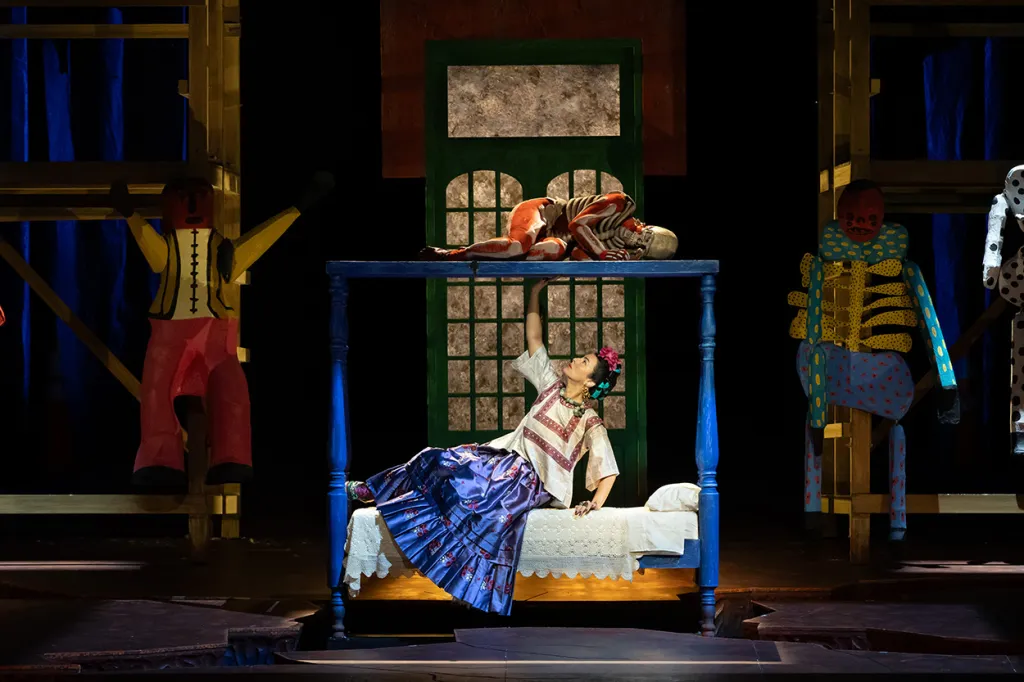
But if Act I draws cues from Frida’s paintings, Act II shifts visually into Rivera’s world. Wooden beams and scaffolding take the place of the imposing red tree, and blue walls rotate into place around Frida once she re-enters Casa Azul. Her blue bed rises from an opening in the floor.
Carlos Álvarez as Diego and Isabel Leonard as Frida in a scene from Gabriela Lena Frank’s “El Último Sueño de Frida y Diego.”
Photo Marty Sohl. Courtesy Met Opera
The opera’s central prohibition—the dead may revisit the living world but cannot touch people there—should imbue the reunion scenes with frisson that it is largely lacking. Emotionally, they’re ships passing each other in the night; it’s hard to imagine that they were ever passionately in love. Frida sums up her attitude early on: “When in life I had two major accidents: the impact of a trolley, and the blow of meeting Diego Rivera.” El Último Sueño underlines their severed connection: a hand hovers near a shoulder before falling away; bodies angle toward embrace only to recompose themselves into parallel lines. When she finally embraces Diego, physical pain floods back into her body almost instantly. Agony returns “armed with knives” and Diego is drawn irrevocably into the realm of the dead.
The opera itself often feels curated like an exhibition in motion—tableaux assembling and dissolving and assembling themselves again. Indeed, Bausor’s designs resonate with the concurrent Museum of Modern Art exhibition, “Frida and Diego: The Last Dream,” which he also co-curated. The show includes Rivera’s set sketches for the 1932 ballet H.P. (Horsepower) alongside paintings by both artists. The display, meanwhile, extends many of the opera’s visual motifs into gallery space: fissures, scaffolding, mirrors, arterial reds, claustrophobic corridors opening suddenly into expansiveness.
Despite its emotional unevenness, El Último Sueño de Frida y Diego is worth seeing for its tactile richness and its sparks of sensuality, best embodied by a minor character, Leonardo (Nils Wanderer), a dead actor who impersonates Greta Garbo and whom Frida chances upon in the underworld. Leonardo’s countertenor achieves a clarity and emotional openness that Diego’s baritone never does, especially in scenes where Leonardo persuades Frida to return not merely to Rivera, but to art itself. Frank’s score, too, often finds a supple momentum that keeps the opera from sinking under the weight of its own symbolism. If the central relationship never fully ignites, the surrounding world crackles with invention.
