


A small German city unearthed a large chunk of history this past May. Urban construction in the Black Forest municipality of Pforzheim uncovered an undetonated World War II bomb, forcing an evacuation of surrounding areas before its eventual defusing.
Other ghosts are not so easily exorcised. This past spring, a teen disco in Brandenburg saw more than a hundred adolescents chant Nazi slogans, while young folk in North Frisia were recorded intoning the same lines in May: “Foreigners out, Germany for the Germans.” The exhibition I had come to review in Munich, the Bavarian cradle of Nazism—“Antifascism: Now”—felt laden with urgency in its very premise.
Germany is hardly the only country witnessing a resurgence of nationalist populism. Yet given its outsized consequence for 20th-century history, the momentum of the Alternative for Germany (AfD) Party proves particularly unnerving. Compounding that unease is the attendant, attempted criminalization of anti-fascist activism across the globe. The President of the United States has decreed “Antifa” a “terrorist organization,” though no such body formally exists. The move positions anti-authoritarians as the true enemies of the state. That the actual, original Antifa formed in clandestine resistance to Nazi terror during the early 1930s appears lost amid the rhetorical vagaries of political propaganda.
Conceived as both an exhibition and a call to action, “Antifascism: Now” at the Lothringer 13 Kunsthalle sees artists pay tribute to acts of resistance past and present, refracting similarities and differences among antifascist practices. One of the show’s touchstones is an outsized painting by the Yugoslav-Bosnian artist (and former soldier) Ismet Mujezinovic titled Charge (1947). Exhibited for the first time outside of Sarajevo, the churning Socialist Realist homage invokes Eugène Delacroix’s Liberty Leading the People in figuring partisans heroically overcoming their would-be Nazi aggressors. From here, the exhibition unfurls in a centrifuge of wide-ranging formats and geographies.
An installation by Jonas Höschl explores the work of the anti-fascist journalist collective Recherche Nord as they have documented right-wing attacks against reporters in Germany over the last two decades. Monochromatic markers colored blue (for neo-fascist attackers) and yellow (for photographers and journalists) abstract violent encounters into a choreography of stylized confrontation, no less disturbing for its (literal) objectivity. In a similar vein, Forensic Architecture applies 3-D modeling and surveillance tools in reconstructing the assassination of Pavlos Fyssas, an anti-fascist rapper murdered by the Greek far-right Golden Dawn organization in 2013. Aside from its reflexive aestheticization of these documentary modes, the empirical elements from The Murder of Pavlos Fyssas (2018) proved instrumental to the declaration of Golden Dawn as a criminal entity and the incarceration of its leaders in Greece.
Part of 13 Error 417 Expectation Failed’s Scores against Technofascism, 2026.
Photo Christian Kain
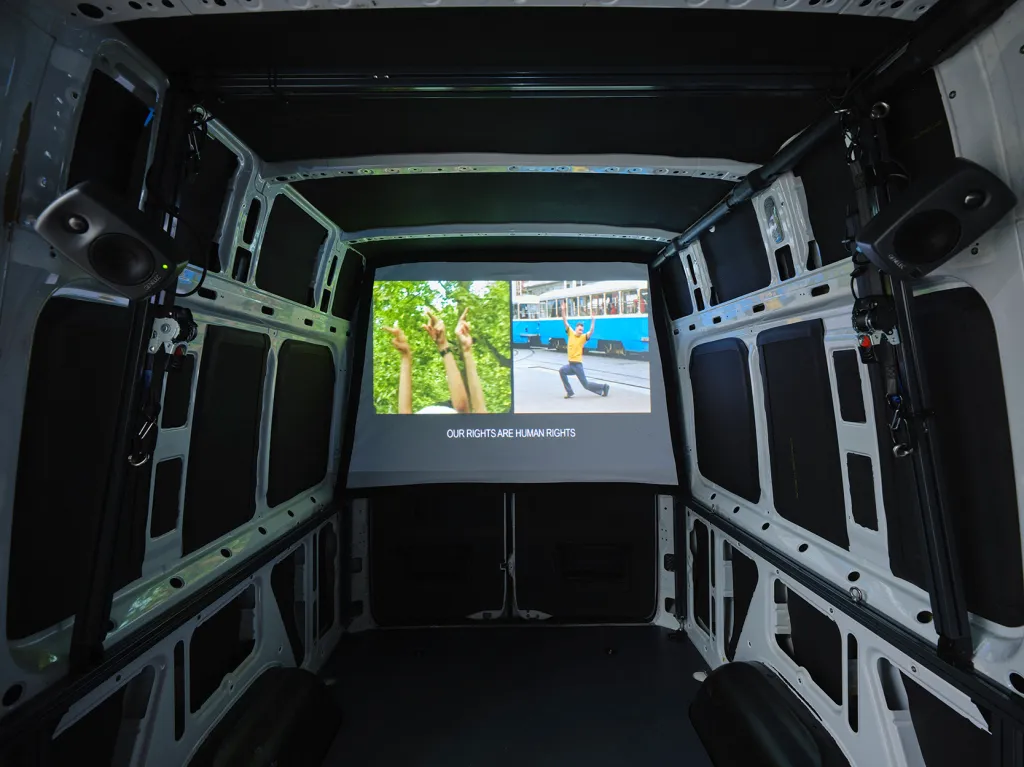
Cutting between documentary footage of violence at turn-of-the-millennium Gay Pride parades in Zagreb and Belgrade with scenes of dance, Igor Grubić’s East Side Story (2006–08) echoes the shibboleth of Mikołaj Sobczak’s nearby mural: QUEER SEX IS THE OPPOSITE OF FASCIST IDEALS. The inclusion of this and other works underscores the exhibition’s intersectional thrust: It conceives of fascism in iterations at once familiar and evolving, historical and contemporary. We find the same tack in the 13 Scores against Technofascism (2026) by the artist group Error 417 Expectation Failed interspersed throughout the show: mordant “how-to” suggestions for reclaiming public and private space from the creep of AI-fueled surveillance technology. In light of Big Tech’s increased imbrication with state power, the definition of fascism shifts away here from nationalism per se to comprise an insidious, cross-border corporatism.
The same capacious characterization informs the inclusion of works confronting Russian aggressions in Ukraine, from the “Ribbons and Flags” watercolors (2022–24) by Davyd Chychkan (a front-line soldier in the war) to Lexi Fleurs and Nikol Goldman’s Hello-82 (2026), which immerses the viewer in disturbing virtual reality scenes of Russian drone assaults against civilians. Nikita Kadan’s charcoal Universal Ruins (Kyiv) & Universal Ruins (Gaza) (2024) hauntingly evokes the damage to these eponymous landscapes. But these twin allusions open onto wider fault lines: Though the exhibition references Russian “war criminals” and “genocide,” no such terms appear with regard to events in Gaza, begging questions about free speech regarding Palestinian suffering under recent German decrees.
That’s not to say Palestine is entirely absent. Fragments of Survival (2024) by Hussein al-Jerjawi—a Gazan displaced five times since 2023—speaks to his plight while entailing community response. On display are sacks of flour bearing hand-painted logos of the United Nations food organization, which will eventually be distributed to bakeries who in turn will donate proceeds to humanitarian aid in Gaza. The same collective ethos drives Patrick Thomas’s CINEVAN, which was commissioned for the exhibition and serves as a site of mobile screenings and discussions, working with local communities to lend voices to marginalized groups. The exhibition incorporates a similar ethos in its very design, with concentric rows of stools inviting discussions which might further activate the works on display.

Hussein al-Jerjawi: Fragments of Survival, 2024.
Photo Christian Kain
In a related vein, curator Kalas Liebfried aims to decentralize this particular show’s efforts. Following the exhibition’s conclusion in Munich, it will travel through Southeastern European cities until 2028, involving local artists, activists, and researchers in honing anti-fascism as an evolving practice. If being antifascist is a status that many progressive thinkers can get on board with, practicing antifascism proves less straightforward (a predicament which the Black Lives Matter movement set into incisive relief, by insisting that passive support does not necessarily result in change). Proposing that “democratic (cultural) work is antifascist work,” the exhibition opens up art to wider civic engagement.
But in taking a wide view, does the exhibition thereby dilute the ideological specificity of respective neo-fascist repression and aggression? In the wake of rising instances of authoritarianism which scramble historical categories and precedents, does such a dilution matter? Whatever its international echoes, the exhibition incited local responses by far-right entities. An AfD-sponsored publication dispatched a report criticizing the exhibition and queried the state funding involved in its mounting. Undercover police had to monitor the grounds.
