


In her essay collection The White Album (1979), Joan Didion wrote the now-famous sentence: “We tell ourselves stories in order to live.” For more than 50 years, the French artist Sophie Calle has worked in the space between facts and their retelling, demonstrating how the narratives we share about ourselves are always partial, constructed. Working across photography, text, film and installation, she reveals how fantasy and projection intervene in our best attempts to see and be seen. These preoccupations with what is public and private, documented and performed, form the throughline of the artist’s exhibition Overshare at the Orange County Museum of Art (OCMA).
The comprehensive survey, Calle’s first in North America, gathers work from the 1970s to the present. Organised by the Walker Art Center in Minneapolis and curated by Henriette Huldisch, it premiered at the Walker in October 2024. For Courtenay Finn, the chief curator and director of programmes at OCMA, the decision to bring the show to California was an obvious one. “The state appears like a character in her work over the past five decades,” she tells The Art Newspaper. In many ways, the 72-year-old artist’s career began here. In the late 1970s, Calle photographed the words “mother” and “father” engraved on headstones in a Bolinas cemetery in the Bay Area, anticipating the mix of intimacy, memory and absence that would come to define her practice. She went on to stage her first major exhibition at Fred Hoffman Gallery in Los Angeles in 1989.
California recurs throughout Overshare. In the installation Journey to California (2003), correspondence, black-and-white photographs and a carefully wrapped oversize package document the time that the San Francisco artist Josh Greene wrote to Calle asking if he might spend the months following a breakup in her bed. Calle duly shipped off her bedstead, mattress and sheets, which Greene returned to Paris six months later.
Calle’s cumulative four years spent in the US may help explain her comfort with unabashed self-exposure and her relative indifference towards others’ privacy. Asked whether the new context and proximity to Los Angeles, arguably the most image-conscious city in the country, might alter the reception of her work, she is characteristically brusque. “That is not my problem,” she says. “The work is my problem, and it exists. That’s it.”
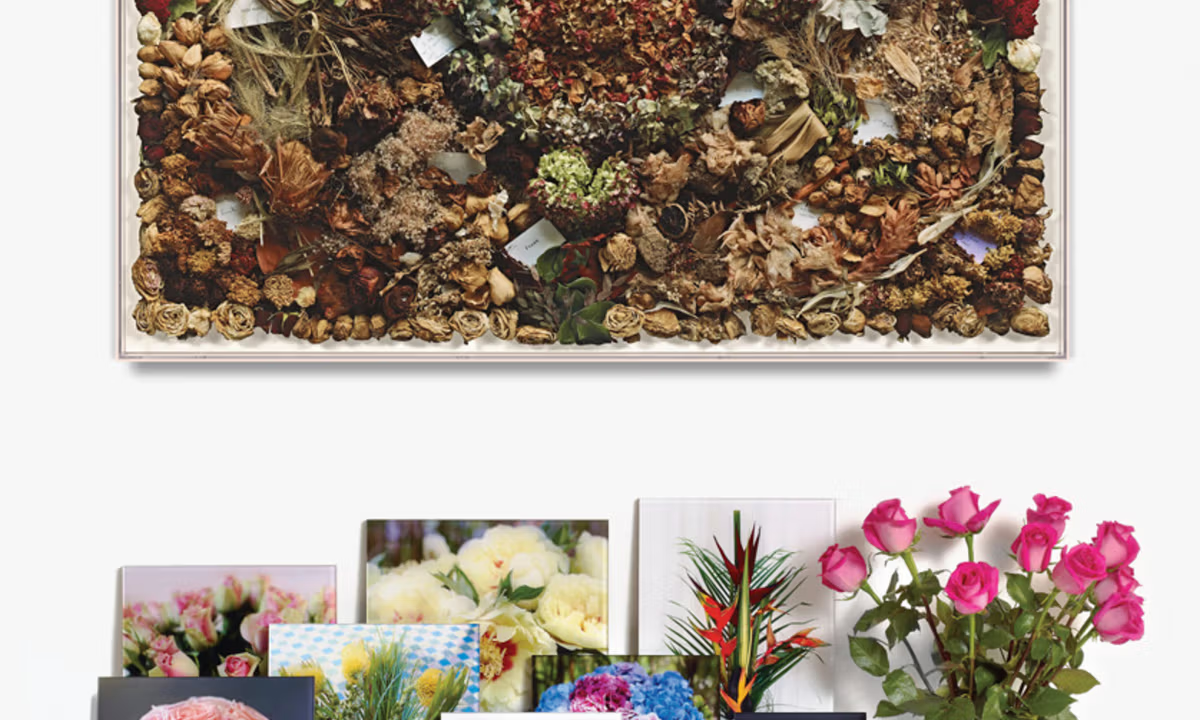
Detail of Calle’s North Pole (2009). The 72-year-old artist works across photography, text, film and installation
Courtesy the artist and Paula Cooper Gallery, New York; Photo: Steven Probert; © 2024 Artists Rights Society (ARS), New York/ADAGP, Paris
Her exhibition is divided into four sections—the Spy, the Protagonist, the End and the Beginning—intended to foreground Calle’s “intense investment in lived experience”, Finn says, “and her commitment to sharing, some would say oversharing, this with others”. The first gallery centres on Calle’s voyeuristic inquisitions into the lives of strangers, featuring a series of projects based on invented rules of engagement that invite questions about surveillance and authorship. Suite Vénitienne (1980, printed 1986) chronicles Calle’s clandestine pursuit of a stranger from Paris to Venice. Likewise, The Hotel (1981) documents her foray as a housekeeper in a Venetian hotel, where she photographed guests’ belongings, tried on their clothing and perfume and wrote short, often droll, stories imagining their lives.
Autobiographical diptychs
Later sections focus on the more explicitly autobiographical works for which the artist is best known. Though, as Calle often points out, all the works ultimately reflect her more than their ostensible subjects. Several pieces from her ongoing series Autobiographies (1988-present), composed of diptychs pairing photographs with short texts, are on view. In Bad Breath (1994), an image of an ornate couch accompanies Calle’s account of how her father sent her to a doctor at age 30, allegedly for halitosis. She found that the man was, in fact, a psychoanalyst. Her text ends with the line: “And so I became his patient.”
Bad Breath exemplifies Calle’s singular use of text and image to reveal and conceal in equal measure. The habit, she says, of pairing the two derives from a lack of confidence. “If my images were not good enough, the text could help,” she says. “If my text was not good enough, the images would help.”
Long before social media normalised the conversion of private life into public content, Calle was mining her daily existence and closest relationships for material. What now circulates online as dematerialised self-performance appears in her practice as something embodied and consequential. The works in Overshare may resonate today not because they mirror contemporary habits so much as they expose the desires and fears that underlie them: the desire to be seen, the fear of being misunderstood and the uneasy balance between disclosure and control.
- Sophie Calle: Overshare, Orange County Museum of Art, until 24 May
