


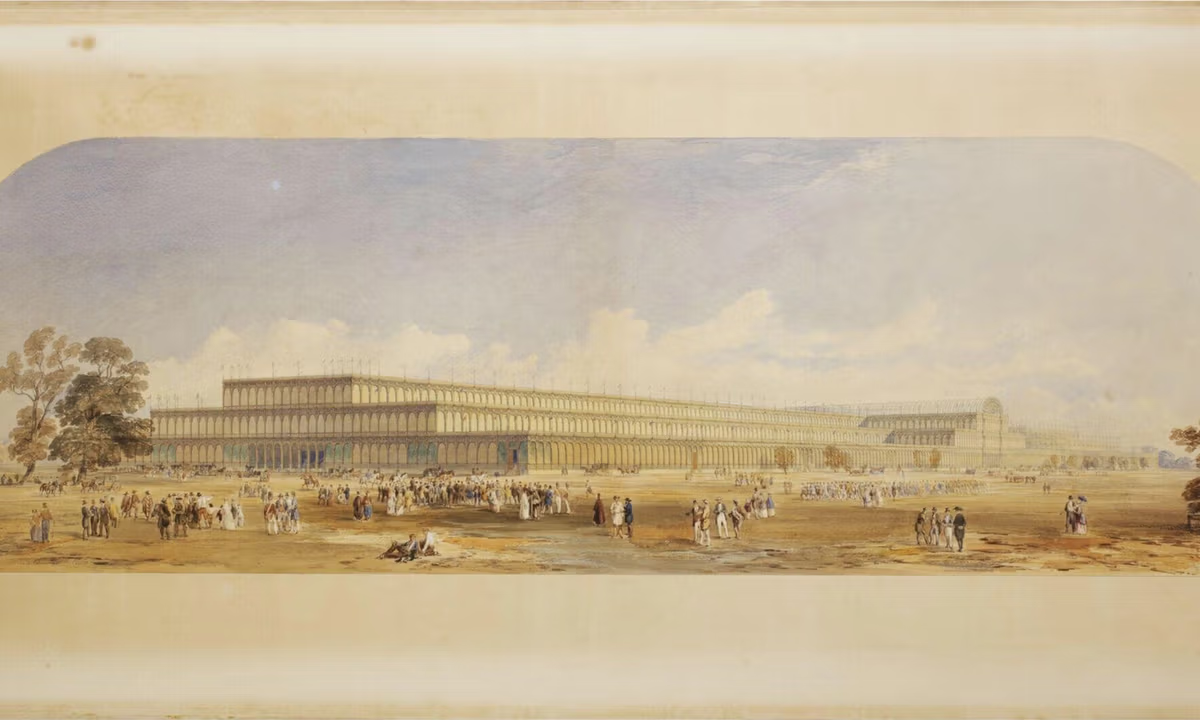
The Great Exhibition, held in Hyde Park in 1851, is inextricably linked with the formation of the Victoria and Albert Museum. For this fourth volume in his ongoing account of the V&A’s founding and development, Julius Bryant needed a new approach to this Victorian phenomenon that many may feel they know already. The clue is in the title: the focus is on the numerous sources that presented it to the public—paintings, prints, periodicals, photographs. Bryant is looking at and questioning the visual evidence rather than reading or thinking about its social significance. Industrialised Britain was advanced in manufacturing and technology but deplorably lacking in taste, a defect that the exhibition, along with a raft of individual initiatives, sought to improve.
An introduction, seven chapters and a conclusion track the project from its origins in 18th-century trade fairs, through the 1754 founding of the Society for the Encouragement of Arts, Manufactures and Commerce, and the establishment in 1850 of the Royal Commission for the Exhibition of 1851, with Prince Albert as its president, to its legacy. In a deft rebalancing, Albert’s key role is given its proper place among competing claims, principally from Henry Cole, “the great exhibitor” and self-promoter.
The extreme youth of the main protagonists is awe-inspiring: Albert was 30, Matthew Digby Wyatt, committee secretary, was 29 and Lyon Playfair, Albert’s “special commissioner”, was 31. The speed at which the enormous structure was built defies belief; begun on 20 January 1850, it opened to the public on 5 May 1851. Albert and the Royal Commissioners brought together 13,937 British and international exhibitors, with half the space devoted to British manufacturing and the rest offered to foreign countries.
The unrivalled collection of Great Exhibition material in the V&A’s National Art Library provides an extraordinary range of material. Recorded in Helen Pye-Smith’s bibliography, The Great Exhibition in Print (1998), it includes a singular element. Charles Wentworth Dilke, a member of Albert’s executive committee from the outset, collected everything he could lay his hands on during the exhibition’s run, right down to the flimsiest ephemera, which he catalogued in 1855. Alongside the official record, Dilke’s unconsidered trifles provide details absent from the standard narrative.
Chapter 4 is dominated by David Roberts’s five-foot-wide panoramic view, the Inauguration of the Great Exhibition (1852), which he called “unpaintable”. This view of the transept shows Albert reading the Report of the Commissioners to Queen Victoria and about 25,000 spectators. A printed plan from Dilke’s archive paves the way for a revealing virtual tour of the building in Chapter 5, a route through enormous lumps of coal, displays of furs and machines, before reaching the decorative items. Fine art is represented by sculpture, as paintings did not qualify as works of “industry”. With over 235 examples it comprised the largest show of Victorian sculpture ever assembled. The “Comprehensive Views” in Chapter 7 show tranquil groups viewing exhibits, when, in reality, there would have been jostling crowds as more than six million visitors toured the great glass palace.
Even before the exhibition closed, Albert suggested its surplus profits should be used to establish educational institutions. South Kensington’s “Albertopolis” was to become a hub for science, culture and education, centring around some of the finest examples of Victorian architecture: Alfred Waterhouse’s Natural History Museum, Henry Cole’s South Kensington Museum (now the V&A); Arthur Blomfield’s Royal College of Music, the Royal College of Organists by H.H. Cole, and the Royal Albert Hall, in the form of an ancient amphitheatre, by Captain Francis Fowke and Major-General Henry Y. D. Scott. Albert died on 14 December 1861; the planned follow-up, the International Exhibition of 1862 opened in May under a cloud of mourning. Less tangible, but equally significant, 1851 marked a step change in Britain’s position on the global stage.
Julius Bryant, The Great Exhibition in Art: Picturing the First World’s Fair, 1851, Lund Humphries/V&A Publishing, 160pp, 150 col. & b/w illus., £39.95 (hb), published, 27 October 2025
• Charlotte Gere was a renowned specialist in Victorian art and design, and a valued writer for The Art Newspaper. This review is published in her memory
