


The selection of the artist for the Giardini’s biggest and most imposing pavilion was unusually fraught. The first artist selected to represent the US was dropped before he was officially announced, according to reports in The Washington Post, while the announcement of the artist to take on the commission—Utah-born, Mexico-based Alma Allen—was delayed because of the US government shutdown. Allen was also a surprise choice as he is less well known than previous artists to take on this commission.
Ahead of the opening, we spoke to the pavilion’s curator, Jeffrey Uslip.
In announcing Alma Allen, the State Department referred to furthering the Trump administration’s “showcasing of American excellence”. How do you curate a show when its interpretation is so determined? Or is it?
The premise of the question reverses the order of events. Every two years, the US Department of State’s Bureau of Educational and Cultural Affairs (ECA) issues an open call for proposals for the US pavilion at the Venice Biennale. Each application consists of a commissioner, a curator and an artist; this year was no exception. The State Department’s press release follows the selection; it doesn’t determine the curatorial direction of the exhibition.
Like every nation participating in the Biennale, the United States is presenting a project it believes reflects artistic excellence. In our case, that excellence is expressed through Alma Allen’s singular sculptural vocabulary—his transformation of geologic material into forms that remain open, exploratory and resist a single interpretation. We had artistic autonomy throughout this process.
The exhibition’s title, Call Me the Breeze, evokes lightness. Did this attract you to Allen’s work? How will the exhibition convey this?
I first encountered Allen’s work at the 2014 Whitney Biennial where his sculptures immediately struck me as both worldly yet not of this world: stone seemed to liquefy as if rippling through space, while walnut burl suggested an uncanny presence from within. Call Me the Breeze captures that paradox. Allen works with extremely dense materials—stone, bronze, wood—that seem to defy their own weight.
Alma Allen’s Not Yet Titled (2016) is made from travertine marble
Courtesy of the artist and Perrotin
There is a material lightness of being that echoes Alma Allen’s way of being in the world and embodies a freedom of thought. That said, while Allen’s sculptures project an immediate visual lightness, they are materially and intellectually rigorous. It is worth recalling that walnut burl forms as a response to trauma—it is, in essence, the tree’s scar tissue. I’ve often described Alma Allen’s work as both sphinx and chimera. His sculptures contain quiet clues to their own meaning; beneath their apparent buoyancy lies a profound conceptual, artistic and philosophical depth.
You were the co-curator of the Malta pavilion in 2022. How did that experience influence your US pavilion? The alchemical transformation of matter features in both, yet the US pavilion concept is much more optimistic.
My work on the Malta pavilion in 2022 explored the dangers of ideological certainty—how easily conviction can slide into moral absolutism. The exhibition posited we were back in the time of John the Baptist and cautioned against zeal without philosophical doubt. Call Me the Breeze moves in a different direction. We are thinking through the agency and possibility for art and aesthetics as our nation approaches its semiquincentennial—the 250th anniversary of the signing of the Declaration of Independence. Call Me the Breeze is a proposal for self-reflection, renewal and unity; the exhibition offers a portal to be our future selves in the present.
Allen’s sculptures function as actants that generate meaning, rather than artefacts that illustrate an idea. As actants, Allen’s works are not passive objects to interpret; instead, they shape behaviour, perception and relationships. I am attuned to the moments when timing and form align, when the work of art reveals its urgency.
How has Allen’s Mormon background and life in Mexico influenced his art?
The landscapes in which Alma Allen has lived and worked—first Utah, then Joshua Tree, and later in Mexico—are fundamental to his work. These environments have helped shape his points of view, develop his sculptural vocabulary, and inform how he moves through the world with courage and integrity.
I’ve carried Allen’s work with me since I first encountered it in 2014. It is the kind of work that does not resolve itself in a single viewing but returns, quietly and insistently. Allen’s work favours deep time, eschews finite positions and encourages remembrance. His sculpture is simultaneously ancient, decidedly present and strangely prefigurative. In this way, Allen’s sculptures are atemporal: matter, time, and landscape co-author meaning. We are at a critical moment in culture and the immanent concept of elevation in Allen’s sculpture offers more than a formal condition.
How do the materials relate to America’s history and future?
Materials make meaning. Colorado Yule marble, for example, is the stone used to construct several of our nation’s historic monuments, including the Lincoln Memorial in Washington, DC, and the Tomb of the Unknown Soldier at Arlington National Cemetery.
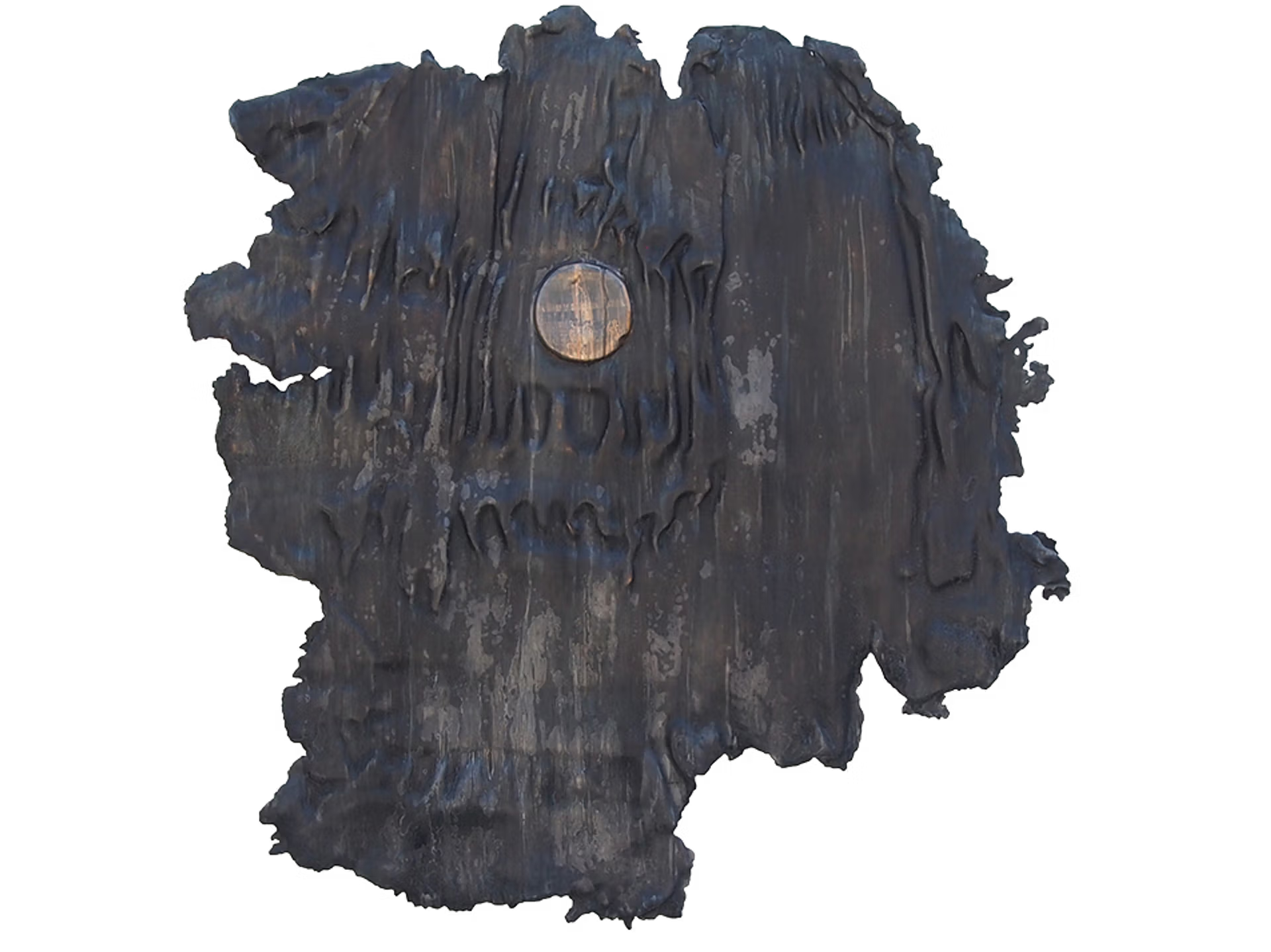
Not Yet Titled (2025)—Allen’s works are deliberately untitled in order to “remain open to multiple readings”
Courtesy of the artist and Perrotin
Materials carry the historical weight of the past while the form points towards the future. The sculpture becomes a site where historical memory and new possibilities coexist. On a geologic level, Allen’s sculptures are materially grounded in the landscape of the Americas (Colorado Yule marble, Guatemalan green quartzite, American walnut burl). Symbolically, they speak of self-realisation. The landscape has a way of slowing things down, recalibrating scale, expanding perception and offering perspective.
What role does poetry play in the exhibition?
The exhibition unfolds as a first-person narrative rather than a third-person critique. Allen’s sculptures are all intentionally Not Yet Titled: they resist fixed interpretation and remain open to multiple readings; they are in a constant state of becoming. Allen thinks in images, not words. The pavilion’s catalogue echoes this first-person structure by including work by seven poets whose deeply personal writing engages landscape, time, memory and perception in ways that resonate in tandem with Allen’s sculpture. Like Allen’s forms, these poems move between the geological and the personal, the ancient and the immediate. Together, they create parallel fields of meaning that each hold a mirror up to our contemporary imaginary.
• Giardini
