


A taut line of rope stretches across the upper register of Winslow Homer’s Saved (1889), an etching made during a period of experiments in printmaking he undertook in the second half of the 1880s. On view in an exhibition at Maine’s Portland Museum of Art (PMA) dedicated to this brief but significant period, Saved is a reworking of his hit oil painting The Life Line (1884) that pares down the earlier canvas to enhance the drama of a rescue at sea. The painting included a billowing sail from the distressed ship against a backdrop of the stable ground of shore. An initial etching hewed more closely to the original, but in Saved, it’s only the rope line that supports the unconscious woman and her rescuer. Carried along by a rescuing device known as the breeches buoy, then only recently developed, the pair hangs suspended against crashing waves and dark rock, all rendered in Homer’s vigorously incised strokes. Marrying two technologies of line—the rescuing rope and the etched mark—Saved anchors curator Ramey Mize’s argument for the importance of etching in Homer’s career.
Winslow Homer: The Life Line, 1884.
Titled “Winslow Homer: Painter, Etcher,” this exhibition begins from a familiar place: Homer’s earliest work in print, including the Civil War reportage published in Harper’s Weekly that made his name. But while Homer left what he called the “treadmill existence” of commercial illustration and promised to make his living from painting in 1875, his return to printmaking in the 1880s shows he remained open to working in a variety of media from both artistic and market-driven perspectives.
Etching was undergoing a revival at the time that Homer took it up, celebrated for its more “artistic” qualities at a moment when photomechanical reproduction could produce a reasonably accurate copy of a painting. (Homer himself had several of his canvases reproduced via photomechanical processes). Though most of his etchings revisit subjects from his paintings, he reworked those subjects to take advantage of the qualities of his new medium.

Winslow Homer: The Life Line etching, 1884/1887.
As with a recent Museum of Fine Arts Boston exhibition that explored Homer’s innovations in watercolor, titled “Of Light and Air”, this show closely examines Homer’s working method, tracking the ways it both varied and stayed consistent as his materials changed. Displaying oil paintings, watercolors, studies, and multiple proofs alongside the full corpus of his etchings, the PMA show allows the viewer to discover the process of etching alongside Homer. Self-taught in the technique (as he was in painting), Homer was actively working through the visual possibilities afforded by the interaction of burin and wax, acid and copper, ink and paper. Done largely at his home studio in Prouts Neck, Maine (now stewarded by the PMA) on copper plates that were shipped back and forth to his printer in New York, the etchings are the product of patient, dedicated labor carried out on the rugged Atlantic coast.
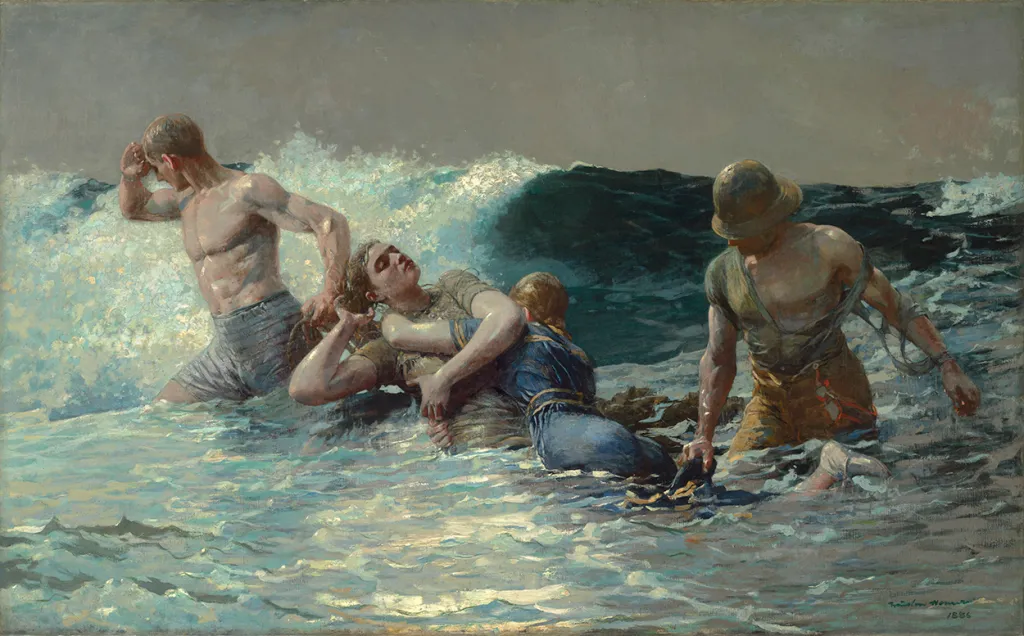
Two Heads (Study after Undertow) (ca. 1886) offers a rare chance to see the artist “sketching” in print. Printed from a plate saved from the dustbin by a handyman who recognized its worth, the sheet shows Homer working through varying thicknesses and densities of line, scraping out areas, adding tone to the plate with sulfur tint, and reserving highlights with stopping-out varnish. It is an example of Homer thinking with his hands, testing out ways of rendering form that are unique to etching.
Winslow Homer: Study for “Undertow”, ca. 1886.
Those discoveries would inform his only etching that did not draw on a prior painting, Fly Fishing, Saranac Lake, (1889). An initial grisaille watercolor features a gentleman fly-fisher—Homer’s ideal client—about to scoop a trout into his net. Translating the watercolor study into print, Homer simplified the background and amplified the weight of the figure. But he preserved the duality of the water, at once reflective and transparent, as well as the shimmering weight of the net and the tension of the line that holds the fish, which hovers just at the surface of the water. Homer annotated the proof with two signatures: on the left “Winslow Homer, Painter,” and on the right, “Winslow Homer, Etcher,” claiming his prowess across media and his investment in both.
“Winslow Homer: Painter, Etcher” is a scholarly show, making a contribution the history of Homer’s art and filling in gaps in his record, especially in its extensive accompanying catalog. But it’s also a show for those who delight in the puzzle of process, who enjoy seeing an artist think through compositional choices. And in this season of reflecting on American revolution, it’s a show for those who want to see a beloved American artist reinventing himself without losing sight of his past.
