


Thomas Zipp, the German punk musician, painter, and installation artist with a relentlessly critical eye, has died. His gallery, Berlin’s Galerie Barbara Thumm, announced the news on social media, writing that he “passed away far too soon.”
“Our thoughts and deepest sympathies are with his family,” the gallery added. “Dear Thomas Zipp, may you rest in peace.”
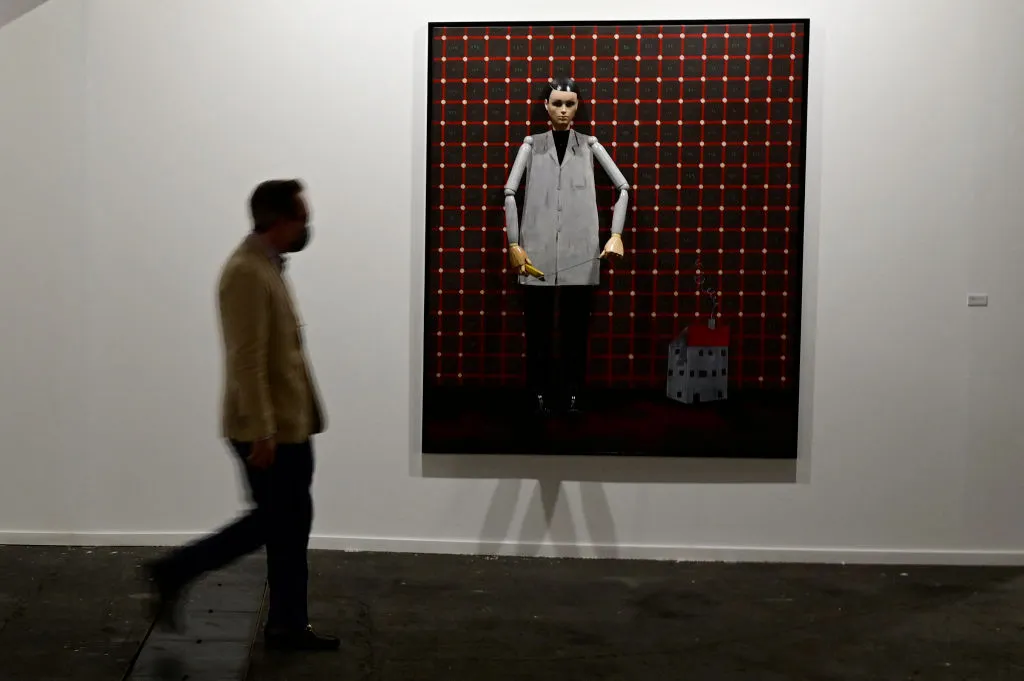
With a zeal for immersion, Zipp reimagined site-specific art as a kind of psychological theater, filling gallery spaces worldwide with multilayered, scenographic installations. Populated by objects and emptied of people, these environments alluded to fields such as religion, medicine, politics, and history, but viewers were asked to make their own meaning from it all, with each encounter yielding a personal constellation.
Handling such weighty concepts, a less deft hand might have lapsed into melodrama. Zipp, however, remained nimble, producing an oeuvre of bizarre institutional satires underpinned by the human compulsion to struggle and create—“the weirdness of mankind”, as he once described it. The same impulse carried him from an intended career in medicine into the wilds of art, he said.
He was born in 1966 in West Germany, five years after the construction of the Berlin Wall began and nearly 20 years after Cold War politics bifurcated the country into the Soviet-aligned German Democratic Republic and the Western-oriented Federal Republic of Germany. Zipp studied at the Städelschule in Frankfurt, where his teachers included Thomas Bayrle. The two shared a fascination with an individual’s sociopolitical agency, and both incorporated grids and repetition into their two-dimensional work, though Zipp gravitated toward painting. Between 1992 and 1998, Zipp studied at the Slade School in London, an apt choice given its curriculum’s renowned emphasis on crossdisciplinary, cutting-edge practices.
Across painting and sculpture, Zipp favored a palette that recalled injuries: scorched umber, ash white and gray, and copious black. Dadaism—a radical, anti-war movement that employed shock and absurdity to challenge social conventions—was a defining influence on his art. He often paired unlikely historical figures: Otto Hahn, the Nobel laureate known as “the father of nuclear chemistry,” and the 15th-century Protestant monk Martin Luther, whose legacy of division Zipp provocatively compared to that of Adolf Hitler.
Though influenced by Dada, he was never entirely deferential to the movement. In his 2008 show “White Dada” at London’s Alison Jacques Gallery, his Dada-like compositions incorporated defaced images from textbook entries on electroconvulsive therapy and non-recreational drugs, suggesting art’s own capacity to sterilize and repackage the radical spirit.
He elaborated on his critique of medical practices for his 2013 Venice Biennale collateral event, in which he transformed the Palazzo Rossini into an uncanny psychiatric hospital. The work’s title, Comparative Investigation about the Disposition of the Width of a Circle, drew on lyrics from David Bowie’s “The Width of a Circle” and Friedrich Nietzsche’s Thus Spoke Zarathustra—which both explore the transcendence of human mortality—in service of its central concern: 18th-century psychiatry and psychoanalysis battles on hysteria. The “circle” referenced in the title evokes the disquieting arc of the spine seen in seizures.
Zipp exhibited widely in his lifetime and occasionally opened exhibitions with performances from his various musical projects. Among the galleries and museums to show his work are the Tate Modern, Transmission Gallery in Glasgow, Kassel’s Fridericianum museum, and the Hamburger Bahnhof in Berlin.
