






Rewriting part of its staff recommendations, and dismissing decades of precedent and its own lawyers’ findings, the National Capital Planning Commission (NCPC) voted on Thursday (9 July) to approve the site plan for one of President Donald Trump’s pet projects, a 250ft-tall triumphal arch at Memorial Circle in Washington, DC.
While the NCPC executive director’s report originally found that the arch needed to comply with the 1910 Height of Buildings Act, which caps the height of any construction in the city to 130ft, the commission’s chair, Will Scharf (who also serves as White House staff secretary), moved to strike those statements from the document and added a note that the panel would be considering the application of the law on federal projects during its next meeting in September. Most of the commission, made up largely of Trump administration appointees, voted to support Scharf’s motion and cleared the arch project through preliminary review.
As part of the executive director’s report—written and researched by staff who are not political appointees—the NCPC’s general counsel, Meghan Hottel-Cox, included a memo outlining the agency’s decades-long policy asserting that the Height of Buildings Act applied to federal projects.
“Because the [act] has been a key limiting principle since at least 1938 for federal projects in the District of Columbia, there are potential impacts that could stem from a reversal of NCPC’s position that the [act] binds federal projects,” Hottel-Cox wrote. “If the [act] no longer applies to federal property in the District, it could fundamentally reshape the city’s architectural fabric, the balance of local vs. federal authority, and the visual character of the nation’s capital.”
Many members of the public who spoke at the meeting raised similar concerns. The Height of Buildings Act ensures “a capital city beloved for its low horizontal skyline that rightly emphasises the US Capitol Building and the Washington Monument”, wrote Rob Nieweg of the National Trust for Historic Preservation in a comment submitted to the commission. “Abandoning this approach now would upend a consistent urban planning principle that has been a century in the making.”
In its memo to the commission, the Department of the Interior, which is managing the arch project, described the Height of Buildings Act as “just a local zoning ordinance” that does not apply to construction led by the federal government. But commissioner Evan Cash, who was the sole member of the NCPC to vote against the site plan and the amendment to the staff report, called this argument “staggering” during the meeting.
“It is an act of congress legislating for the nation’s capital at a time when congress directly controlled the District’s government in 1910,” he said, warning that the commission’s decision about the arch could “change the ground rules for every future federal project” in Washington, DC. “I’m not willing to lend my vote to plans that could have the effect of upending decades of NCPC practice and the century-old height framework, all without congressional authorisation or a commemorative works process, for a project that—as far as I can tell—has only one real advocate, and that advocate is not congress.”
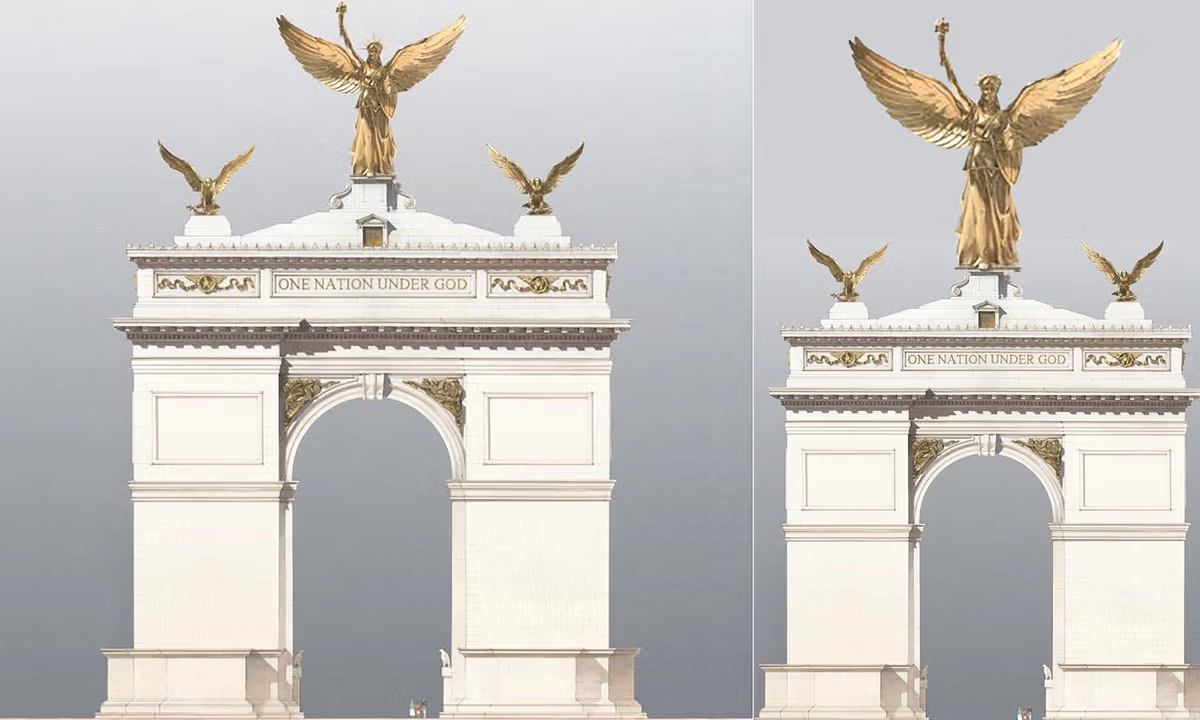
To skirt the issue, NCPC staff initially recommended that the proportions of the arch be adjusted by shortening its height, including the observation deck, to 150ft total—counting the top level as a “penthouse”, which is allowed thanks to a 2014 modification to the law.
To keep the overall size of the project at 250ft, based on the Trump administration’s stated goal of honouring the country’s semiquincentennial, the report suggested that the gilded statuary “or other architectural embellishments” at the top could then be increased to 100ft, turning the arch into a very fancy plinth. (The Art Newspaper created a comparison approximating the new proportions based on a rendering in the report, above.) If the NCPC’s policy over the Height of Buildings Act is reconsidered, however, this option would be moot.
Several speakers also voiced their support for an alternative site for the arch near the city’s athletic fields near the Anacostia River waterfront, suggested by Washington, DC’s historic preservation officer David Maloney as part of the project’s review consultation process. But so far, Trump has been fixated on building the arch at Memorial Circle, despite its proximity to Arlington National Cemetery, the nation’s most important military burial ground. A group of Vietnam War veterans has sued to block the arch’s construction, saying it disrespects hallowed ground, a sentiment echoed by many members of the public who spoke at the NCPC meeting and have family and friends buried at the cemetery.
Utah State Capitol, Salt Lake City Photo: Scott Catron, via Wikimedia Commons
Memorial arch fever spreads to Utah
Meanwhile, another proposal for a monumental arch to be built in Salt Lake City, Utah, is raising similar concerns among residents because of its swift approval without public input.
A $55m, 38ft-tall and 60ft-wide bronze Grand Liberty Arch by the New York-based artist Sabin Howard was quickly approved by the city’s Capitol Preservation Board in May so it could be complete in time for the 2034 Winter Olympics in Salt Lake City, according to The Salt Lake City Tribune. But the Capitol Hill Neighborhood Council, organised by residents of the district where the arch would be built, recently voted to file formal complaints against the project. The council is asking the city and county governments, as well as the Utah Department of Transportation, to reconsider.
Jonathan Bruns, the chair of the neighborhood council, told the Tribune that residents are not opposed to projects celebrating history, “but they are surprised and upset about the process”. Monuments built near the Utah State Capitol are meant to honour the state in some way, the local resident Glen McBride said, “and this statue is just not that”. He added that the design was “overtly political” and seemed to cater to Trump’s over-the-top tastes.
State representative Jennifer Dailey-Provost, who serves on the preservation board and approved the project, said she was “distressed” about the outcome and that it was not clear to her that the vote had been final. She plans to share a survey of residents to the board at its next meeting, including their complaints about its scale and concerns that some of the depictions of people from history on the arch may appear racist. “It is not something they will feel proud of right in the middle of our neighbourhood,” Dailey-Provost said.


