


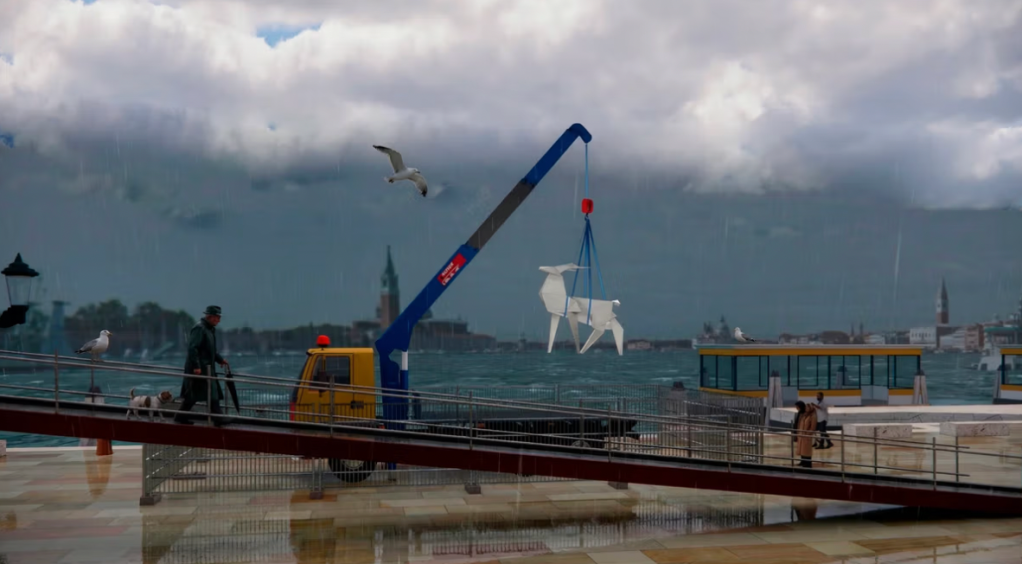
The Ukrainian Pavilion at this year’s Venice Biennale will take aim at a question that has haunted the country for decades: what are security guarantees worth? According to an announcement made in Kyiv on February 5, the pavilion will focus on the failure of international promises to protect Ukraine.
Titled “Security Guarantees,” the project refers to the 1994 Budapest Memorandum, an agreement signed by Ukraine, the UK, the US, and Russia, under which Ukraine gave up its nuclear arsenal in exchange for assurances of protection. “Thirty years ago, Ukraine gave up its nuclear weapons and signed documents that promised security,” says Zhanna Kadyrova, the artist representing Ukraine at Venice. “These guarantees were supposed to protect us. But they existed only on paper.”
At the center of the pavilion will be Kadyrova’s Origami Deer, a concrete sculpture that has itself been shaped by the war. First installed in 2019 in a park in Pokrovsk in eastern Ukraine’s Donetsk region, the work was dismantled and moved across the country in 2024 as the Russian frontline drew closer.
In Venice, Origami Deer is expected to hang from a crane mounted on a truck parked along the lagoon embankment, though discussions with authorities are still ongoing. In its suspended state, the sculpture mirrors the uncertainty of life in Ukraine today. As a project statement puts it, the work has been “forced to leave its pedestal” and is now “wandering the world.”
Inside the Ukrainian Pavilion at the Arsenale, the exhibition will include archival material related to the Budapest Memorandum, alongside a multi-channel video installation tracing the sculpture’s journey through Ukrainian cities and across Europe. Ahead of the biennale, Origami Deer will travel to Warsaw, Vienna, Prague, Berlin, Brussels, and Paris.
The sculpture’s original pedestal adds another layer to its meaning. It was made from a dismantled Soviet-era aircraft designed to carry nuclear weapons. When the situation in Donetsk deteriorated, the work was relocated by Kadyrova with the help of specialists, municipal workers from Pokrovsk, and the NGO Museum Open for Renovation.
“That aircraft represented military power and a militarized state,” Kadyrova said. “We changed its shape and added concrete elements, and it became a contemporary art sculpture. When the evacuation of people started, the sculpture was evacuated too.” She describes how Origami Deer was cut free from its base, lifted by crane, and moved to safer cities along the same routes as civilians fleeing the fighting. “The object carries this history with it,” she adds. “It is no longer just an art object. It contains the experience of evacuation and movement.”
Kadyrova describes the war as “a black hole” and says international support has not been enough. Beyond the front lines, she noted, daily life in Ukrainian cities remains deeply affected. She also points to the imbalance in cultural messaging. “Russia has more instruments to produce propaganda and fake news,” she says. “Some cultural projects function as political propaganda. Because of that, Ukraine has fewer possibilities to communicate reality.”
For Tetyana Berezhna, commissioner of the Ukrainian Pavilion, Venice offers a crucial platform to raise these issues. “Here Ukraine takes on the role of saying: look, security guarantees don’t work,” she said at the pavilion’s announcement in Kyiv. “The world must review them.”
The Ukrainian Pavilion at 2024’s Venice Biennale also addressed Russia’s invasion. Titled “Net Making,” it was inspired by Ukrainian civilians seemingly mobilizing overnight and weaving camouflage nets to shield Ukrainian defenders. In church basements and museums, these volunteers twisted together strips of dark fabric and rags.
