


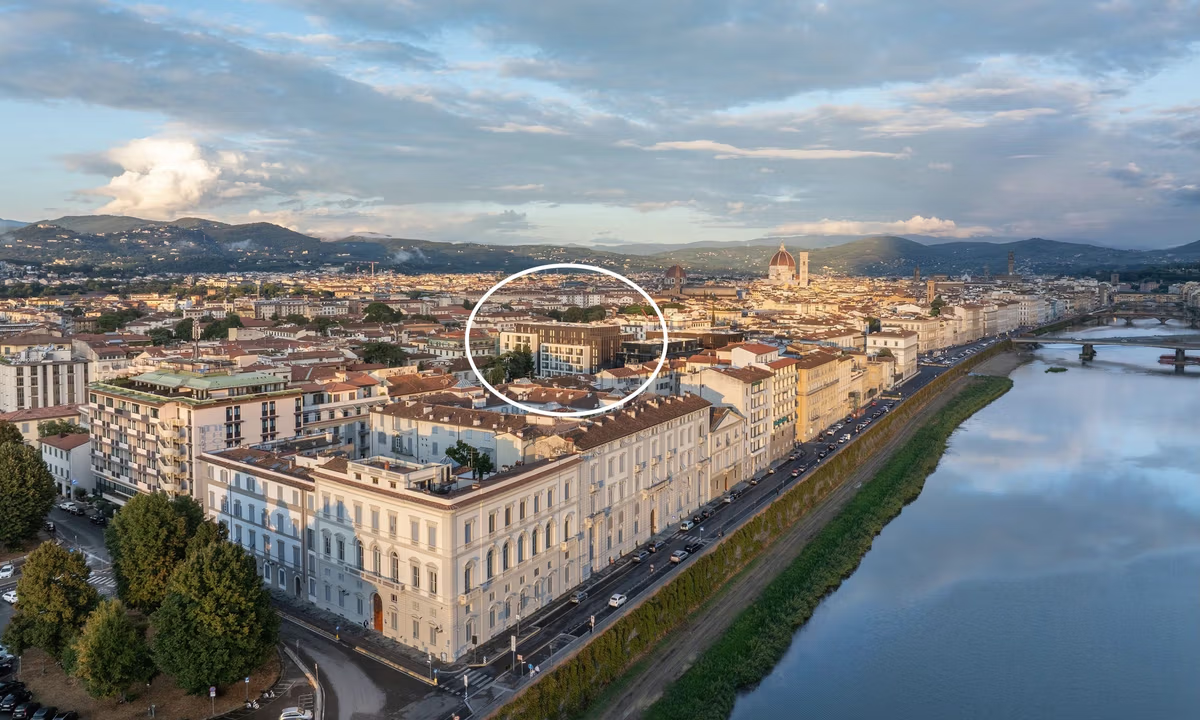
Unesco is reviewing the redevelopment of Florence’s former opera house following complaints that the controversial project widely dubbed the “black cube” has blighted the Renaissance city’s skyline, The Art Newspaper has learned.
The redevelopment has become one of the most divisive building projects in recent Florentine history. Images of a dark-coloured block rising behind the former theatre’s surviving Neo-Classical façade circulated widely online after completion, prompting protests, widespread criticism and a criminal investigation into 15 people involved in the project.
A Unesco spokesperson says the organisation was assessing whether the redevelopment is compatible with Florence’s World Heritage status. The city’s historic centre was inscribed on the World Heritage List in 1982 in part for the “exceptional manner” and “unique coherence” with which it expresses Florence’s power as a merchant city during the medieval and Renaissance periods.
“Unesco is aware of the redevelopment of the former Teatro Comunale in Florence,” the spokesperson says in a statement to The Art Newspaper. “The project is currently under review by the World Heritage Centre in close consultation with the Advisory Bodies to the World Heritage Committee.” The spokesperson notes that Unesco’s operational guidelines require that “any project planned for a World Heritage site must ensure that it does not have an irreversible impact on the attributes that justified its inscription on the World Heritage List”.
They add that removal from the World Heritage List is “an exceptional measure of last resort”. Unesco would normally first engage in “in-depth dialogue” with national authorities to identify measures needed to address any threats, including possible inscription on the List of World Heritage in Danger. “Unesco will continue to work in close co-operation with the Italian authorities to support conservation efforts and to identify appropriate preventive and corrective measures where necessary,” the spokesperson says.
Growing opposition
Most of the former opera house was demolished in 2021 after years of disuse, leaving only its cream-coloured façade standing. Last year, the Milan-based architect Vittorio Grassi unveiled a redevelopment of luxury apartments. The scheme includes a nearly 30m-high dark structure rising behind the theatre’s façade and two additional white residential blocks topped by black upper storeys.
Opposition to the project has intensified in recent months, with protesters gathering outside the former theatre in December. They carried flares and banners, with some constructing piles of cardboard black cubes.
Eike Schmidt, the former director of the Uffizi who now leads Florence’s opposition councillors while also directing Naples’s Museo di Capodimonte, was reported by Italian media to be considering a complaint to Unesco.
Contacted by The Art Newspaper, Schmidt says he has not filed a complaint, suggesting formal communication was unnecessary given the extensive media attention. “Unesco per their own by-laws is required to monitor, so the only thing that’s needed is that something comes to their attention, with or without a formal complaint,” he says.
Prosecutors are investigating 15 people—including Grassi, senior Florence planning officials and heritage authorities—over the transformation of the 19th-century theatre into a luxury residential complex on the edge of the city’s historic centre. Investigators are examining whether parts of the project exceeded authorised height limits, whether heritage approvals complied with planning regulations and whether officials were pressured into approving the scheme. Those under investigation are accused of forgery, planning offences and violations of Italy’s cultural heritage and landscape code. Grassi’s studio declined to comment.
‘Something bad, something horrible’
Plans submitted by the architect Marco Casamonti, who was initially assigned the project, envisaged a predominantly residential complex clad in pale stone. The proposal was approved by Florence city authorities in 2018 but rejected by heritage officials in May 2020. Four months later, however, a redesigned scheme received approval from the soprintendenza, despite the completed project differing substantially from the version originally authorised by the council.
The finished development includes 156 apartments for short- and medium-term stays operated by Starhotels, the Florence-based hotel group, and a further 30 apartments offered for sale.
The residents’ campaign group Salviamo Firenze says the redevelopment exemplifies a broader transformation of Florence’s historic centre into an investment asset. Massimo Torelli, the group’s spokesperson, tells The Art Newspaper that 300,000 sq. m of property within a 1.5km radius of Florence’s Duomo had been converted for tourism and investment-driven uses. “The Florence model has been very subservient to major interests and very harsh towards residents,” he says. “The black cube is becoming a figure of speech for something bad, something horrible.”
Salviamo Firenze has criticised Stefania Fanfani, the civil servant who has led the city’s urban planning office for the past 17 years, accusing her in an op-ed on the website of perUnaltracittà, a local association and political think tank, of playing a central role in planning decisions that encouraged the commercialisation of the city centre.
Fanfani declined to comment, saying she did not believe it would be “appropriate” to do so while the investigation remained ongoing.
Caterina Biti, Florence’s councillor for urban planning, defends Fanfani in a statement sent to The Art Newspaper: “It is unacceptable that anyone should speak in such terms and make unspeakable personal attacks against the professionals who run our local council’s departments—professionals who have long been recognised for the high quality of their work.”
