


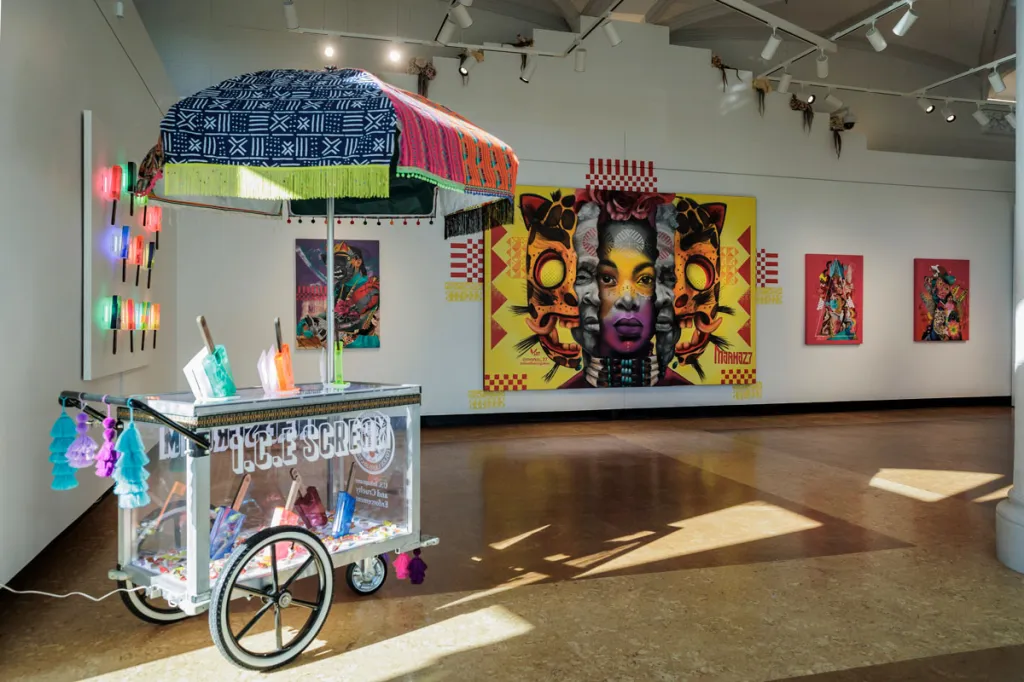
Members of the faculty of College of Visual Arts and Design (CVAD) at the University of North Texas (UNT) released an open letter on Friday objecting to the cancelation of a solo exhibition of artist Victor “Marka27” Quiñonez.
In the letter, which was addressed to the “Office of the President and University Leadership, University of North Texas,” the faculty said that they “strongly object to the abrupt and unexplained cancellation” of Quiñonez’s exhibition, adding, “The removal of legally protected artistic expression from a university gallery contradicts the institution’s own commitments to academic freedom, constitutional principles, and the open exchange of ideas fundamental to higher education.”
The letter cites three UNT policies regarding freedom of expression on campus, including its “Academic Freedom and Academic Responsibility,” which was last updated in 2024 and says “it is not the proper role of the University to attempt to shield individuals from ideas and opinions they find unwelcome, disagreeable, or even deeply offensive,” as well as a policy stating that the university “does not discriminate against works of art based on its content or the viewpoint(s) expressed.”
UNT has still not officially given a reason for the exhibition’s cancelation, and its office of communications has not provided comment to multiple publications, including ARTnews, beyond confirming the exhibition’s closure. (A request for comment sent on Tuesday regarding the faculty letter also went unanswered.)
But, Quiñonez told ARTnews that he had received an anonymous email from someone claiming to be a UNT employee who said that the exhibition was closed because his work included anti-ICE content. If that’s the case, Quiñonez said, he views the closure as censorship, adding, “Unfortunately, I’m not the first artist to be censored, and I won’t be the last. It’s a direct violation of freedom of speech.”
Without directly calling the exhibition’s closure a form of censorship, the CVAD faculty’s letter says, “When a completed, approved exhibition can disappear overnight, it raises urgent questions about whose voices are vulnerable, whose stories are treated as conditional, and whose work may be erased without dialogue. When such an exhibition centers the lived experience of a marginalized community, its unexplained removal signals that certain voices are more easily set aside within our institutional spaces, and that artists are disposable. As a faculty community, we reject this implication and affirm the University’s responsibility to protect the expression and dignity of those whose histories and identities have too often been rendered invisible.”
The CVAD faculty also called for UNT leadership “to explain the rationale and decision-making process that led to the cancellation of this exhibition, to demonstrate how that decision aligns with constitutional protections and university policy, and to reaffirm its commitment to academic freedom, artistic expression, and the public trust entrusted to it.”
The CVAD faculty letter also noted that UNT is federally designated as a Hispanic-Serving Institution, meaning that its student population is at least 25 percent Hispanic or Latinx. (UNT’s is 30 percent.) “That designation,” the letter reads, “reflects not only enrollment metrics, but an institutional responsibility to support, protect, and meaningfully engage the communities such a designation represents. When an exhibition rooted in Latino cultural experience is removed without explanation, it undermines that responsibility and the trust it implies.”
News of the closure and cancelation of Quiñonez’s show at UNT’s CVAD Gallery, which had debuted at the Boston University Art Galleries last fall, broke last week. The exhibition reportedly opened on February 3 but was soon closed afterward, with the gallery’s blinds being drawn and the doors locked.
Quiñonez told ARTnews that his communication with CVAD Gallery director Stefanie Dlugosz-Acton ceased around this time and it wasn’t until UNT students began reaching out to him asking about when the show would open and then sending documentation of the gallery’s closure that he was alerted to something being wrong. Then on February 11, Dlugosz-Acton sent Quiñonez a brief email stating that UNT had “has terminated the art loan agreement with Boston University Art Galleries” and was in the process of returning his work.
Quiñonez said that the exhibition’s closure had in a way reaffirmed the importance of his work: “if artists are producing work that is expressing the truth and showing people a narrative that is speaking up against any kind of indecency or any kind of violence toward other humans, then that truth is worth telling—even if it’s being suppressed.”
The faculty’s letter seems to echo that sentiment, stating, “Universities exist, at their best, as places where ideas are encountered rather than concealed. Art, particularly art that engages questions of identity, belonging, and lived experience, is not ornamental. It asks something of us. It invites reflection, disagreement, curiosity, and growth. These are not disruptions to be avoided; they are central to the work of education.”
