


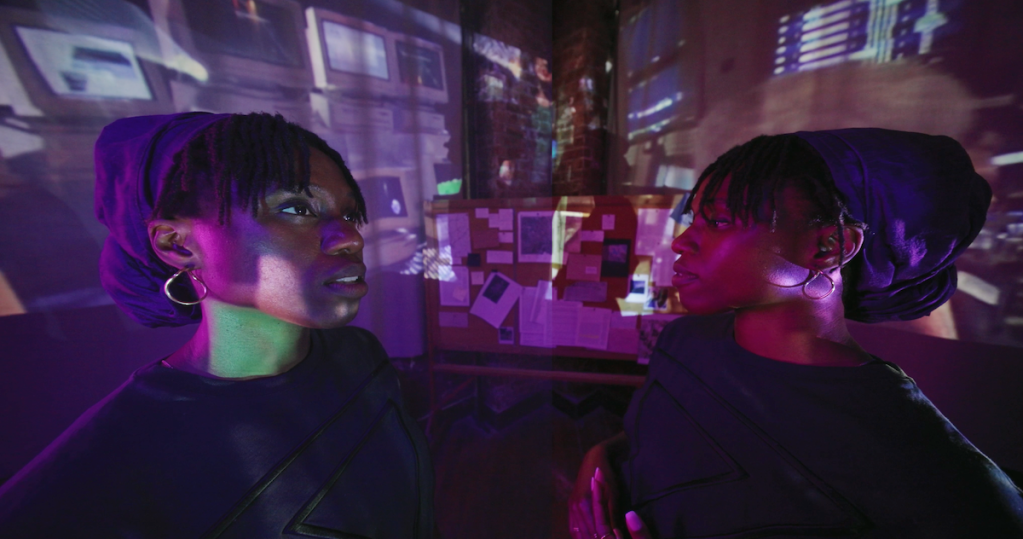
When I visited her Brooklyn studio, Mimi Ọnụọha was working beneath a handwritten sign that read what we don’t talk about. That phrase came to her while making new work for a show that opened in late November at the Vienna Secession, but it also speaks well for nearly all Ọnụọha’s multimedia works, which incisively contend with all that datasets contain—and all that they leave out.
Starting in 2019, Ọnụọha began working closely with Patrick Ball, a statistician with the Human Rights Data Analysis Group, to investigate the bodies of 95 Black people discovered in a grave in Sugar Land, Texas, where Ọnụọha was raised. These people were victims of the convict-leasing program of the late 19th and early 20th centuries, in which Southern states allowed former plantations and private companies to use inmates for harsh forms of labor. Locals had suspected such a grave existed, but they had no proof until 2018, when archaeologists made the discovery. “I was very interested in what forms of evidence can break through,” she told me. “Remains, you can’t really deny those.”
Ọnụọha built a machine learning model to estimate the likelihood and locations of other unexcavated convict-leasing mass burial sites. With a team of researchers, she began collecting data on such sites from archives, community databases, and oral histories before feeding it to the AI. Now she is displaying the results of her findings in Ground Truths, a video for the Vienna Secession show.
That work, along with many others by Ọnụọha, implies that missing information is one means by which racism becomes systemic. Her 2016 project The Library of Missing Datasets suggested as much: Visitors could pull open stacks of drawers to find folders labeled with phrases like “White children adopted by POC” and “Muslim mosques/communities surveilled by the FBI/CIA.” These folders contained no documents whatsoever because Ọnụọha was unable to find the information she sought. The year afterward, in a GitHub post, she dubbed these lacunae a form of “algorithmic violence,” which she defined as “violence that an algorithm or automated decision-making system inflicts by preventing people from meeting their basic needs.”
Mimi Ọnụọha: The Library of Missing Datasets, 2016.
Photo Brandon Schulman
Ọnụọha told me that she had been aware of algorithmic violence from a young age, before finding the vocabulary to describe it. Born in 1989 in Parma, Italy, she was raised in the suburbs of Houston, where she grew up browsing an internet that felt both “expansive” and like a “walled garden,” as she put it—its borders drawn by the corporations who ruled it. When she attended Princeton University’s anthropology program as an undergraduate, she started to think of everything as a system with the power to both include and exclude, and went on to develop an interest in technology’s sociopolitical ramifications. In the mid-2010s, she published her writings on data in publications such as Quartz and National Geographic, but these pieces exceeded the bounds of impartial, investigative journalism, dealing with facts as well as her responses to them. She came to realize that these articles were in fact closer to art than reporting, and she began producing her first artworks not long afterward.
These days, she is searching for something more “visceral,” she told me. The Cloth in the Cable (2022) pays homage to Ala, an Igbo goddess whom Ọnụọha honored by knotting together internet cables and seeding them with fragrant spices—“a healing gesture,” she explained. Ground Truths features Ọnụọha herself, playing a character who contends with new knowledge about the possible existence of other graves filled with Black inmates. Putting herself in the video, Ọnụọha ensured that her research was not only cerebral, but embodied.
