


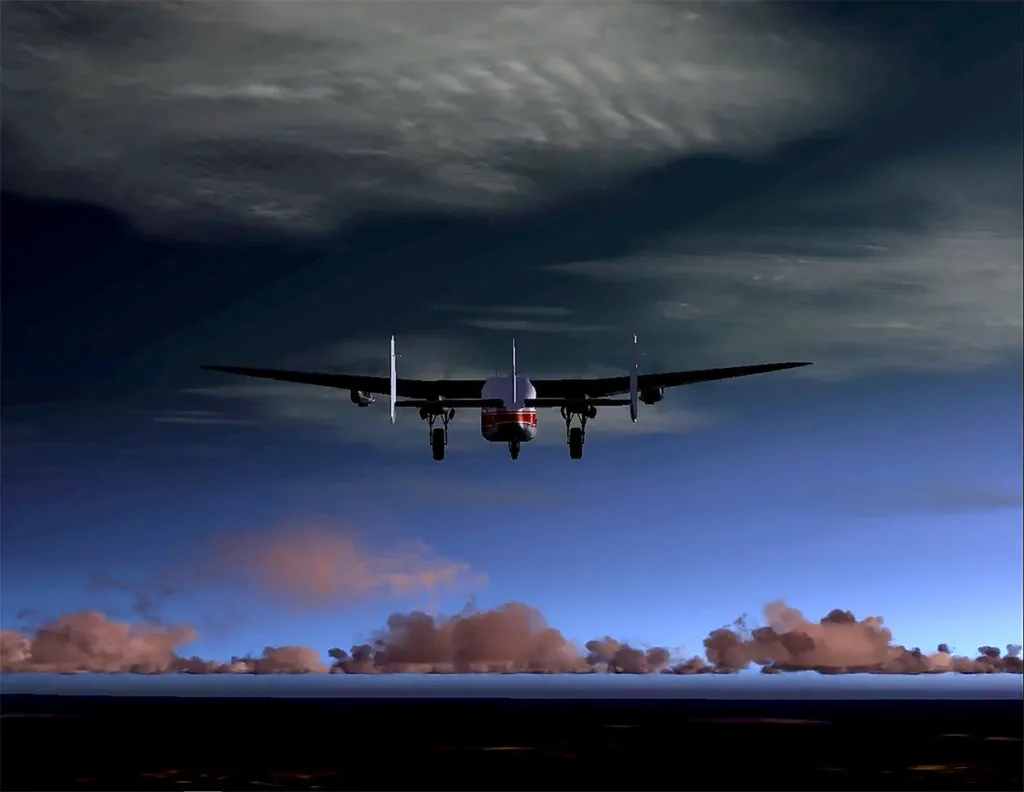
‟The stewardess has a recurring dream of her airplane soaring / through a milky veil of rotating clouds / Clouds of memory, clouds of erasure, / Clouds blurring the view of her homeland below,” says Peggy Ahwesh in the poetic yet pointed voiceover anchoring her solo exhibition ‟The Wayfinders,” recently on view at New York’s Microscope Gallery. Ahwesh (b. 1954) is an icon of experimental film and forerunner in avant-garde digital animation whose traveling 2021 survey ‟Vision Machines” was received with great acclaim. Her latest show marked a pivot: in a first for the filmmaker, the new large-scale installation assembles both original footage and animated clips captured in an early-2000s flight simulator. She shapes it all into an elegy for Palestine’s thwarted right to the sky.
At its center is the abandoned Qalandia/Atarot airport, situated between the town of Qalandia and Jerusalem. Built by the British during the British Mandate in 1924 as a military airfield, it operated as a civilian airport from 1948 to 1967, until Israel annexed the site and renamed it Atarot. Hovering somewhere between ruin and monument, it marks a moment when Palestine’s borders were porous—unlike today, when life and death can hinge on a settler’s whims. Where does the border end? The show suggests: wherever the day decides. Where Ahwesh’s imagery shows contemporary modes of travel, her voiceover reflects on the long history of navigation that relies on the stars. With the airport in disrepair and drones behind the clouds, the only escape for the confined heart is upward, along a gentler, cosmic corridor.
If you don’t mind beginning with a personal question: You’re Syrian and Irish; where in Syria is your family from?
My family is from near Homs. It’s a village called Habnemra.
In the Christian Valley, right?
In the Christian Valley, yes. I think my relatives lived in the Krak de Chevalier [a medieval castle] for a couple of centuries, but now they live in the valley area immediately around it. I’ve been there a couple times. I have a cousin who’s quite elderly, who worked at the Krak; he was a poor guy in the old days. It’s a super interesting collision between my family and the culture there. With the war, you know—it’s complicated.
People tell me that the Christian Valley is left alone; it wasn’t the center of the conflict. My relatives tell me they lost a couple of people from the village, but basically, they just kept their heads down.
My dad’s family is from the Valley, too. We have a big, old, framed poster of the Krak at our house, and we went all the time to the restaurant in Allentown. You probably know it, the Damascus?
Yeah, of course.
If you remember, the restaurant has framed the same sort of vintage pictures of Syria. It all reminds me of the themes of “Wayfinders”: travel, simulation, and cultural memory. Seeing it, I felt like I was growing up in a simulation of a place that had long left behind the moment that picture was taken.
You’ve spoken previously about the idea of ‟internalized borders.” Is that how you view yourself, carrying the baggage of these borders?
Yes, absolutely. There are a couple of relics within my clan, objects that have all this extra meaning. Like, I have this Syrian lamp: brass and punctured with holes, with a little fringe. Somebody probably brought it from Syria in the 1920s; it’s old. My sister had it, and I always thought, ‘Well, good, she’s not going to fuck it up.’ (I’d probably get it ruined.) But recently, I got it back, and I brought it to a very fancy place in Brooklyn for a photogrammetry [3D imaging] thing; the sort of expensive place where they set up all the cameras for you.
So, I have these really beautiful images that I’ve never shown of the lamp breaking down into these abstract versions of itself, the sort used for video games. One’s metal, one’s kind of neutral, and one’s all kinds of white. You’re supposed to put them back together in a video game. But the actual lamp—I’ve wondered about passing it down: Who the heck is going to care for it after me?
When I was living in the West Bank, I was teaching at Bard’s program there. All the kids are local; they’re from Ramallah and Jerusalem. They don’t travel, they’re stuck there, but they had this idea that they are Bard students. They had this idea of upstate New York and what it’d be like to be with their peers.
So, where exactly did ‟The Wayfinders” begin for you? In your past, or in our present? It’s easy to think of modern entry points for it: the archival and archaeological destruction of Syria and Palestine; the weaponization of mobility in Gaza.
I’ve stewed about being American and making work about these concepts, about having lived there and knowing the reality of what it’s like there, which is terrible: poverty-stricken, and just really, really complicated. And my privilege, too. I’ve been going to the area basically since the ’80s. I’ve traveled to the Middle East with my family, to visit relatives or to look around.
Peggy Ahwesh, installation view of “The Wayfinders,” at Microscope Gallery, New York.
But my entry to [‟Wayfinders”]? I have footage I shot in 2011, when I lived there, of this abandoned airport near Ramallah. And it’s just a perfect graph of the contested land, the borders, the occupation. In Palestine, those concepts are articulated in such a dramatic, frightening way. So I broke into this airport with a friend. I didn’t want to make a documentary; I wasn’t interested in that. I used to shoot very quotidian Super 8 movies, people just confessing their problems. So I flipped over to working with a Harun Farocki kind of image that is processed, with all this inlaid material from corporations, the government, or the dominant state. It sends me into a terrain that allows me to be more philosophical. Farocki has a term for it: ‟operational images.”
Recently, I was poking around, and I found renders of the airport done by some guy for this flight sim program. I don’t know if you’ve ever flown around on one of these.
I’ve played with one; it’s not easy.
It’s basically a video game, but it’s serious. You have a joystick, and you have to know how to fly a little bit, or else you’re going to crash. I’m fascinated by this community of dudes around it—it’s all men.
Anyway, this one guy, Tom, who lives in Ohio, had designed what he calls ‟sceneries.” He set them all at the airports around Jerusalem, Aleppo, and Amman as they looked in 1962. You get a little zip, pop it open, and it has a ‘read me’ that is long and complicated.
Sometimes they’re very complicated: they list the different buildings they’re trying to represent, but it’s very funky; just a little box with a little roof on it. Still, I appreciated the information, and I appreciated that he did these renderings of my airport, and it was a really good representation of a place I had been in. I thought the game would be a really great vehicle to talk about the region and talk about the situation without being whiny; it freed me to be able to talk about it at an angle to the situation.
How would you describe that angle?
I’m not attacking any particular person. I’m talking about a space of freedom that’s in a person and allows for a specific kind of expression, something maybe all viewers could identify with.
Several times in the past, I worked with images of people, and I described these images—well, you could call them ‟poor images,” somewhere between mass production and access. I could have used a much more recent program; this one is from 2004. My brother-in-law is a retired pilot, so he plays the flight sim, but he uses a really recent version of the program that connects to Google Earth. But that didn’t leave a space for the sort of philosophical investigation I was interested in, or the ability to enter the image ambiently. I don’t have the answers, but I pose questions and situations that allow for critique of the situation.
Some of the simulations are from a first-person perspective. You don’t provide obvious physical indicators that you’re piloting, like gears or levers. Why remove the body from the project?
I really resist autobiography. It’s something I have avoided most of my so-called ‟career.” For me, it’s just very essentializing. It’s tricky, and I think where the viewer enters has a lot to do with the editing. It’s like a first-person shooter game; that’s how they participate. I wanted my view to be every person’s view: wherever your imagination takes you outside the plane.

Peggy Ahwesh, installation view of “The Wayfinders,” at Microscope Gallery, New York.
Do you play video games? I kept thinking about how in RPGs, movement between checkpoints can change the character entirely; the word and idea of course recalling the danger of travel within Palestine. Even the title “The Wayfinders” brought to mind this Dungeons & Dragons artifact—a compass activated by imagination.
Oh interesting. I’m not really a gamer, but I’ve made work by playing games and recorded the screen. For a 2001 work Shape Up I recorded hours of footage while playing Tomb Raider obsessively for a whole summer. Then I constructed a 15-minute video from the material, sort of about this figure, Laura Croft, who’s the main character in this game. And I give her a certain kind of agency; she’s in every shot, but she’s this female CGI thing, this construction.
“Wayfinders” relates to that in a pretty serious way. But also, it refers to an anthropologist who wrote a book about ancient cultures and cosmology, and issues of navigation within ancient cultures, and how that might be useful to us now with navigation, as with the compass.
It’s fascinating to think about technology like cosmic navigation systems that is so old and obscure to anyone outside the culture that it appears magical, especially when juxtaposed against modern, or recently obsolete settings and means, as “Wayfinders” does.
I worked on “Wayfinders“ with my friend Marianne Shaneen, who wrote the text. She was the one who first pointed me toward early navigational systems in pre-Islamic cultures and Arab cultures, so I ran with that. And it became a beautiful motif throughout the piece. The work flows malleably between past and future. Doing research for the project, I was like, Wow, right now, there’s a lot of Arab science fiction with a lot of future-bending. Speculation about the future: it’s like a lot of Middle Eastern people aren’t allowed to go there, which makes it a really important kind of imagination: Whether it’s imagining that one day you’ll reclaim your original land, or that one day you’ll get on a spaceship.
Peggy Ahwesh, installation view of “The Wayfinders,” at Microscope Gallery, New York.
Can you talk about the importance of naming and renaming in the context of “Wayfinders”?
Totally. The airport was really cool in its heyday. People would fly in and out under the Jordanians, movie stars would use it, and the stewardesses wore those cultural little outfits. It was almost normal. It was called the Jerusalem airport. And then the Israelis took it over, and they called it Atarot, after some village that got emptied in the 40s. Israelis always manage to find some tit-for-tat, some sort of equivalence, like, ‘Oh, we displaced you people, but you displaced us.’
I knew a lady who lived in a high-rise in Ramallah that overlooked the airport. I didn’t even know it was an airport; it’s just this big patch of land that you can’t go on that has been occupied. She explained to me the whole thing about the airport, affectionately called Qalandia, though sometimes people call it Jerusalem. It’s like this big triangle, and at the end is the checkpoint, and then there’s Qalandia village, and then Qalandia refugee camp, and then the airport. Anybody who lives around there would conflate the refugee camp with the neighborhood, with the checkpoint, with the airport.
Do you consider renaming in this case an act of violence?
Yes. You can get very confused being in West Jerusalem, because they have taken away all the Arab names of everything, so clinging to the language is one of the things people do, to keep the culture intact. The neighborhood of Qalandia is on the West Bank side of the wall; those people pay Jerusalem taxes but don’t get any services. There’s no garbage pickup, and the water isn’t treated.
I read interviews with Palestinians recalling their childhood memories of the airport, when they could fly from it to Jordan or Lebanon, or singers would come to Palestine and perform at the airport. They mourned the sense of optimism and adventure the airport offered.
When I taught at Bard in the West Bank, it was in a place that used to be a suburb of Jerusalem, but then the separation wall went up, and it became an isolated bunch of houses. A really, really tough place. It has no government, so there’s no trash pickup. Most of the students live with their parents. I’m so glad there’s such a thing as the internet and digital culture, because that freed their minds to expand. If it weren’t for their phones and their ability to travel virtually, it would just be ‘Mom, what’s for dinner?’
It’s like how from our phones, we can see the war, not that we could stop it. But to be able to see the war, that’s what got politicians freaking out over that we got the wrong idea about what’s happening in Gaza as Israel lost control of the narrative. I have a lot of hope in this generation that expanding their virtual horizons will expand their imaginations, and so their community.
