


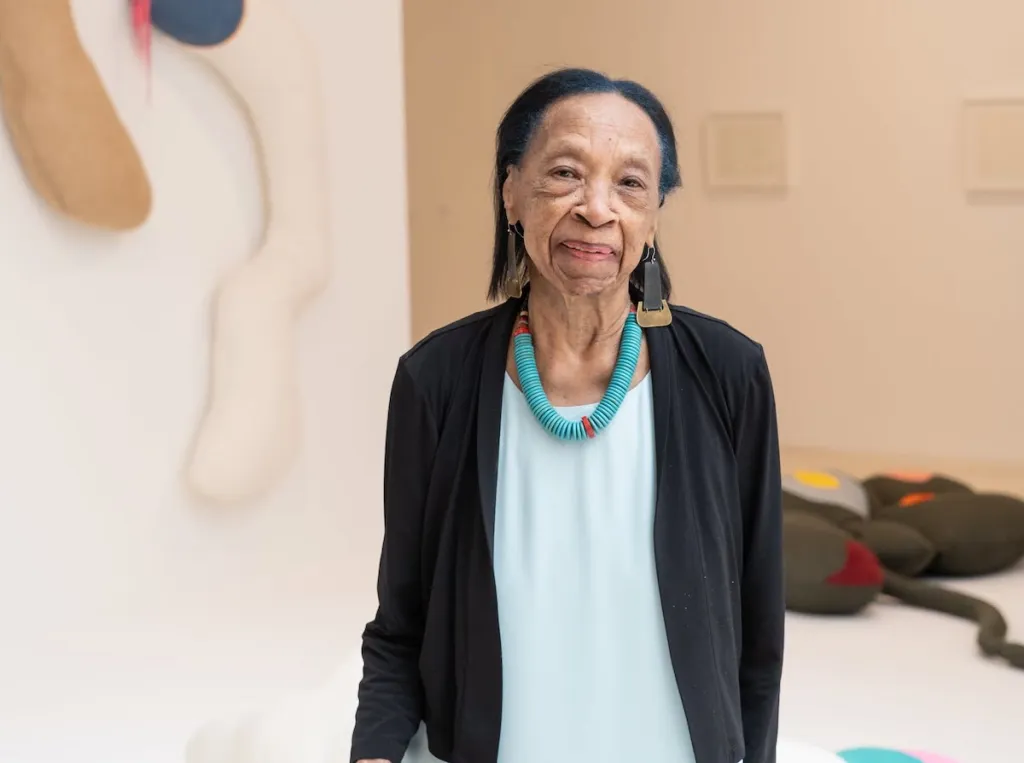
Valerie Brathwaite, an artist whose sculptures utilized sinuous forms that intentionally recall both geographic formations and curvaceous bodies, died on Monday. The news was announced via the artist’s Instagram page, whose bio memorably terms her a “Sculptress & Dj.” She was either 87 or 88.
In the second half of the 20th century, Brathwaite rose to become one of the most important artists working in Venezuela. Working in ceramic, drawing, and less classifiable mediums, the Caracas-based artist produced abstractions that drew parallels between bodies and landscapes, showing that the two were always intimately related.
Her work has often been seen as a response to her upbringing on the island of Trinidad, which is separated from Venezuela by the shallow Gulf of Paria. Her sculptures frequently enlist cool blues, deep reds, and lush greens, some of which recurred in nature around her. In 2024, she told Contemporary And América Latina, “Caracas is beautiful, there’s so much green, so many plants, and very interesting architecture.”
She has also written, “I sleep little and prefer to work at night; I draw a lot during the night. The night is when lines, shapes, and colors start to take liberties that, by day, become volumes of wood and fabric […] or plaster, metal, ceramic, cement, and whatever materials are necessary.”
In recent years, Brathwaite’s work had begun to increasingly resemble bodies. Her “Soft Body Series” enlisted fabric that she sewed and stuffed, creating the illusion of tumescent flesh. Yet even these works contained the pastel hues seen in her sculptures of the 1970s and beyond, which variously resembled ovoid forms and mountain ranges.
Born in San Fernando, Trinidad and Tobago, in 1938, she began her art education in London, first at the Hornsey College of Arts and then at the Royal College of Art. Then she went to Paris, studying at the École des Beaux Arts from 1959 to 1964; one of her teachers was the modernist sculptor Ossip Zadkine.
In 1969, Brathwaite was lured to Venezuela by the promise of an art scene she had admired from abroad. She was particularly enamored of Gego, a sculptor known for spare wire sculptures that she termed “drawings in space.” “Gego, in Brathwaite’s life, symbolized the bridge between Modernism in Europe and her own future path,” art historian Cecilia Fajardo-Hill has written. Gego and Brathwaite met in 1969 at the former artist’s Caracas apartment, where they bonded over drawings by the sculptor Kenneth Armitage that Gego had displayed.
Brathwaite’s star rose quickly in Venezuela, earning a string of prizes at Salon exhibitions in the ’70s. Lourdes Blanco, one of the country’s foremost art critics of the era, wrote that Brathwaite “brought to the new art of the early 1970s in Caracas a sense of formal knowledge that infuses the materials with carnal sensuality without the need to appeal to the descriptive or the figural.”
And yet, as Fajardo-Hill pointed out in her 2021 essay, written on the occasion of a Brathwaite exhibition at Henrique Faria Fine Art in New York, the artist has generally evaded large-scale recognition, even despite the praise she got in Venezuela. The paradox led Fajardo-Hill to ask why Brathwaite wasn’t better known and then to suggest, as a response, that this was because she “does not fit in either the history of modernist abstraction or the conceptualist tendencies that defined the period from the 1960s to 1980s in Venezuela.”
Since that essay, Brathwaite has begun to gain more attention. The Museo Latinoamericano de Buenos Aires (MALBA), the most internationally recognized museum in Argentina, gave Brathwaite a survey in 2025, the same year that curator Raphael Fonseca included her work in his edition of Brazil’s Bienal de Mercosul. The MALBA exhibition was subtitled “A Flowing Path of Her Own,” a reference to a quotation from a piece of writing by critic Roberta Guevara that lauded Brathwaite for taking “a flowing, independent path.” MALBA honored Brathwaite on social media on Monday as an “artist of extraordinary sensitivity.”
That path is evident in such recent works as Brathwaite’s 2020 stuffed fabric sculpture Where Have All The Flowers Gone? Longtime Passing!, which resembles a bouquet of wilting tulips. Yet rather than situating the flowers in a vase, Brathwaite places them above an array of arm-like appendages, suggesting that they have sprung from a body. It is no ordinary still life.
