








The Russian Pavilion, already a focal point for pro-Ukrainian protests at the Venice Biennale, has drawn fresh controversy after an Instagram post accusing the anti-Putin band and art collective, Pussy Riot, of censorship.
“Pussy Riot asked us to remove the footage featuring them from the documentary film about the project,” the Russian Pavilion wrote in an Instagram caption beneath an image bearing the words “Censored on request by Pussy Riot.”
The caption continued: “[Pussy Riot] wrote that they do not want their protests shown in the Pavilion … strange. We wanted to be honest and show what really happened, but it’s turning into pure self-censorship. Apparently they are unhappy with their own performance.”
Commenting directly on the post, Pussy Riot responded: “lol are you even allowed to use Instagram,” referring to the Russian government’s 2022 ban of Instagram and Facebook after Meta, the platforms’ parent company, was designated an “extremist organization.” The move was widely understood as a response to criticism of Russian soldiers on the platforms following Russia’s invasion of Ukraine earlier that year.
“You forgot this part — meta is an extremist org in Russia since 2022,” Pussy Riot continued, adding, “btw which vpn did you use, or is this one of the perks of being in Italy??”
Speaking to ARTnews, Pussy Riot’s Nadya Tolokonnikova rejected the framing of the situation as an “honest dialogue about censorship,” citing the Russian government’s record of suppressing dissent within its borders: “these are murders and people who throw people in jail for crayon drawings,” she said.
Tolokonnikova also pointed out what she described as an obvious power imbalance between the parties involved—“a random exiled girl with some help from my punk feminist friends taking on a literal nation state”.
Tolokonnikova added that the pavilion’s post was “a good self-own by the Kremlin idiots,” suggesting that “eventually their superiors will try to redact and remove any mentions of this,” and speculating that “whoever runs their IG account got a little zealous and successfully trolled by us. Mission accomplished.”
The “documentary film” cited in the pavilion’s post appears to refer to the digital documentation scheduled to screen outside the Pavilion for the remainder of the Biennale’s run. Ahead of the Biennale’s pre-opening vernissage (May 5–8), the Russian Pavilion faced intense backlash from the international art and political communities, including threats by the European Union to withdraw funding for the exhibition over Russia’s continued invasion of Ukraine. Amid mounting sanctions on Moscow, the pavilion’s team reportedly coordinated with Biennale organizers to open only during the preview period for live performances tied to the exhibition “The Tree Is Rooted in the Sky,” leaving films of the performances to screen on monitors installed in the building’s windows.
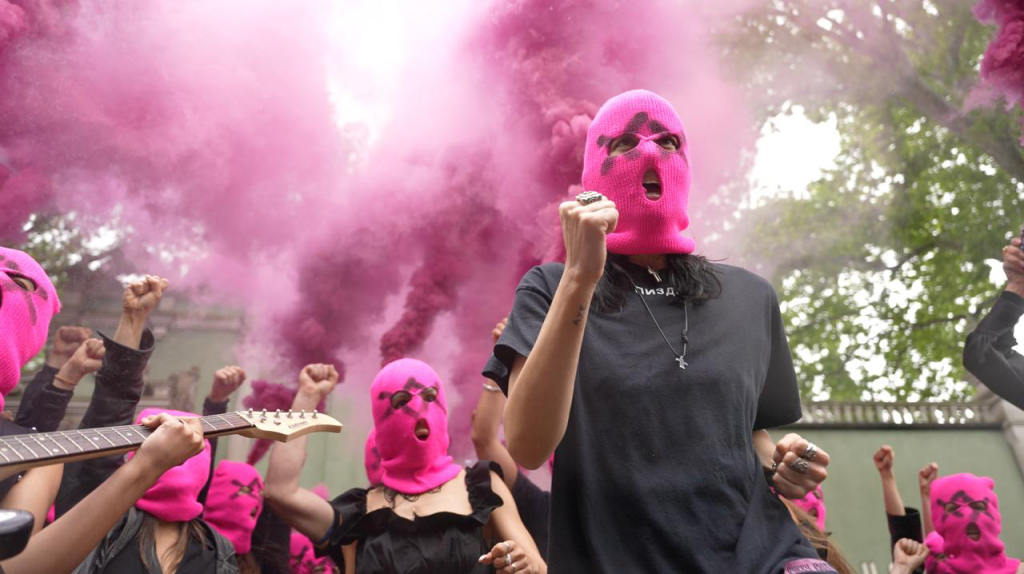
The plan did little to quell the controversy surrounding Russia’s participation. Dozens of protesters crashed the pavilion’s opening, chanting slogans including “Russia kills! Biennale exhibits!” Leading the demonstration was Tolokonnikova alongside other members of Pussy Riot. The dissident punk collective and art project joined forces with FEMEN, the Ukrainian activist group that describes itself as fighting patriarchy “in its three manifestations—sexual exploitation of women, dictatorship, and religion.”
The scene, as ARTnews wrote, “quickly took on something of the feel of a mosh pit at a punk concert”: protesters clad in the hot-pink balaclavas synonymous with Pussy Riot mingled with others who bared their breasts and sent plumes of yellow and blue smoke—the colors of the Ukrainian flag—into the Venice sky.
The post has been updated to include a comment from Nadya Tolokonnikova. A representative of the Venice Biennale did not respond to a request for comment by the time of publication.


