





Entering the main exhibition of the 2026 Venice Biennale, “In Minor Keys,” from the Arsenale, the first artwork one encounters is a poem. “If I must die / you must live / to tell my story,” the poem by Palestinian poet and professor Refaat Alareer begins. Those lines became a rallying cry for the pro-Palestine movement after Alareer was killed in Gaza by an Israeli airstrike in December 2023, and have since achieved a ubiquity that once seemed all but impossible for a poem in the 21st century.
For “In Minor Keys,” the poem acts as a kind of benediction or, perhaps, a statement of purpose. The last edition of the Biennale opened just seven months after October 7; this edition is truly the first to grapple fully with the bloodshed wrought since. For the most part, the destruction of Gaza, like the rise of global fascism, is an unignorable context that every work in the show breathes in.
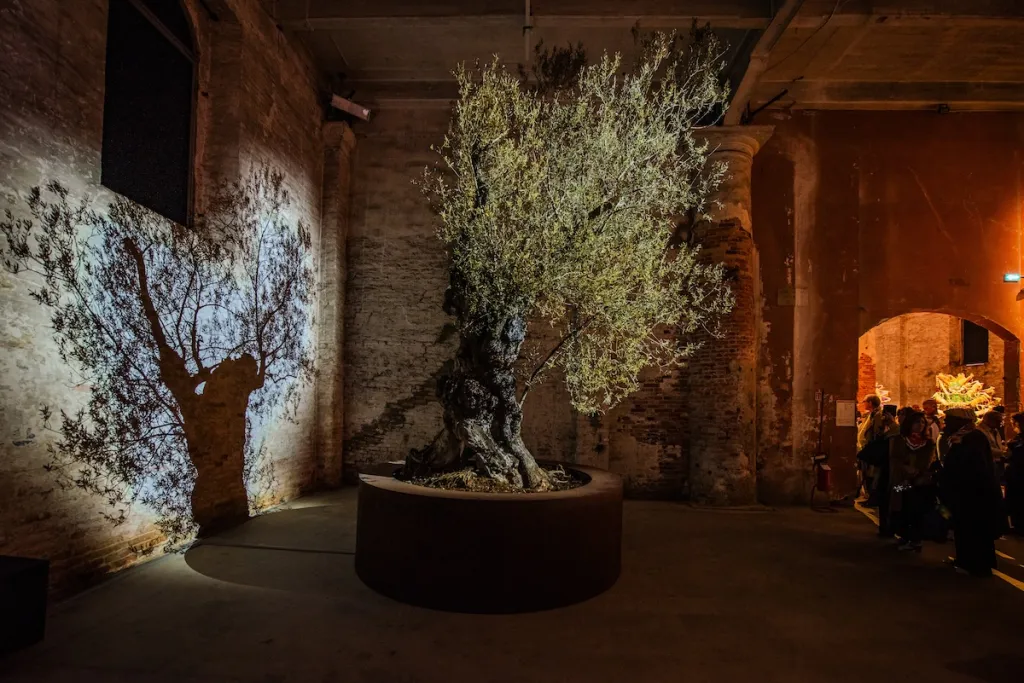
Take The Garden of the Broken-Hearted (2026), a new work by British Ethiopian artist Theo Eshetu in which a live olive tree is mounted on a rotating dais, while a video of the tree in nature is projected onto it. Eshetu told Art in America that he doesn’t intend the work to be “symbolic” and that it largely arose out of the idea that the garden is “a space to look at humanity away from narratives of culture.” He pointedly declined to disclose where the tree came from, saying its not important. And yet the embedded narrative of an olive tree—one of the most potent symbols of Palestinian subjectivity—taken from nature and put on a dais to wither, while a video of it plays endlessly, is too obvious to ignore outright.
In conceiving the work, Eshetu said he and Koyo Kouoh, the late curator of “In Minor Keys,” spoke extensively about mourning: “mourning the present, mourning the difficulties of creating in a moment when we feel sorrow and a lack of faith in human nature because of all the tragedies that surround us.”
Several works take up the conflict more directly, as ARTnews’s Maximilíano Durón noted in his review: Gazan painter Mohammed Joha presents a series of watercolor landscapes, titled No Shelter 12-29 (2025), while Haitian artist Manuel Mathieu presents a mixed-media painting titled GENOCIDE (2026) in which a coastal landscape appears like bruised flesh beside pitch-black sea. Israeli artist Avi Mograbi is most explicit, with his installation Between a River and a Sea (2026). On one screen plays business directories from Lebanon, Palestine, and Syria from 1938, a decade before the establishment of Israel; on another, Mograbi scrolls through the Yellow Pages for Gaza in 2023.
But for all the protest that attended the Biennale’s opening—with as many as 100 artists in the main exhibition and national pavilions protesting the inclusion of the Israeli Pavilion—the most direct treatments of the conflict remained outside the Biennale’s gates.
Gabrielle Goliath’s “Elegy” at La Chiesa di Sant’Antonin in Venice.
Photo Luca Meneghel/Courtesy the Artist
That was not always meant to be the case. Last year, Gabrielle Goliath, who showed in the main exhibition at the 2024 Biennale, was chosen to represent South Africa at its pavilion in the Giardini with a new edition of her ongoing performance series, Elegy, which has honored the victims of the South African femicide, as well as the Herero and Nama genocide in the early 1900s. In the work, a diverse cast of women, one after another, hold a single note as a lament for the dead. However, when Goliath’s proposal called for a new version of Elegy that mourned Gazan poet Hiba Abu Nada—who was killed by an Israeli airstrike in October 2023—alongside other murdered Palestinians, culture minister Gayton McKenzie pulled the plug.
“If you read the minister’s letters—the first threatening letters I started getting in December—he very explicitly said that the aspect that deals with femicide in South Africa and the Ovaherero and Nama genocide is acceptable,” she told ARTnews in an interview during the Biennale’s vernissage week. “But you need to remove the aspect that deals with Palestinian life.”
Goliath sued McKenzie to get the commission reinstated in January, but a judge declined to reverse the decision. In the lawsuit’s wake, however, several organizations banded together to present the work in the city anyway, at the Chiesa di Sant’Antonin, thanks to the Patriarchate of Venice. At the 12th-century church, the new iteration of Elegy mourning Palestine occupies five channels, while previous editions mourning the femicide and the Namibian genocide take up one and two, respectively.
The acoustics of the church carry the voices of Goliath’s women as they endeavor to hold that single note in honor of the dead. Sometimes, the voices fuse into a collective, while at other times they differentiate, with one singer stopping to take a breath as another takes up her lament. The solemnity of the space, and the juxtaposition of Black and Brown bodies on the screens beneath the idealized white Christian ones in the church’s murals, clarifies the series’s intervention.
Elegy appears in a brochure produced by the Art Not Genocide Alliance (ANGA), an international group of artists, curators, writers, and cultural workers that have led protests against Israel at the Biennale in 2024 and this year, including a 24-hour strike that closed over a dozen pavilions on Friday. That brochure, available alongside other protest materials at Venice activist art space Sale Docks, excoriates various countries for their “complicity” with Israel and lists Elegy in its “Palestine Solidarity in Venice” section. Also appearing in that section is another exhibition that arose out of an act of censorship, “Taring Padi: People’s Liberation Collective Banners, 2023–2026.”


Protest materials produced by ANGA on offer at Sale Docks in Venice.
In 2022, the Indonesian artist collective Taring Padi was thrust into a political maelstrom when their banner People’s Justice (2002), on view in an already fraught Documenta 15, was covered by Kassel officials and later dismantled. Many had argued that the banner, which largely meditates on the violence of the Suharto dictatorship in Indonesia, contained antisemitic caricatures.
In a roundtable talk on Thursday at Sale Docks, also the venue of the exhibition, Alexander Supartono, a member of Taring Padi, framed the new works on view as a direct result of the Documenta experience, saying that not long after that work was removed, the collective held a talk titled, “What to Do With the People’s Justice Banner?”
“That question was not rhetorical. It was genuine,” Supartono said, appearing via live video at the talk. “We really didn’t know what to do with the banner. What we did know was that the struggle for equal justice had to continue, and it had to continue in a way that was progressive and inclusive.”
In 2023, according to Supartono, the collective began developing a new series of People’s Justice banners, in collaboration with other organizations, collectives, and communities such as the Noongar people of Australia and MST, the Brazilian Landless Workers’ Movement. Six of the nine banners produced out of that effort appear in the Sale Docks exhibition.
The centerpiece of the show is no doubt People’s Liberation, produced in collaboration with Italy-based think tank Institute of Radical Imagination from December 2025 to March 2026. In its three-part structure, notched at the top with the title, the banner seems defiantly modeled after the dismantled People’s Justice (2002) banner, as well as a Palestinian flag. On the left side of the banner, a red fist rises skyward out of the rubble of Gaza; on the right, a green one that recalls an olive tree. In the center, a diverse crowd of black-and-white figures, many wearing keffiyehs, appear united in resistance above the phrase “Abolish Fascism, Organize Autonomy.”
The intention of the show, per Supartono, is “to show how we can transform that which has been condemned and dismantled into a platform of political education, political occupation, political propaganda, and political associations.”
People’s Liberation (2026) by Taring Padi at Sale Docks in Venice.
Alongside the Taring Padi exhibition is a presentation of charcoal drawings by Gaza-born artist Mosaab Abusal, who speaking through a translator at the roundtable, said that the works, which depict emaciated bodies often in repose or death, are not a “representation of reality” but rather a document of reality, Abusal’s experience of trauma transmitted directly into the rough, jagged charcoal lines of the drawings.
“The charcoal documents the trauma and trembling that inhabits the body,” Abusal said, as he explained how he struggled to reconcile what value art can have in the face of extreme acts of violence like those he had witnessed in Gaza.
The most striking treatment of the conflict in Venice was at Palazzo Mora and Palazzo Bembo, where the Palestine Museum US, a Connecticut-based institution founded by Palestinian American businessman Faisal Saleh, staged a presentation as part of the European Cultural Centre’s own biennial exhibition “Personal Structures.” Acting as a de-facto Palestine Pavilion (only states recognized by Italy can participate in the official Biennale), the Palestine Museum’s presentation, titled “Gaza—No Words—See the Exhibit,” presents 100 works of tatreez, a Palestinian embroidery practice, created by women artists in refugee camps in Lebanon, Jordan, and the West Bank. Collectively, the works form the Gaza Genocide Tapestry. (The museum had previously commissioned Gaza-based artists to produce tatreez, but that has become impossible for obvious reasons.)

Iman Shehaby, Man on Fire, 2025, crossstitch on fabric, based on Tell me what you’re feeling when you see anybody burning an artwork by Mahasen Alkhatib in memory of Shaban al-Dalu, a 19-year-old man killed on Ocotber 14, 2024. Alkhatib was killed in an Israeli airstrike only days later.
Courtesy Palestine Museum US
Whereas traditional tatreez is used to embroider patterns on garments, the tatreez in the exhibition depict images of the war on Gaza since 2023, many of which first appeared on social media and have since become iconic. The tatreez is done so intricately—with each work taking an expert two-and-a-half months to produce—that at the right distance they appear indistinguishable from a photograph. The images, which variously depict a student engulfed in flames from an airstrike, a man holding his dead granddaughter, and a mass grave, among others, are journalistic in their precision: no artistic liberties, just precise reproductions. In the exhibition, surrounded by 100 of them, hung on white cloth in a grid, the horror of the conflict is irrefutable.
In one of the few tatreez that isn’t drawn from a news photograph or an image posted to social media, the opening words to Alareer’s poem appear, paired with a kite, a symbol for the poet of hope.
At the exhibition’s opening last week, Saleh described the transformative effect the work had on many of the women commissioned for the piece. “We received a few letters after they finished their work,” he said. “One told us that it was really difficult to look at the images day in and day out. She said that the women were so depressed by all the news, but that the work had restored their dignity.”
But as matter-of-fact as the exhibition was, it still had the potential to provoke. Just as Saleh and I began to speak, two Israeli artists, one of whom said she was also presenting work nearby, interrupted to speak with Saleh. At first, they seemed to find common ground: all three were born just after Israel’s founding; Saleh and the artist had both studied at the same university in Jerusalem; they all could agree the occupation was a terrible thing for all parties involved. But the longer they spoke, the more the conversation devolved, as the artist turned to exhort me to see the conflict from “both sides,” that it was a “complicated situation,” that Palestinians “can’t judge” Israelis, and that Israelis “can’t judge” Palestinians. The conversation ended amicably, if only, it seemed, through Saleh’s herculean restraint.
“The important thing is, the only way to solve this problem is if you and I become equal,” Saleh said gently. “If you can convince everybody on both sides of that, then you have a good starting point.”
“But, somehow, that’s utopia,” the artist responded.


