








As New York’s spring art fairs approached, disruptions tied to the war in Iran continued to strain global logistics, though most galleries showing in the city this month said shipments were arriving on time and their plans remained largely unchanged.
“The Iran war isn’t stopping art shipments into New York—but it’s removing flexibility from the global system. Logistics is becoming more fragile, and that’s changing how the market plans,” says Robin Eckstein, the regional manager for the Middle East at the logistics firm Hasenkamp. “What used to be flexible is now fragile.”
Airspace closures, reduced flight availability and rising fuel costs have led to a sharp decline in art shipments to and from the Middle East. Eckstein says that logistics “has become a much bigger variable than most people realise”.
Disruptions have persisted despite ceasefires between the US and Iran (and between Israel and Lebanon), and the on-again-off-again negotiations between Iranian and US officials. Iran largely closed shipping through the Strait of Hormuz, while the US imposed a naval blockade that further restricted sea travel through the vital channel in and out of the Persian Gulf.
While those pressures are reshaping how art is transported globally, their impact on New York fairs—including Frieze, Tefaf, Independent and Nada—has so far been uneven. Alexander Bradford, the manager of global business development and sustainability at the fine-art logistics firm Gander & White, says that with the conflict and closure of the Strait of Hormuz, sea shipping is not an option and all flights face last-minute cancellations, delays or rerouting. “Prices continue to increase alongside rising oil prices,” Bradford says.
Oil futures have remained above $93 per barrel since reaching a multi-year high of $119.50 on 9 March. The International Energy Agency has warned that actual, physical oil recently hit record highs near $150 per barrel.
“In art logistics, the transport itself is rarely the problem,” Eckstein says. “The challenge is everything around it: routing, customs, insurance and risk planning. And that’s exactly where geopolitical instability is hitting hardest.” The war has caused a “knock-on effect”, he says, because the region serves as a connector between Europe, Asia and the US. So, have logistics become less predictable worldwide?
While the Strait of Hormuz remains effectively closed, certain ports cannot be accessed through usual routes. As a result, Eckstein explains, shipments are rerouted via alternative ports and then transported by land across the region. “Just last month, we handled a sea-freight shipment for Abu Dhabi that arrived via Oman,” he says.
Gulf countries have “reacted quickly” with regulations to enable cross-border solutions, keeping shipments moving despite the disruption, Eckstein says. Even so, alternative ports are co-ordinated on short notice and routing has become less predictable overall. “We’re seeing a shift from efficiency to resilience,” Eckstein says. “Clients are no longer asking how fast a shipment can move but how safely it can arrive under changing conditions.”
“What we’re seeing is not a slowdown in activity but a shift in behaviour, with earlier booking of transport, increased buffer times in planning, more internal approvals from lenders and insurers, and a stronger focus on contingency scenarios,” says Eckstein, adding that, in some cases, costs have increased by as much as 2,500%. “Clients remain committed to New York Art Week, but they are planning with significantly more caution and structure than before.”
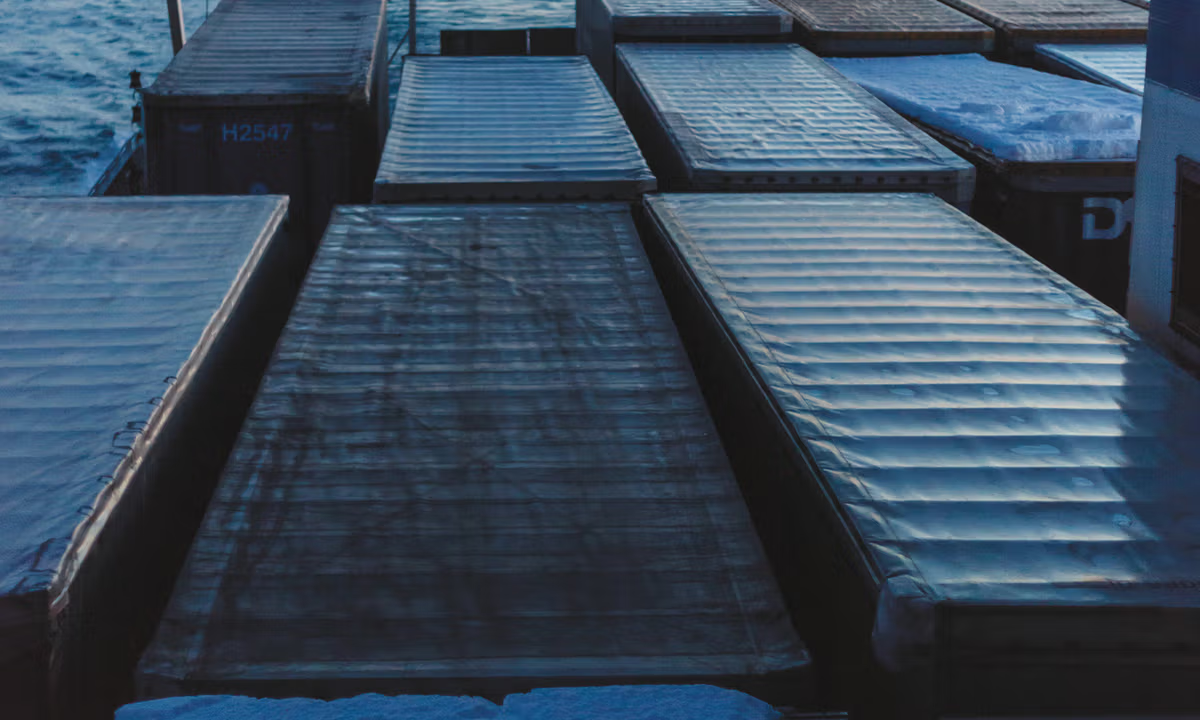
Some galleries participating in this month’s New York fairs say that the war in the Middle East has had little impact on their logistics planning Michael Bracey/Alamy Stock Photo
Prepared to adapt
Asked if galleries are facing logistical challenges ahead of this month’s fairs, Elizabeth Dee, the founder and creative director of the Independent art fair, says: “We have not yet had the issue raised with us.” Leanne Jagtiani, the director of Tefaf New York, likewise says she has not heard of any planning changes. Representatives for Nada New York and the 1-54 Contemporary African Art Fair did not return requests for comment.
“The international art market, particularly at the high end, has historically proven resilient during periods of geopolitical uncertainty. At this time, we are not anticipating changes in collector turnout or buying activity for New York,” says Jagtiani, calling this an “undeniably challenging” moment. She adds that her team is monitoring potential impacts from the war.
Despite global flight disruptions that extend to passenger travel, Jagtiani says Tefaf anticipates strong attendance in New York. She notes that its Maastricht edition was held in March amid the disruptions and still had “strong attendance and sustained sales” throughout the fair, with representatives from the Middle East on both the collector and institutional sides, including the Louvre Abu Dhabi.
Jagtiani adds: “While shipping routes and costs may be impacted, our exhibitors and dealers are very experienced in navigating these complexities and are well prepared to adapt as needed.”
Meanwhile, galleries shipping from Asia and Africa—less directly tied to Middle Eastern transit hubs but still exposed to global fuel costs—said they had not yet felt significant disruptions. Yiwen Tang of Gene Gallery in Shanghai said that the conflict has not impacted their plans for Nada New York. “We have not experienced any delays or complications getting works into New York, and we have not seen any noticeable changes in shipping or insurance costs,” Tang says. “We have not had to make any special adjustments in terms of timing, selection or sourcing of works.”
Kayode Adegbola said his gallery in Lagos recently participated in its first international fair, Expo Chicago, in April. Adegbola Gallery is also showing at 1-54 in New York this week. “Our shipment from Lagos arrived in three business days, on schedule and within normal cost range, with no heightened risk flagged by our insurers,” Adegbola says of the gallery’s arrangements for Chicago. “That gives us confidence heading into 1-54. Selection for New York is purely curatorial, and we are seeing steady engagement from our New York collector base.”
Hena Lee, a partner and director of the São Paulo-based Almeida & Dale, which is participating in both Frieze New York and Independent this year, says the gallery “has not experienced significant disruptions” but she acknowledges that it is operating in a “more complex global environment”.
“Logistics always require careful co-ordination, a process that at Almeida & Dale is also supported by a dedicated internal department focused exclusively on international logistics, ensuring smoother co-ordination and the management of any challenges we may encounter,” Lee says. “We have planned accordingly with our partners to ensure works arrive safely and on time.”
In terms of collector turnout, Lee says the gallery remains optimistic, noting that New York “continues to bring together a highly engaged international audience”, and that Almeida & Dale has seen strong interest in its artists’ work ahead of the May fairs.
“The art market hates uncertainty and volatility,” Bradford says, “so we very much hope that the crisis resolves itself as quickly as possible.”


