


“In Minor Keys” is the only biennial in memory that’s made me find a dark corner to cry in.
The Arsenale opens with a poem on the wall by Refaat Alareer, written before he was killed by the Israeli military in Gaza in 2023. “If I must die / you must live,” he writes, “to tell my story / to sell my things / to buy a piece of cloth and some strings,” to assemble a white kite that might serve as a symbol of hope for a child somewhere in Gaza, floating in the sky.
The strongest threads of the show take up the poem’s themes of perseverance and play—with our tragic times always heavily present, but more as exposition: looming backdrops against which artists imagine the worlds to come. It’s a show not only about surviving against the odds, but thriving through them. The wall text promises a show meant to “nurture society” and provide “spiritual rest,” and it delivers.
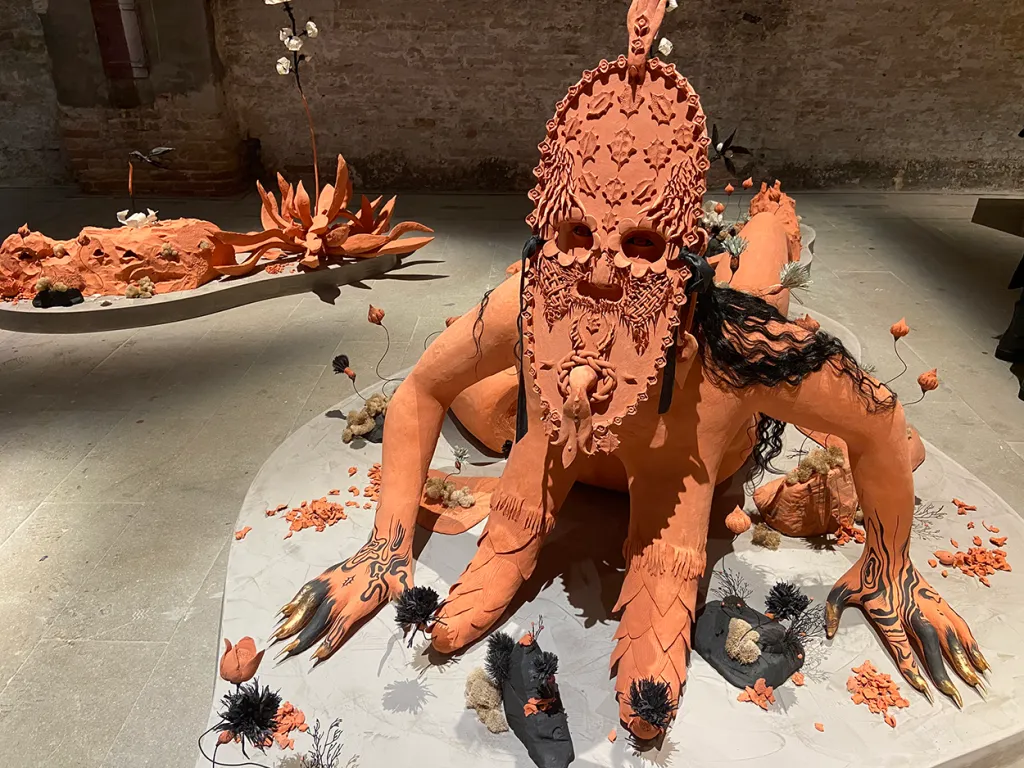
It was Guadalupe Maravilla’s sculptures that first choked me up. I have always loved his work, which is all about healing from biological and social ills—in his case, migration by foot from El Salvador to the US as a child, and his subsequent, not unrelated experience of stomach cancer. But these new versions of his Disease Thrower sculptures—chillingly titled for our “ICE Age”—incorporate versions of the blue bunny hat memorably worn by 5-year-old Liam Conejo-Ramos when he was kidnapped by ICE on his way home from preschool.
Work by Guadalupe Maravilla in the 2026 Venice Biennale.
Maravilla’s work confronting how illnesss is socially and politically produced finds its echo in the Giardini, in Alexa Kumiko Hatanaka’s linocuts on handmade paper. They depict melting snowdrifts the Inuit have used as navigation guides for centuries. The work was made partly in response to a study suggesting that bipolar disorder—which Hatanaka has—may have emerged during the first Ice Age not as a disorder at all, but as an adaptive tool for navigating extreme weather variability. Elsewhere in the Arsenale, a section devoted to nature emphasizes not its ephemerality, but its capacity for perseverance. Works by Carolina Caycedo, Waqas Khan Shabbir, Michael Joo, and Vera Tamari take on defiant “weeds,” seed-saving traditions, and fossilized forms. If the saying “adapt or perish” derives from Charles Darwin, these are lifeforms that have survived by adapting across countless contexts.
Works in “Minor Keys”—a title that invokes both sonic tonality as well as islands—are invested in world-building and change, but often on an intergenerational scale, evoking transformations that may not happen within our lifetimes. Where the show frames art as a tool for world-building, curator Koyo Kouoh dedicated her own work to institution-building, and dedicates galleries to a number of artist-led groups invested in the same ethos: Denniston Hill, the Nairobi Contemporary Art Institute, and fierce pussy.
Kouoh died before completing the biennial, and the exhibition was carried out by the team she assembled. From what I gather from those who knew her well, if anyone could build a coalition and pass the torch, it was Kouoh.
It’s part of why I wanted, in this quick-response diary, to identify a few of the show’s strongest threads. Inevitably, without a lead curator present to articulate them directly, some of those connections remain unnamed—and I’m left wondering whether the argument would have felt tighter had Kouoh been able to see it through herself. I’ll also add that, as with most sprawling international exhibitions, there was plenty of work I found mediocre—not bad in a way that’s particularly interesting to critique, just not exactly to my taste either.
Because I do believe, ultimately and strongly, in the model of art that “Minor Keys” advocates. It’s a show invested as much in the social as in the visual, in the realities of the world as in imaginations of what it might become. And it’s about art that takes the bad of the world and transmutes it into something good. I’ll dwell on that more in a proper review later, and leave you for now with two examples of what I mean.

Work by Walid Raad in the 2026 Venice Biennale.
Duchamp’s Boîte-en-valise is on view in the Giardini, a work that’s been haunting me as we approach a new ’30s. “Everything important I’ve ever done can fit inside a suitcase,” he is known to have quipped before recreating miniature paper versions of his most iconic works and boxing them up. I always took the line as self-deprecating, which it is. But he also said it as fascism was rising, war loomed on the horizon, and he faced the real possibility of fleeing Europe. He was choosing to adapt, not perish.
Walid Raad points to a similar resourcefulness in the Arsenale. After the Lebanese Civil War ended in 1990, militias sold off weapons, many of which found their way to the Balkans—meaning the Yugoslav Wars were largely fought with Lebanese weapons. Yet underneath the wooden pallets the weapons were shipped on, according to Raad, people found beautiful copies of Arab and Turkish paintings that had long been reported stolen. Imagining who was brilliant enough to put them there, I’m reminded that resilience requires creativity.
