


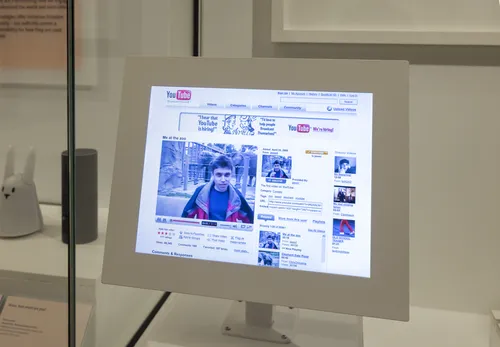
The Victoria and Albert Museum (V&A) in London has acquired the first video ever uploaded to YouTube. Titled Me at the zoo, the recording is now on view in the museum’s Design 1900–Now gallery, presented alongside a reconstruction of an early YouTube video page from this era. The museum also acquired this webpage, which includes the front-end code and the Adobe Flash Player video player that defined YouTube’s preliminary visual identity.
“This snapshot of YouTube during the early days of web 2.0 marks an important moment in history of the internet and digital design,” said Corinna Gardner, the V&A’s senior curator of design and digital, in a press statement. “The acquisition opens new storytelling opportunities for us to showcase and explore the ways in which the internet has shaped our world… In addition, the ability to work with YouTube to bring the early watchpage into the collection, has enabled us to forge new ground in how we collect and preserve complex digital objects for the future.”
Me at the zoo, a 19-second clip uploaded on April 24th, 2005 by YouTube’s co-founder, Jawed Karim, features Karim sharing a fact about elephants. It was filmed at the San Diego Zoo and has over 382 million views. The video marks a significant turning point in the history of the internet, as it ushered in the transition from a text-only culture to one built around multimedia content and digital social interactions, also known as Web 2.0.
The work shows the website as it was captured in December of 2006 by the Internet Archive. It is the earliest timestamp of the site documented online. The museum, YouTube’s UX team, and the interactive design studio OIO Studio spent 18 months recreating the visual experience of the site’s nascent years, including the buttons, ratings, and badges. A mini display of this reconstruction process will be on view at the V&A East Storehouse.
“By reconstructing the original 2005 watchpage, we aren’t just showing a video; we are inviting the public to step back in time to the beginning of a global, cultural phenomenon,” said YouTube’s chief executive, Neal Mohan.
The acquisition underscores the museum’s continued commitment to preserving digital design. Previous digital acquisitions include the mobile application Flappy Bird, the mosquito emoji, and a version of WeChat, China’s largest social media platform.
