


“We cannot be free until our art is free,” reads a flyer from the 1960s issued by the Arts Workers Coalition, an activist group whose protests helped reshape the New York art world. Remember that remark when you visit the Studio Museum in Harlem’s divine survey for Tom Lloyd, a member of the Coalition who spoke on similar terms with his art.
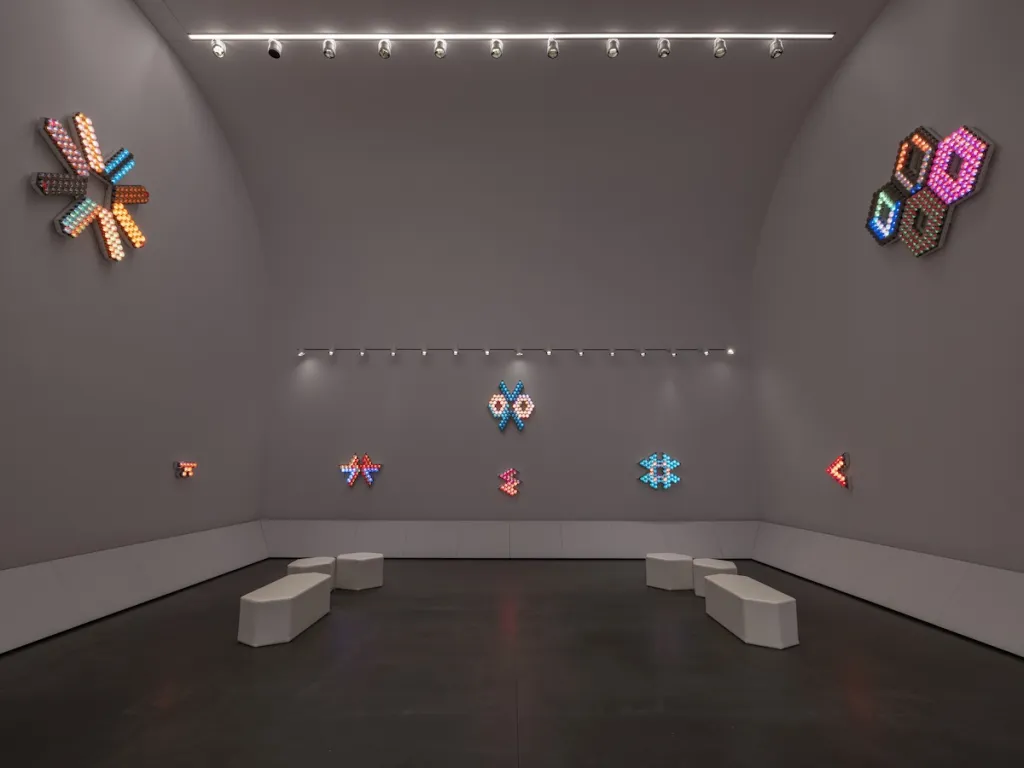
Set inside a church-like space with a high ceiling, the Studio Museum’s one-room show is mainly devoted to Lloyd’s light sculptures from the mid-1960s. They blink, strobe, and stutter, rhythmically switching between rich shades of orange, green, yellow, and red. The sculptures look a bit like the painterly abstractions from the era but remade in a new medium—Op art with a keener awareness that it existed in the consumer age, not a formalist void.
Here, the medium is the message. Lloyd made use of Christmas lights and Buick taillight covers—materials that could be bought with ease. This was decidedly not the stuff of art in the traditional sense. For Lloyd, there was no division between the everyday and the field of art.
He was not the only artist of his time to utilize saleable goods for abstract art. The first half of that decade saw Yayoi Kusama make paintings from rows of postage stamps; Chryssa craft sculptures with neon lights bought from commercial sign fabricators; Nam June Paik create pieces in which magnets were attached to TV sets.
Despite regularly exhibiting these works at venues the Institute of Contemporary Art Boston, Howard Wise Gallery, and the Studio Museum, Lloyd, by his own choice, left the art world behind. He opted instead to form his own institution, the Store Front Museum, in the majority-Black neighborhood of Jamaica, Queens, in 1971. Even after the Store Front Museum closed in 1986, Lloyd never looked back. The search for liberation that he began in abstraction was continued by his quest for freedom for audiences overlooked by the art literati, which at the time held court in Midtown Manhattan.
Until the Studio Museum reopened in a new home this fall, Lloyd’s art and activism had nearly been lost to time. The reasons for his being forgotten are complex, in no small part because of the bitter response to Lloyd’s 1968 show at the Studio Museum, which inaugurated this venerable institution. Some audiences perceived Lloyd’s art as being too “downtown,” and therefore not Black enough, for Harlem—a reaction that now feels both dated and nonsensical, which may be why the Studio Museum mostly ignores that history within the exhibition itself.
Installation view of “Tom Lloyd,” 2025, at Studio Museum in Harlem, New York.
Photo Kris Graves
Three cheers, then, for his current show at the Studio Museum, which restores Lloyd to his rightful place in art history. The exhibition is both a feat of scholarship—curator Connie H. Choi searched high and low for sculptures by Lloyd, some of which remain unfound—and a useful primer on an artist who bridged the gap between life and art.
Lloyd did so starting in the mid-’60s, creating oddball assemblages of cogs, gears, and wiring. They resemble Jean Tinguely’s sculptures of the era, except that Lloyd’s are less ramshackle, more orderly. Early on, Lloyd appeared to ask: What if the gadgetry of machines were released from their original purposes and lent a new context?

Tom Lloyd, 1968.
Photographer Unknown
The greyness of these early sculptures gives over to joyous color with his light sculptures, which are unconventional not just in their warm aesthetic, but also in their making—beginning around 1965, Lloyd worked on them with an engineer named Alan Sussman. Arranged like starbursts, parallelograms, Xes, and chevrons, Lloyd’s lights are accompanied by mysterious names, heightening their otherworldliness. Veleuro (1968), an asterisk-shaped work containing nearly 800 Christmas light bulbs, has a title that’s about as unknowable as the object itself, which looks it might be advertising some sort of mod product.
Just a handful of works in this show date to the period after Veleuro. All are abstract paintings, and all are sad and conventional in comparison to the light sculptures. Perhaps that’s because Lloyd had by this point set his focus elsewhere. So committed was he to advancing the Black community, in fact, that the artist Benny Andrews once remarked on how Lloyd “alienated everyone” involved with the Black Emergency Cultural Coalition, leading him to exit that group and join the Art Workers Coalition, formed in 1969.
Tom Lloyd, Narokan, 1965.
Studio Museum in Harlem
While the Studio Museum exhibition’s insightful catalog does explore Lloyd’s activism in depth, the show itself sands down the edges of his political engagement, confining them mainly to vitrines filled with historical ephemera. It’s true that Lloyd’s sculptures are not explicitly about race. It’s also true that Lloyd’s activism deliberately resisted the conventions that guide art exhibitions, resulting not in objects that can be shown in a gallery but in discussions about change within museums. But the Studio Museum exhibition gives Lloyd’s art more space than his activism, which feels like a mistake—the two appear to have been equally important to him.
Still, the fact that the exhibition exists at all seems like solid evidence of progress. It may even a pathway toward canonization. Lloyd’s work has officially departed storage and taken center stage, and that means his art is finally free.
