


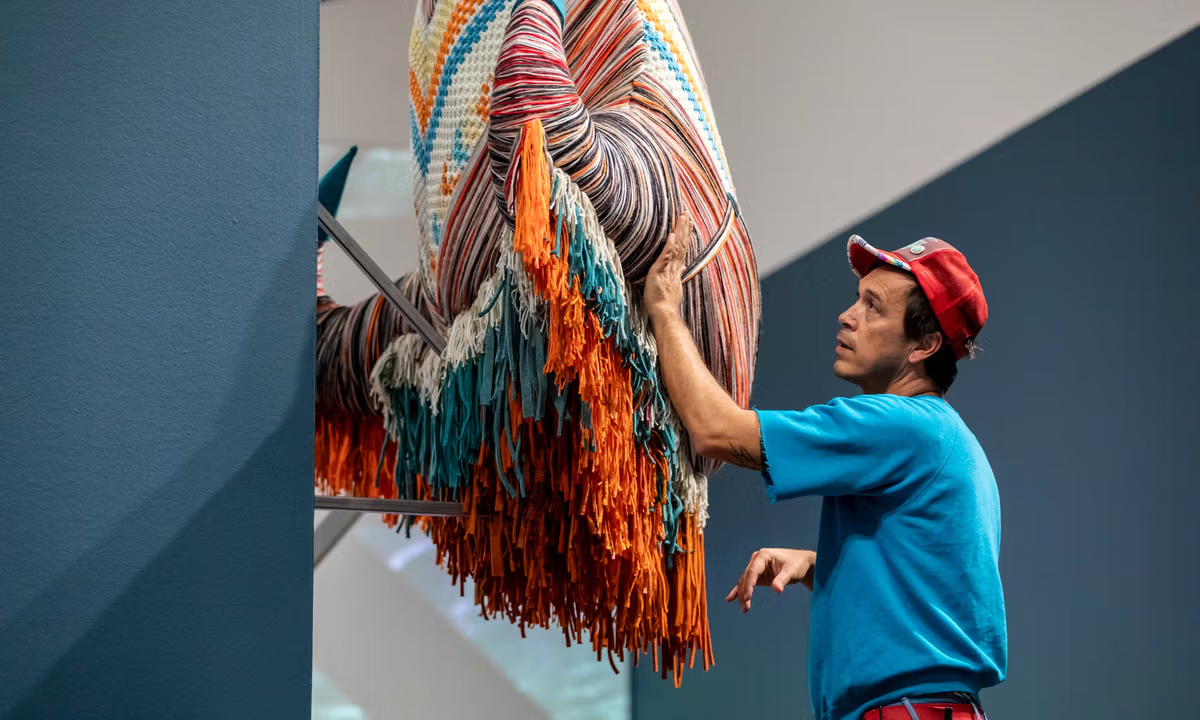
How do you map time in three dimensions? Cannupa Hanska-Luger’s new exhibition at the Joslyn Art Museum in Omaha, Nebraska asks that question in a choir of material tones, locating both harmony and discordance in Indigenous futurity. Dripping Earth (until 8 March 2026) is an ambitious undertaking, ushering viewers under water, over land and through the magma-hot center of historical turmoil. Luger, whose Mandan, Hidatsa, Arikara and Lokota lineage has long informed his interdisciplinary practice, started his conceptual journey into Dripping Earth from an unlikely starting point: the landscape watercolours of the Swiss artist Karl Bodmer (1809-93).
From 1832 to 1834, Bodmer followed Prince Maximilian of Wied, an avowed German naturalist, on an expedition through North America, serving as the royal’s official documentarian. Bodmer’s sketches and paintings were transformed into lithographs once the pair returned to Europe, a valuable but fraught record of the Indigenous American tribal regalia and ceremonial traditions he witnessed during his travels. When these images were translated from paper to print, liberties were taken with the subject matter in the form of “corrections”, both redacting and reimagining the already impossible truth of subjective experience. The Joslyn Art Museum’s collection includes more than 380 works by Bodmer.
Karl Bodmer, Leader of the Mandan Beróck-Óchatä, Joslyn Art Museum
Photograph © Bruce M. White, 2019
Luger’s interest in colonisation’s violent legacy and its manifestation in pseudo-documentary materials is tangible throughout Dripping Earth, whether in the narrative reclamation of Bodmer’s legacy through the series of speculative lithographs Future Ancestral Technologies, or in large-scale formal experiments that turn rote symbolism on its head—like a giant abacus in the shape of a buffalo or repurposed, hand-woven bison regalia that toes a Marvel-ian line. Much of the natural topology Bodmer captured in his watercolours of the Missouri River is now submerged, but Luger does not consider that history “lost”; rather, he says, this is nature’s reabsorption of the storytelling apparatus, a formal rejection of the settler attitude towards “terra incognita”.
Luger was born and raised on the North Dakota Standing Rock Reservation, and learned about stone carving and ceramics from his mother, Kathy “Elk Woman” Whitman. He received a BFA from the Institute of American Indian Arts in Santa Fe, New Mexico, and has shown his work at museums all over the world, including the Princeton University Art Museum, the Museum of Northern Arizona, and the Crystal Bridges Museum of American Art. He is a recipient of the Burke Prize from the Museum of Arts and Design in New York and his renowned installation, Every One, a cascade of 4,000 handmade ceramic beads forming a collective portrait of murdered and missing Indigenous women from across North America, has been exhibited at the Gardiner Museum, the Museum of International Folk Art, and the Denver Art Museum.
The Art Newspaper caught up with Luger to talk about lithography, unreliable narration and the art of counting.
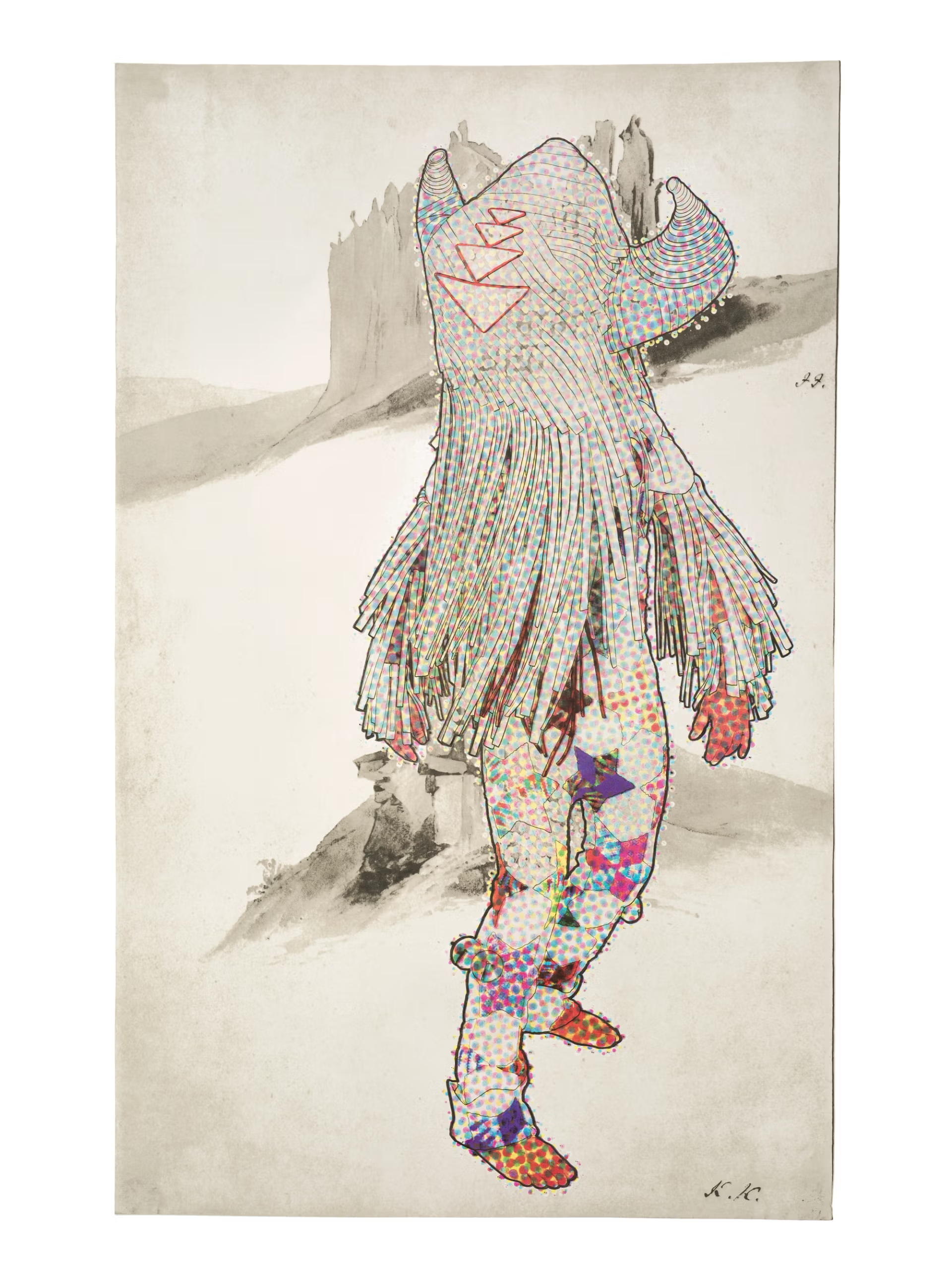
Cannupa Hanska Luger, Light as Remarkable Landscape, 2025, from the series Future Ancestral Technologies © Cannupa Hanska Luger. Courtesy of the artist and Garth Greenan Gallery, New York. Photo by: Wendy McEahern
The Art Newspaper: How did you come across the work of Karl Bodmer, and what prompted your response to it?
Cannupa Hanska Luger: Why I was really interested in doing this exhibition was that Karl Bodmer and Prince Maximilian ended up staying with the Mandans for a long time. In the lithographs and in his watercolours, there’s a lot of material from that stay. And this is my tribe, you know? After smallpox wiped out like 90% of our population, a lot of our customary practices turned into survival mode. And Bodmer’s illustrations I remember looking at growing up as a point of reference for some of our customary visual language. So there was this connection to Bodmer’s work. Of course, George Catlin came through as well, and then you have Lewis and Clark tangled in the American story. But so much of it is mythical at this point that it’s nice to have these physical memories gathered at that time rather than moving through the game of telephone that is history.
I was interested in doing this work and engaging with the watercolours because I grew up seeing the lithographs. Through the process of observation, through the process of reproduction, there are little artifacts that get left heind. And when I saw the original watercolours and could compare them against the lithographs, which I grew up seeing, there were a bunch of interesting things that I was taking notice of.
This is why I was kind of interested in doing a lithographic series because I’ve had the opportunity to do them a few times and I’ve passed on it because I really didn’t understand how a sculptor engages with printmaking. In this instance, the process of printmaking felt like a medium to work with. I wanted to reproduce the watercolours in lithographs, which are from Bodmer’s book of landscapes, the series that he was calling Remarkable Landscapes. In the book where I was first engaged with these landscapes, there was a subnote and it described the number of them that are now submerged under dam projects. And my rez is one of those dam projects: 40 % of my reservation is underneath Lake Sacagawea, so the landscapes that I chose for the backgrounds of those lithographs are submerged.
I wanted to build this narrative that tracks the processes in which we mass-produce stories, and how that affects the general psyche, and navigate these two definitions of artefact: one, an object of cultural significance; and two, an anomaly produced through observation. That’s why I did the lithographs and why the lithographs look the way they do. The backgrounds, the watercolours, we turned them to a greyscale and used a four plate drop to get a really rich gray tone. The figure on the top of it is done in a huge halftone dot. In looking at the histories of printmaking and my exposure to printmaking and thinking about comic books, the figures are very heroic in their stances.
What is your relationship with materiality as an artist?
I’m pretty agnostic when it comes to materials, the story that the materials bring to any of these conversations. If I specialise, I only get to tell that story. But if I become a little adept at a bunch of things, then it opens up the possibility to have deeper stories. A lot of this exhibition is about material, material science and also how the history of traditional and customary practices move through time and through materials. Being able to tell a very old story with new materials tells us something about the agency of Indigenous people that has been stifled as part of the historical record. This is why there’s so many different materials that I’m working with in this exhibition. They have their own stories to tell and those materials do it better than I can.
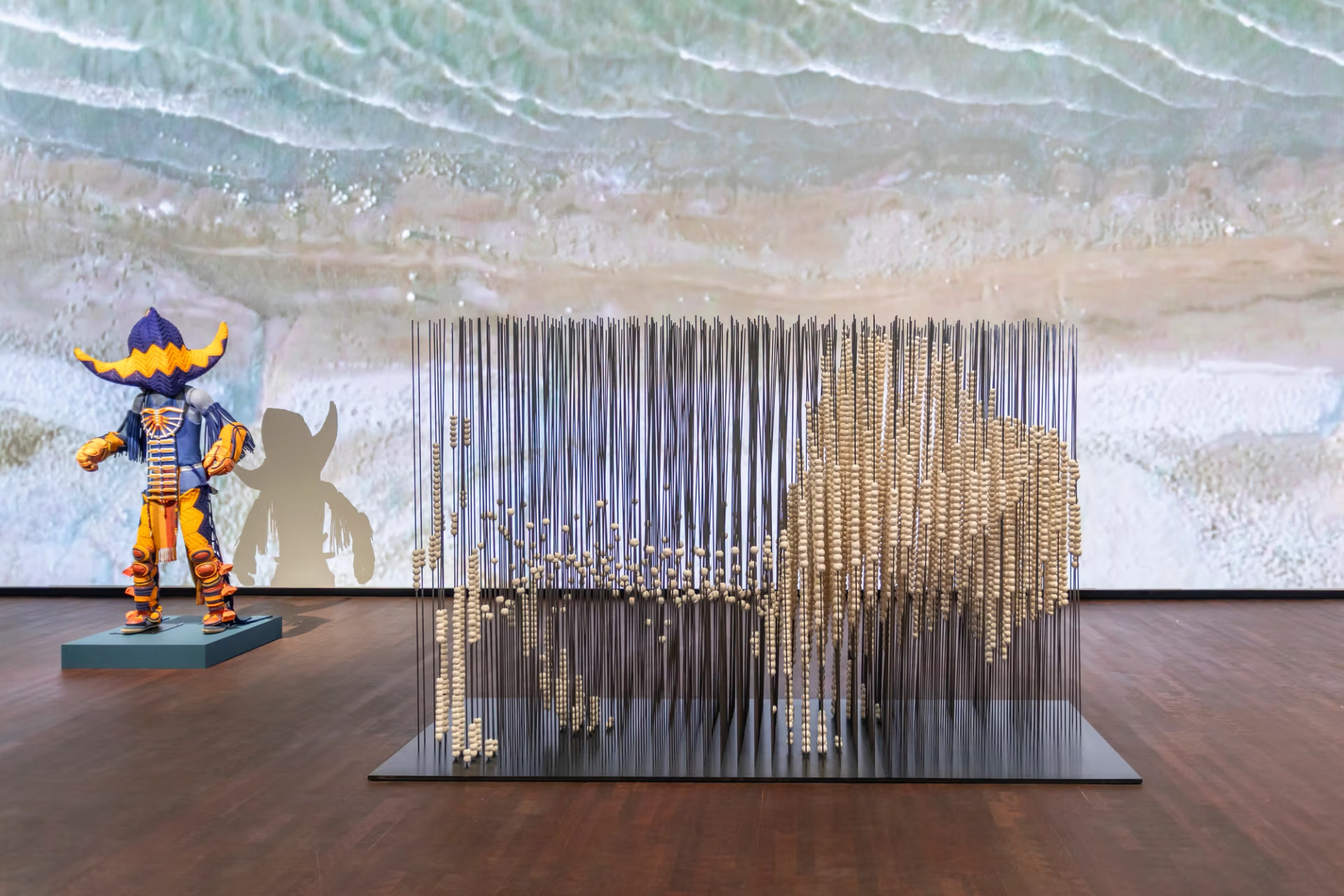
Installation view of Dripping Earth: Cannupa Hanska
Luger in The Joslyn’s Temporary Exhibition Galleries.
Photograph by Shayla Blatchford (Diné), 2025
Could you tell me more about the giant abacus?
Aside from the materials as an expressive thing, at the end of the day, it’s a self-portrait. These are techniques that I’ve been developing as an individual in the continuum of craftsmanship and whatnot. One of the projects that I’ve done in my career are these things that I call Counting Coup; it’s really data visualisation and engineering projects, trying to create prompts for people to participate in the creation of a piece. This giant abacus is the latest iteration of a Counting Coup project; it’s a bison bead project and that accumulation of ceramic beads that are being built by community members are calculating the wild bison in North America. When that bison is complete, it’s a three-dimensional dot matrix presentation, and it will consist of around 20 ,000 beads, which is the number of wild free bison in North America presently.
I’ve been wanting to build this sculpture for years, which is wild. I pitched this bison bead project maybe five or six years ago. The Joslyn, luckily, saw my idea and saw how it would benefit their connection and reinforce the community relationships that they have, so they’re helping to steward the project in this iteration.
Do you feel that your role as an artist involves educating the viewer?
I don’t know if it would be education. I’m more interested in inspiration than education. I like how a viewer interprets work, so I try to paint with as broad a stroke as possible and invite the viewer and their histories into the process so that they complete it, but also build a bridge between all of their experiences and all of my experiences, and then all of their community and all of my community. Build an imaginary bridge first so that we can eventually over time construct something that’s meaningful.
I like to remind people that we can imagine alternatives to the present and that is truly the definition of what freedom could be—not being able to choose but to create one—and I think we’re lacking in that right now. So if this inspires somebody to imagine themselves in a different place or time, or it inspires them to consider another way of making, describing something that they want to talk about, that’s great. And if they misconstrue the message that I’m presenting to them, and it becomes something alternate to it, that is actually profoundly more generative than them understanding exactly what it is I’m trying to express.
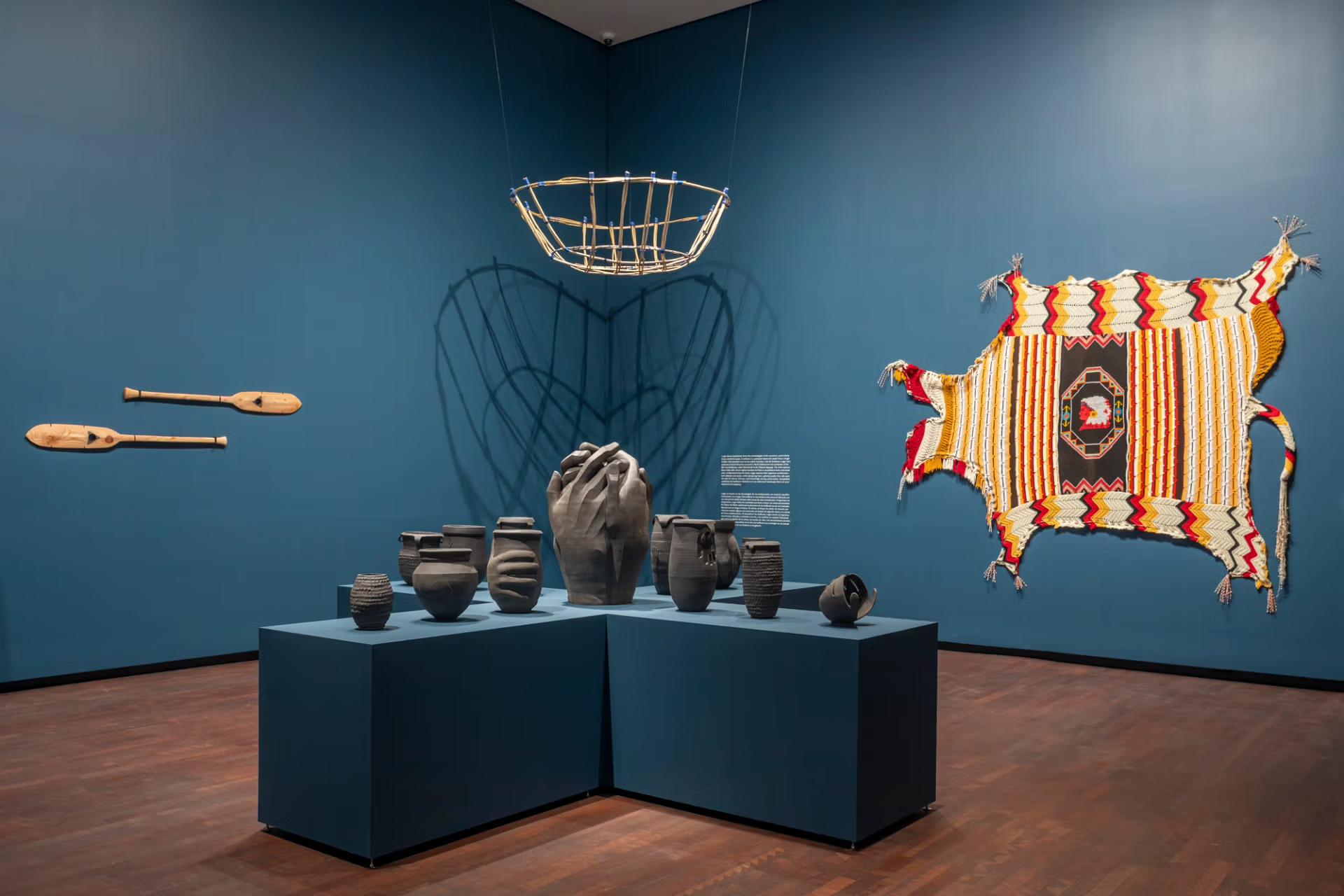
Installation view of Dripping Earth: Cannupa Hanska Luger in The Joslyn’s Temporary Exhibition Galleries. Photograph by Shayla Blatchford (Diné), 2025
Nonlinearity is a big part of how this show moves. How important was that to you, and how do you logistically communicate non-linear time to visitors?
That was something that I was really excited about simply because of this relationship that I have to Bodmer’s work and then the Joslyn having that work and all the weird synchronicities in the timeline that I tried to celebrate in this exhibition. There are two little pieces that are not that big and bold, but they’re these wooden oars for our customary bull boats. I was in Switzerland this summer and happened across a beam from a remodel in Verbier, that beam was hewn and set in the 1860s, so this tree was alive in the 1830s, which is exactly when Bodmer was up the river. There are these two oars that were constructed from a tree that was alive at the same time of this storyline. I’m like, “How is it that I’m here now and that this material is available?”
It reinforces this notion that linear time is a construct and we actually are participants in a space-time continuum. I’m this thing radiating in all directions. If space and time are connected, then we should be able to navigate in any direction. And in fact, we do. It might not be a physical transportation, but a fourth-dimensional movement.
Coincidentally, these beams were available to me, so I felt charged and primed to carve them from this wood, even though I’ve never carved an oar, or really worked with wood in that way. It just seemed like the opportunity to express the sphericalness of time. Everything that I know was learned generations ago and moved through the timeline to me presently and I’m just an extension of that latest presentation and anything that I make is going to also move through that time and be a point of reference for generations that aren’t even born yet.
- Dripping Earth: Cannupa Hanska Luger, until 8 March 2026, Joslyn Art Museum, Omaha, Nebraska
