


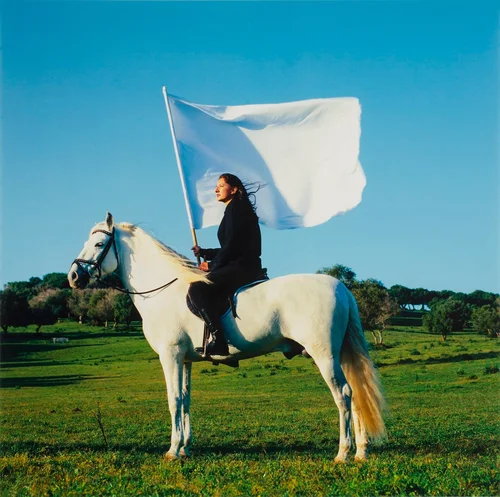
The Hero I, 2001
Marina Abramović
Dallas Collectors Club
You can’t always hang a piece of performance art above your couch. You can’t always photograph it. Sometimes viewers aren’t allowed to document it all.
And yet, performance art has a place in the art market. So, how exactly does one buy it? What changes hands between artists, dealers, and collectors?
Collecting performance art does not usually mean owning the live event itself. More often, it means acquiring one of the forms through which a performance can be preserved, circulated, or reactivated: photographs, video, sound recordings, props, costumes, written scores, instructions, contracts, archival materials, or the rights to stage the work again under specific conditions. In some cases, the collectible work is documentation of the performance; in others, it is an object or set of instructions that emerged from it.
For collectors curious about the medium, here’s Artsy’s guide to buying performance art.
Is performance art collectible?
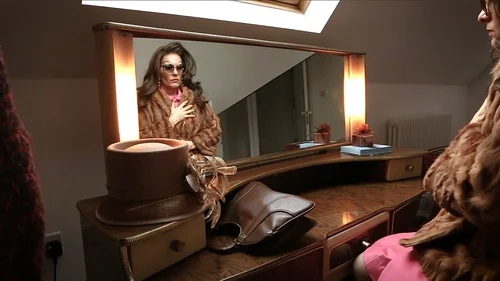
Hat Trick, 2018-2019
Márcia Beatriz Granero
Darling Pearls & Co
Performance art is defined by its ephemerality. It is charged by the experience of being there, and often disappears as soon as it happens.
From that premise, collectors might assume it cannot be purchased. But that conclusion is too neat.
“Although performance is inherently ephemeral, collectors acquire its material ‘residue’—photographs, videos, objects—which anchor these practices in the art market,” said Alessandro Falbo, founder of London gallery Darling Pearls & Co. “The biggest misconception about performance art is that it cannot be collected; in reality, these traces preserve both its legacy and its value.”
Take Marina Abramović, often described as the “grandmother of performance art.” Collectors regularly buy photographs, prints, and editions related to her performance practice, rather than acquiring the performances themselves.
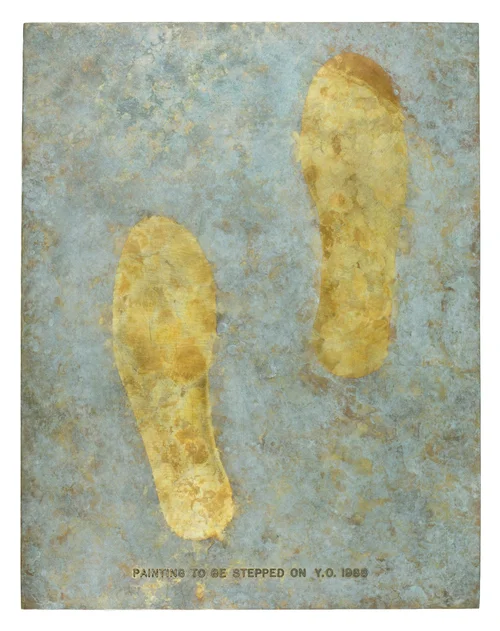
Painting to Be Stepped On (Bronze, cast of 1966 version), 1988
Yoko Ono
Galerie Lelong
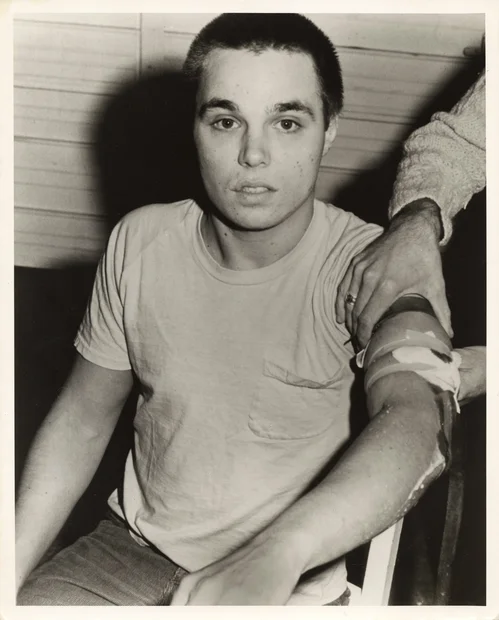
Shoot, F Space, November 19, 1971
Chris Burden
Daniel/Oliver
Collectors can support performance art in several ways. Documentation, scores, props, contracts, and instructions can be part of the work’s collectible form. A collector might also acquire photographs or video that document an action, as with Chris Burden’s performance documentation; or a set of instructions or “event scores,” as in Yoko Ono’s instruction-based practice.
“[Performance art] can engage a multitude of media and is more of a verb (an act of doing) than a noun (a thing),” said New York and Los Angeles–based art advisor Irene Papanestor. “It dismantles static boundaries, is challenging to commodify, and, by extension, can be too slippery for the art world market to metabolize.”
What can you buy with performance artwork?
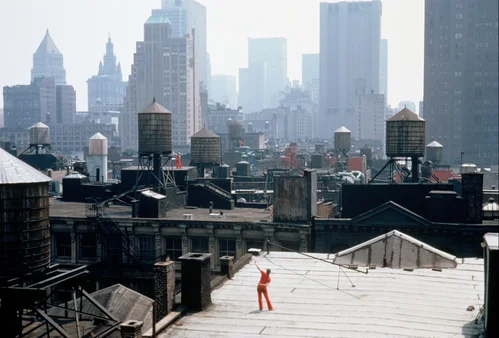
Trisha Brown's "Roof Piece", NYC, 1973, 1973
Peter Moore
Paula Cooper Gallery
In most cases, a collector buying a performance artwork is acquiring some combination of rights, instructions, documentation, and objects. This might include photographs or videos documenting the original performance.
In more specific cases, however, it may include the right to re-stage or activate the work under specific conditions.
“This field is so diverse that it is difficult to generalize,” said Anthony Allen, director of Paula Cooper Gallery. “The material traces of a performance (photographs, preparatory materials, props, etc.) are sometimes made available to collectors, though this varies widely from artist to artist.”
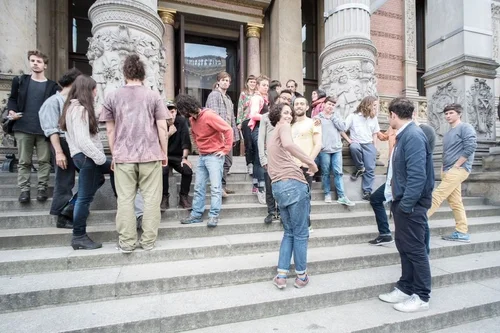
Tino Sehgal, 2015
Tino Sehgal
Gropius Bau
In this sense, buying performance art can be closer to acquiring a score than an object. A collector may acquire the right to re-present a work, but only under terms set by the artist and outlined through a contract, oral agreement, certificate, or other agreed-upon framework. Those terms might determine who can perform the work, where it can take place, how it should be documented, and what must remain unchanged.
In 2012, for example, Javier Lumbreras acquired Tino Sehgal’s Guards Kissing (2002), a work in which two guards kiss each time a visitor enters the exhibition space. Like much of Sehgal’s practice, the piece resists conventional documentation: According to the Adrastus Collection, there can be no video footage or photographic record of the work, and the sale did not involve an invoice or written proof of purchase. Instead, the acquisition took place as a conversational transfer of rights, with witnesses present to attest to the deal.
What should a first-time buyer of performance art ask?
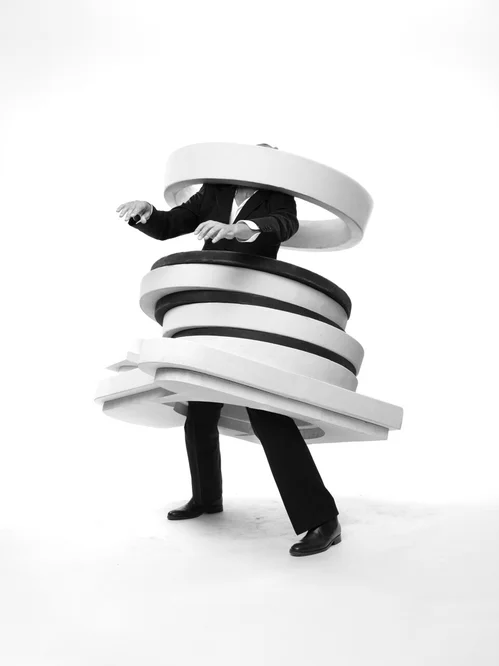
Hooping Guggenheim 2, 2022
Christian Jankowski
Galerie Crone
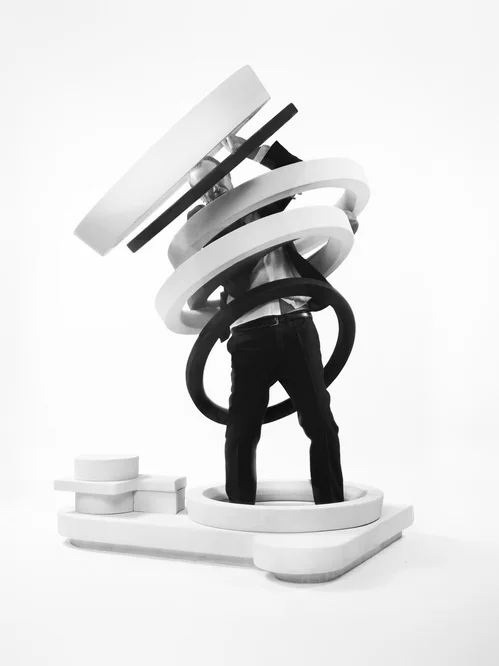
Hooping Guggenheim 5, 2022
Christian Jankowski
Galerie Crone
For collectors used to buying paintings, sculptures, or other object-based works, performance art can feel unfamiliar—especially when the acquisition goes beyond related ephemera, prints, or photographs.
That makes due diligence especially important. A collector should ask advisors, gallerists, curators, and, when possible, artists to explain both the conceptual framework and practical requirements of the work.
“At a minimum, a collector should seek to understand both the context of the artist’s practice and the specific conditions of the work itself, including its conceptual framework and its practical requirements—how it is maintained, activated, or presented over time,” said Falbo. “This involves clarifying what exactly is being acquired (whether documentation, objects, instructions, or rights), under what conditions the work can be exhibited or reactivated, what technical, spatial, or human resources are required for its presentation, and how it is to be preserved, particularly when it involves live or time-based elements.”
Before buying, collectors should ask:
- What exactly am I acquiring: an object, documentation, instructions, rights, or some combination of these?
- Can the piece be re-performed or activated? If so, how?
- Who authorizes future performances?
- Who is allowed to perform the work?
- What space, duration, staffing, technology, or budget does the work require?
- What must remain fixed, and what can adapt over time?
- What documentation is allowed?
These questions are not just about logistics. They help determine whether the collector can responsibly care for the work after purchase.
What does it mean to care for a performance work?
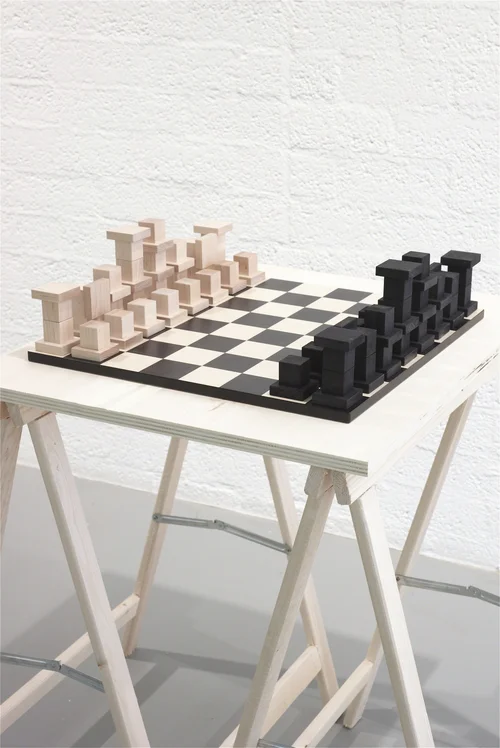
Chess, ca. 1975
Joseph Sassoon Semah
Léna & Roselli Gallery

Iphigenie / Titus Andronicus, from portfolio: Forty Are Better Than One, 1969/2009
Joseph Beuys
Schellmann Art
The best way to understand how to care for a piece of performance art is to get as close as possible to the source.
“This would involve a conversation with the artist or their representative about how best to honor the work in the future, how to remain faithful to the artist's intent,” said Allen. “Obviously, if the collector remains in touch with the artist, these questions can easily be answered case-by-case, but that isn’t always possible. So I would seek clarity on what constitutes an ‘authentic’ iteration of the work and which elements are fixed versus open to adaptation, so the work can continue to exist independently of the artist's direct involvement.”
For collectors, stewardship may involve preserving more than physical materials. It can also mean protecting the artist’s intellectual property, conceptual intent, and conditions for presentation. A performance work may often depend on relationships with galleries, curators, technicians, archivists, or others who understand the work’s original conditions. Caring for the work involves understanding the network and knowing when to consult it.
“Stewardship involves not only conservation but also the capacity to faithfully rearticulate the work over time—often in collaboration with technicians, curators, or others familiar with its original presentation, so that what is preserved is not merely a set of objects, but a network of relationships, instructions, and contextual conditions that allow the work to persist and be meaningfully reactivated in the future,” explained Falbo. Clear terms also help protect authorship, credit, and the artist’s intent when a work is reactivated.
Why do collectors buy performance art?
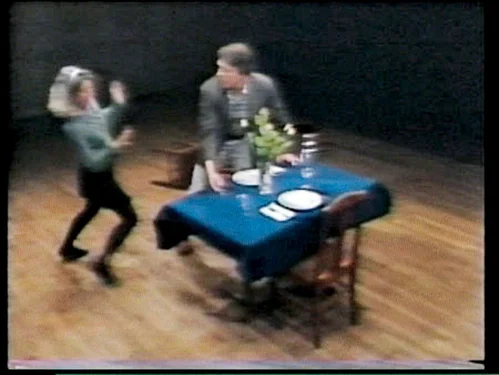
Violent Incident (Man/Woman Segment) I, 1986
Bruce Nauman
Carolina Nitsch Contemporary Art
Performance art can offer collectors a different kind of relationship to an artist’s work. It is often less about possession than participation, stewardship, and support. For collectors drawn to process, experimentation, and conceptual practice, that can be part of the appeal.
Allen encourages collectors to begin by seeing as much performance as possible.
“Attend as many performances as possible, develop relationships with artists working in this field and learn about the conditions, opportunities, and challenges they are navigating,” he said. “It’s particularly valuable to understand how each artist approaches translating performance into objects, instructions, or other formats, and how they envision the long-term life of their work. I would also recommend engaging with institutions, curators, and archives specializing in performance for additional context, and, most of all, remain open to how inherently fluid and variable this medium is.”
Collectors are often drawn to performance because they want to understand an artist’s creative process more deeply. Buying a performance-related work can be a way to support that process, preserve a legacy, and participate in the ongoing life of an artwork that resists easy ownership.
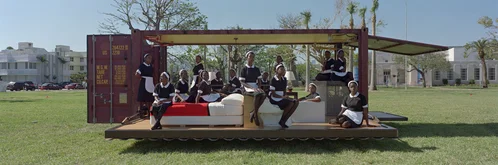
VB58.026.TS, 2005
Vanessa Beecroft
Lia Rumma
“My clients with the greatest curiosity about performance art have an inherent interest in both the creative process—how artwork is ‘made’—and an artwork's conceptual DNA,” Papanestor said. “In 2026, resistance is very much a part of the zeitgeist: our examination of the nature of privilege and the power structures it enables, late capitalism and wealth inequality, and the replacement of human labor by AI.”
For collectors, then, buying performance art requires a shift in mindset. The question is not only “what do I own?” but “what am I responsible for carrying forward?”
