


When Thomas Jefferson wrote about the “inalienable” rights of man in the US Declaration of Independence 250 years ago, it’s possible he lifted the term from the French. And long before it was ever used as an adjective to describe human rights, it defined royal property. To this day, “inalienability” remains a cornerstone of public collections in France—and many other countries—impacting museums and their ability to deaccession, including for purposes of restitution.
The principle is currently set out in two French legal codes, including the Heritage Code, which applies to public museum collections. Under the principle, nothing can be permanently removed from these collections without a special law passed by the French parliament in each case, a cumbersome and time-consuming process.
This was done in 2010 for Māori mokomokai returned from France to New Zealand and for an Ivorian “talking drum” last year. An alternative is to return items to a country of origin as a long-term loan, as was done with the Joseon Manuscripts in 2011; they remain today legally part of the French collection but are physically situated in South Korea, where they will probably stay indefinitely.
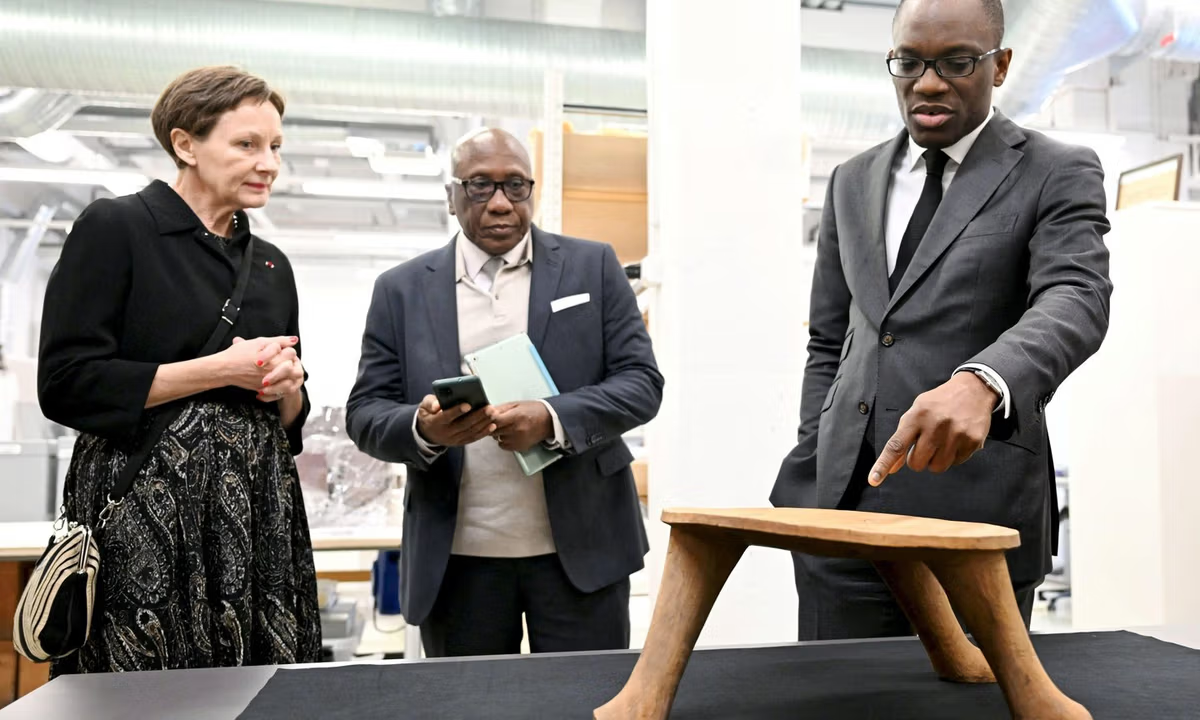
A more recent fudge is to remove an item’s listing from the French inventory. If it’s not on the list, it’s no longer part of the collection—and therefore can be transferred away without legal hindrance. This approach is admittedly risky and seems only possible in exceptional cases. It was used in 2024 to return a ceremonial stool, or kataklè, to the Republic of Benin. The object had been overlooked, deposited by the French at a museum in Finland for over 80 years. A regulation was passed to strike it from the French inventory and therefore allow its restitution to Benin.
Two framework laws were passed in France in 2023 to allow restitution more generally for two classes of objects: art spoliated during the Holocaust and human remains kept in collections. A third law, promising a similar framework for objects taken by “illicit appropriation” during the colonial period (1815-1972), has stalled.
The French have certainly been active, but they still have a way to go.
Papal principles
Another jurisdiction with “inalienable” collections is the Vatican. Due to the unusual nature of the legal system, though, the Pope has been able to deviate from this principle of Vatican civil law. In February 2023, Pope Francis issued an apostolic letter declaring that Vatican property would henceforth be dealt with by canon law, by which it can be alienated for religious reasons. Pope Francis then transferred three Parthenon fragments to the Archbishop of Athens and, at the end of last year, Pope Leo followed suit with the transfer of 62 First Nations objects to Canada through the Canadian Conference of Catholic Bishops.
In the UK, museum collections are not “inalienable” as such, although national museums are generally restricted in disposing of objects, with common exceptions for duplicates, unfit objects or objects that have become useless—with additional exceptions added by legislation for Nazi-looted art and human remains. At the end of last year, the government quietly excluded national museum collections from the application of the Charities Act 2022, which would have given museum trustees more latitude in making moral decisions to return.
Nevertheless, hundreds of non-national museums in the UK are legally uninhibited, provided decisions are made in compliance with charitable trust law, ie are in the best interests of the museum. In rare circumstances, there are additional ways of returning objects when there is an overwhelming moral obligation. In such cases, the law supports moral decision-making on the question of restitution.
Having a legal structure and policy to allow museums to make moral decisions is a sensible way forward—far better than any rigid attachment to sacrosanct principles like inalienability.
