


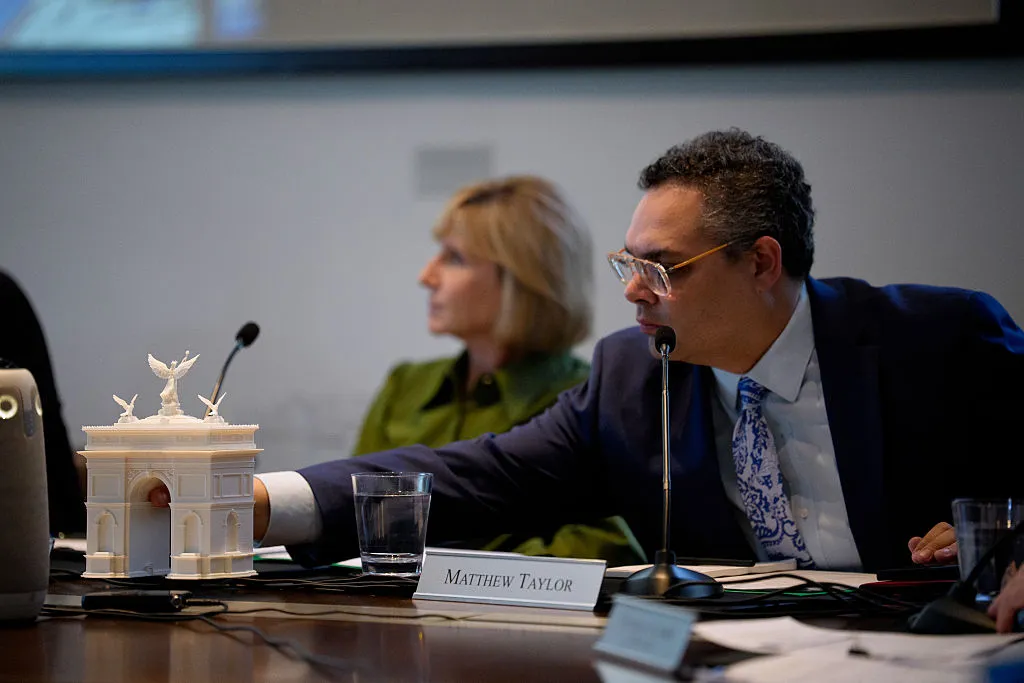
Who is Matthew Taylor, a senior adviser to the National Endowment for the Humanities and a key figure in the Trump Administration’s efforts to reshape the nation’s capital in the president’s image?
Well, the New York Times‘s Zachary Small dug into the little-known, but important figure, and found that Taylor has become a kind of de facto culture czar in the White House. Taylor consulted on the July 4 report that accused the National Museum of American History of “ideological capture”; is overseeing Trump’s maligned National Garden of American Heroes; and continues to serve as a key appointee on the Commission of Fine Arts, whose commissioners Trump fired en masse last year before appointing all seven members himself in January. The Commission has been delegated with reviewing and approving plans for many government projects, including the triumphal arch and the new White House ballroom.
Taylor, Small reports, is intriguing, complex character. In 2020, he directed a well-received Marcel Duchamp documentary, Art of the Possible. He also edited a key attack ad against John Kerry during the 2004 election, and was the editor and cinematographer of Hillary: The Movie, a dispute around which led to the Citizens United ruling, in which the Supreme Court controversially affirmed corporate personhood and overturned long-standing rules around campaign finance.
On his Commission of Fine Arts profile, Taylor describes himself as a “conceptual artist, filmmaker, and messaging strategist whose work spans sculpture, dance, fashion, film, performance, and computational media.”
In one 2018 lecture for the American Association of Political Consultants, Taylor described political candidates as akin to readymades, referencing Duchamp’s famed invention, which includes Fountain (1917) porcelain urinal–cum–sculpture.
