


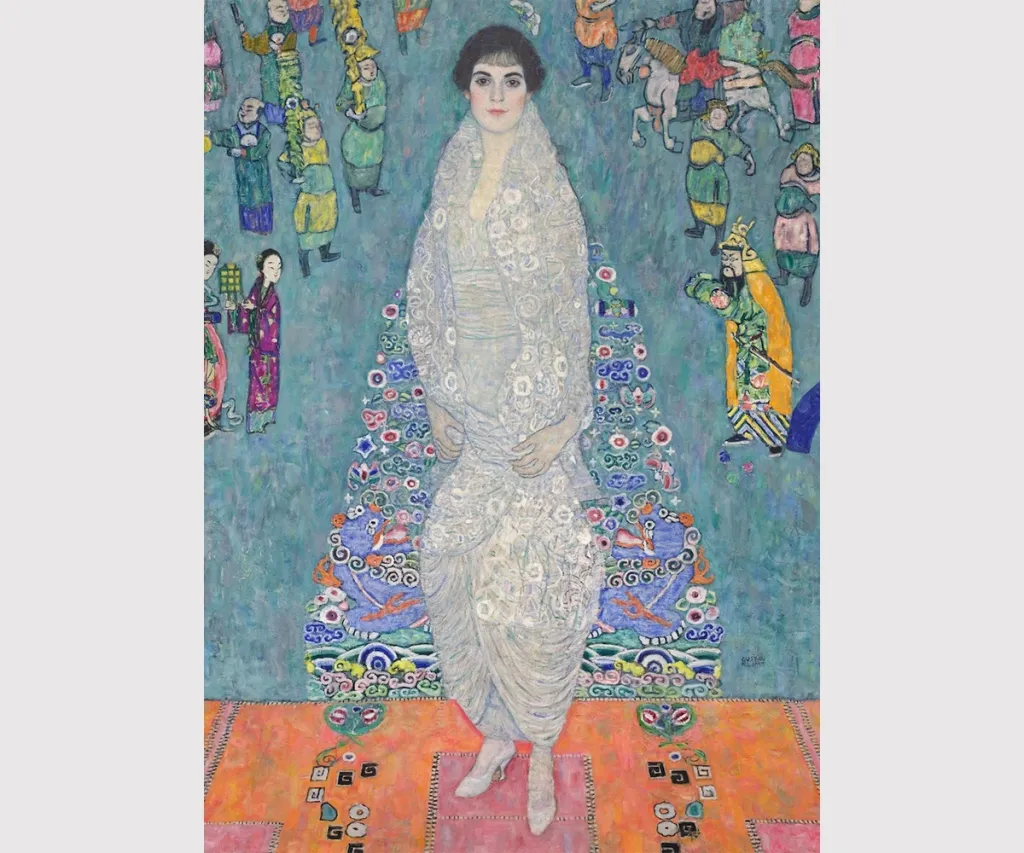
On the night of November 21, 2025, the hammer came down after 20 minutes of heated bidding on Gustav Klimt’s Portrait of Elisabeth Lederer (1914–16), the marquee lot at Sotheby’s New York auction house that evening. Expectations were high, considering that the painting was one of only two full-length likenesses by Klimt still in private hands, but the final offer left even hardened art market insiders goggle-eyed: It sold for $236.4 million, making it the second most expensive artwork after Salvator Mundi (1499–1510), which fetched $450.3 million at Christie’s in 2017 despite its disputed attribution to Leonardo da Vinci. More significantly, the amount paid for Portrait of Elisabeth Lederer represented the most for a modern work of art—proof, if any were needed, that Klimt’s popularity continues to grow.
It’s easy to see why. Opulent and sinuous, alive with floral motifs, dazzling patterns, and arcane glyphs, Klimt’s paintings focus largely on women, both as allegorical figures and as sitters for portraits. His work crackles with eroticism, abandoning itself to sensation.
Sui generis, Klimt’s work combines the swooping sensuousness of Art Nouveau (which he helped to pioneer) with the pictorial solemnity of ancient Egyptian tomb paintings and Byzantine icons—the last being especially notable thanks to Klimt’s use of gold ornamentation and backgrounds. His lesser-known landscapes are just as fantastical in their beauty, with some approaching overall abstraction avant la lettre.
In his art, then, Klimt (1862–1918) straddled ancient and new. But while glossed with a sheen of timelessness, his work wasn’t inured to the currents of his day, or to the place—fin de siècle Vienna—in which it was made.
