


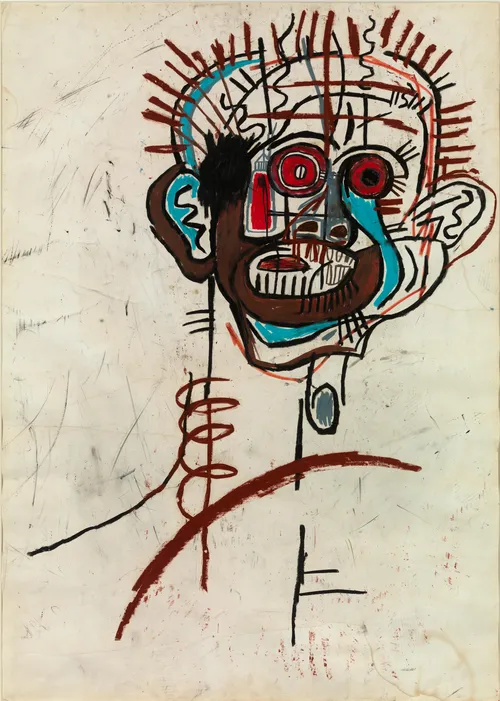
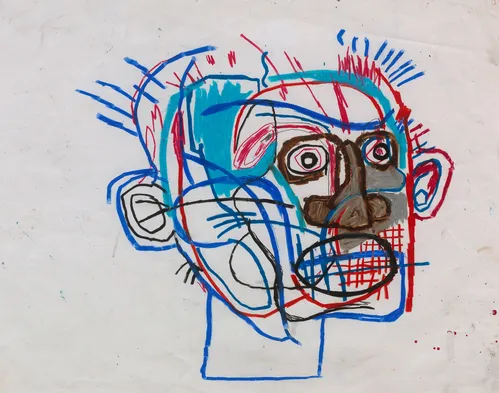
On a large piece of paper peppered with footprints and ink blotches, a large head takes center stage. The facial features are heavily outlined in black, the skin is depicted as quick strokes of crimson, and the eyes are unambiguously misaligned. Even as part of an ensemble with seven other drawings in the first exhibition in Scandinavia devoted solely to works by Jean-Michel Basquiat, the vibrant piece is striking. “We see a big goony head floating in space, its face a series of lines and shapes,” wrote the Pulitzer Prize–winning critic Hilton Als in the exhibition catalogue. “Untitled doesn’t have any words, but it’s a standout in a gallery of standouts because it not only brings to mind his early love of cartoons, but of anatomy.”
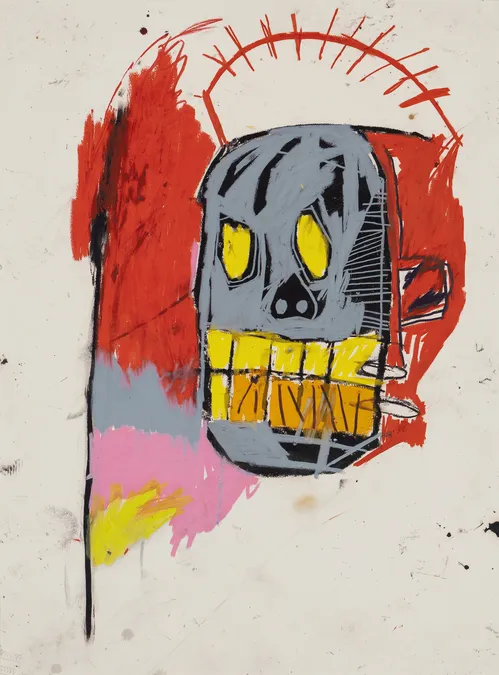
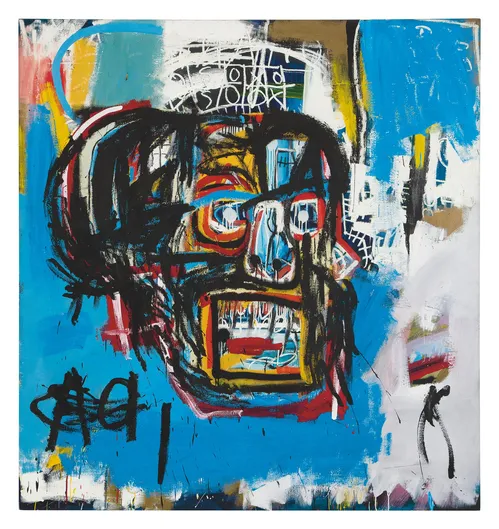
Untitled (1983) is one of almost 50 works in “Basquiat – Headstrong” on view through May 17th at the Louisiana Museum of Modern Art in Humlebæk, a small town just north of Copenhagen. Widely described as the first exhibition devoted exclusively to Basquiat’s depictions of the human head, it brings together an extensive collection of the artist’s works on paper made between 1981 and 1983 and is distinctive for its step away from the iconography-rich paintings he became known for. “It’s not that we’re looking at a group of works that can completely confuse us—they're 120% Basquiat—but there is no writing, there is no ‘famous negroes,’ no Miles Davis, no symbols of corporations or stuff from history,” said the exhibition’s curator, Anders Kold, in an interview. “I was interested in the way we have to make them out ourselves.”
Why Basquiat depicted heads
The New York artist’s fascination with anatomy is attributed to a car accident at seven years old, when he broke his arm and ruptured his spleen. While in the hospital, his mother gifted him the 1858 medical reference book Gray’s Anatomy, which “manifested very clearly” into a “da Vinci obsession,” said Kold. Leonardo da Vinci’s investigation into the human body culminated in an exploration of human nature, including a study of five “grotesque” heads in 1493.
Kold adds in the exhibition catalogue that Basquiat “owned books about the Renaissance master’s art, borrowed from his anatomical studies of the human body, and directly referenced the five grotesque heads.” In Untitled (Charles Darwin) (1983), Basquiat also points more broadly to 19th-century science, portraying the heads of scientists Charles Darwin, Thomas Huxley, and Gregor Mendel.
Basquiat’s drawing practice
While the artist’s relationship to the head is not unknown—having featured in many of his paintings—his drawings have so far never received the same level of recognition, seemingly by his own design, since he never showed most of them in public. The six years before he died in 1988 at the age of 27, when he made most of the works in “Headstrong,” are considered his most prolific and the period that solidified his status as an icon. In 1982, Basquiat had a string of coveted solo shows, including with Annina Nosei Gallery and Fun Gallery in New York, Gagosian Gallery in Los Angeles, and Galerie Bruno Bischofberger in Zürich. And, by 1985, he was on the cover of The New York Times Magazine. Yet, according to Kold, his drawings would only be discovered after his passing, when his father began creating his estate, finding “more than a thousand drawings in storage and in his studio.”
These drawings would first be shown to the public in 1990, two years after his death, at Robert Miller Gallery in New York, showcasing 142 works on paper. “The curator, John Cheim, had curated a salon hang or portrait gallery with 27 heads placed on one wall, looking kind of crazy and a little bit disturbing.” Kold replicated a portion of this display in “Headstrong” using eight drawings including the incongruous self-portrait, Untitled (Self-Portrait) (1982), which Als described as “some version of a self Jean might have seen through someone else’s eyes.”


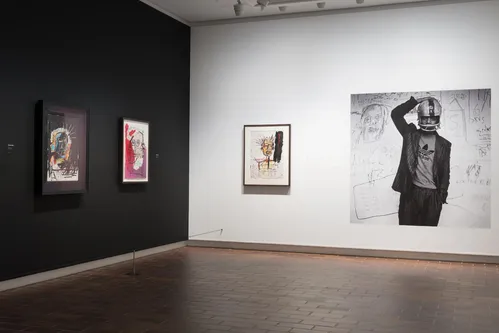
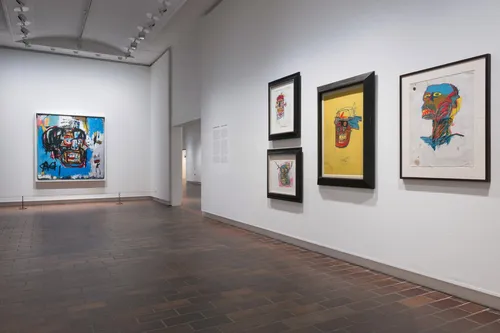
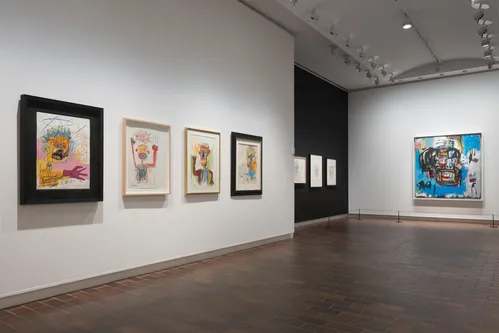
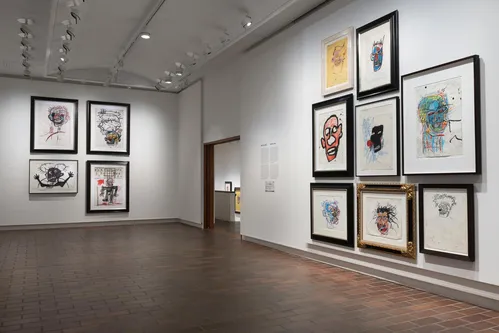
That said, in an interview with Artsy, London-based artist Alvaro Barrington noted that Basquiat’s head drawings can be seen more philosophically. “He took what had been known as a portrait, but it became just about heads,” said Barrington, who had a similar upbringing to the artist (both dual-heritage Black male creatives born to migrants and having grown up between the Caribbean and Brooklyn). Given Basquiat’s age at the time, Barrington believes that the heads illustrate Basquiat’s state of mind more than anything. “In your twenties, most things are just deeply about you,” he said. “I think the heads were really about the world he was seeing.”
The meaning behind Basquiat’s “Heads”
Since Basquiat rarely titled his works, it’s difficult to ascertain the meaning, or even intention, behind these drawings. “What struck me about this series is how different they all are. Such a large output of heads, and each radically different,” wrote the Brooklyn-based painter Dana Schutz in the catalogue. “The head is a site of expression but also the container of the mind. It can be many things at once.” But, what we do know is that “all these heads [are] looking insistently at the viewer,” Kold added, noting that Basquiat was confident in his skills as an artist, but “as a person, he was worried and was trying to come to terms with something (himself or his own place in society or his own identity).”
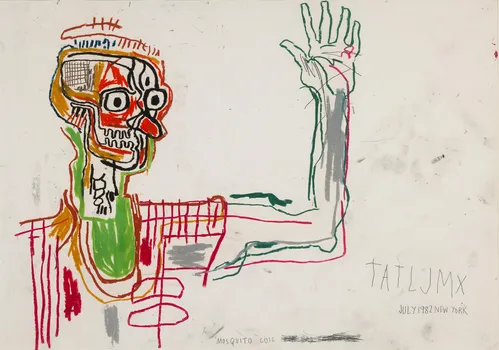
It’s clear Basquiat intended for these drawings to be artworks in their own right. “He’s not painting upside down or with his foot. There’s nothing radical about the drawings as a technique, and the way that he places them in the middle of the sheet of paper is also pretty conventional,” Kold said. Yet, the fact that Basquiat decided to keep these “as a reservoir for himself and does not use them to go into paintings underlines that they’re pretty special.”
The smudges, dirt, and footprints give a clue into Basquiat’s working style, showing that he likely operated on the floor. “There’s a frenetic, ceaseless energy to the works,” Kold said. “I think they are interpretations that include him, but they could also be about—and I wouldn't be surprised if it was—about the art world itself.”
