


Art
Dance and painting may seem like polar opposite art forms: One is dynamic and ephemeral, the other static and enduring. Despite this dichotomy, there’s a long history of exchange between artists of both media. Just think of Robert Rauschenberg and Andy Warhol, who worked extensively with choreographers like Trisha Brown and Merce Cunningham in the late 20th century.
Today, there’s no shortage of contemporary painters following in their footsteps, whether by finding innovative ways to capture dance’s energy in figurative and abstract forms, collaborating with choreographers, or developing their own physical practices alongside their canvas-based work. What drives this impulse?
“I’ve always been a dancer, right from when I was little,” said Nigerian painter Jethro King Oluwatosin, who described winning first and second place at dance competitions at childhood birthday parties. “It has always been my thing.” Then, when he undertook an artist residency in Abuja, Nigeria, last year, where he was surrounded by other artists and dancers, moving together became a shared daily ritual. “I became more intentional about what movement means to me,” he said.
This experience inspired a new phase in his painting practice. He performed as part of the group exhibition “The Awakening” at Odama Gallery in Lagos—featuring choreography rooted in “how we move in Yoruba culture, moving with free flow and pure heart…allowing our ancestors to guide us.” Later, King Oluwatosin created a series of figurative paintings of his dancing body, itself like a canvas painted with symbols and patterns from Yoruba culture. He worked from both photographs, which helped him capture the shapes of his body’s motions, and his embodied memories, which informed his choices of background and color: Azure blues and bright greens reflect the emotions he experienced while dancing. King Oluwatosin believes his paintings, though dreamlike in style, offer a truer documentation of the experience than film or photography.
It’s being able to authentically depict the sensory experience of dance that’s part of the draw for painters who focus on movement in their work. London-based artist and former fashion designer Luella Bartley, for example, similarly discovered that cameras fall short in capturing the full, multilayered reality of dance. Last year, she was invited to observe rehearsals with leading British choreographer Sir Wayne McGregor, an experience that resulted in the paintings exhibited as part of her solo show “Passenger” at Kristin Hjellegjerde Gallery, Berlin, in 2024.
“Through photographs, you can’t really experience the effort, the bulging of calf muscles, the concentration and stamina,” she said. Painting, meanwhile, offers a creative license to convey those sensations. To do so, Bartley experimented with “pronouncing certain areas of the body,” playing with ideas of beauty and ugliness, and giving special attention to the dancers’ dirty sports socks. For her, grimy footwear perfectly captures the “strength and struggle” required to perform seemingly effortless choreography.
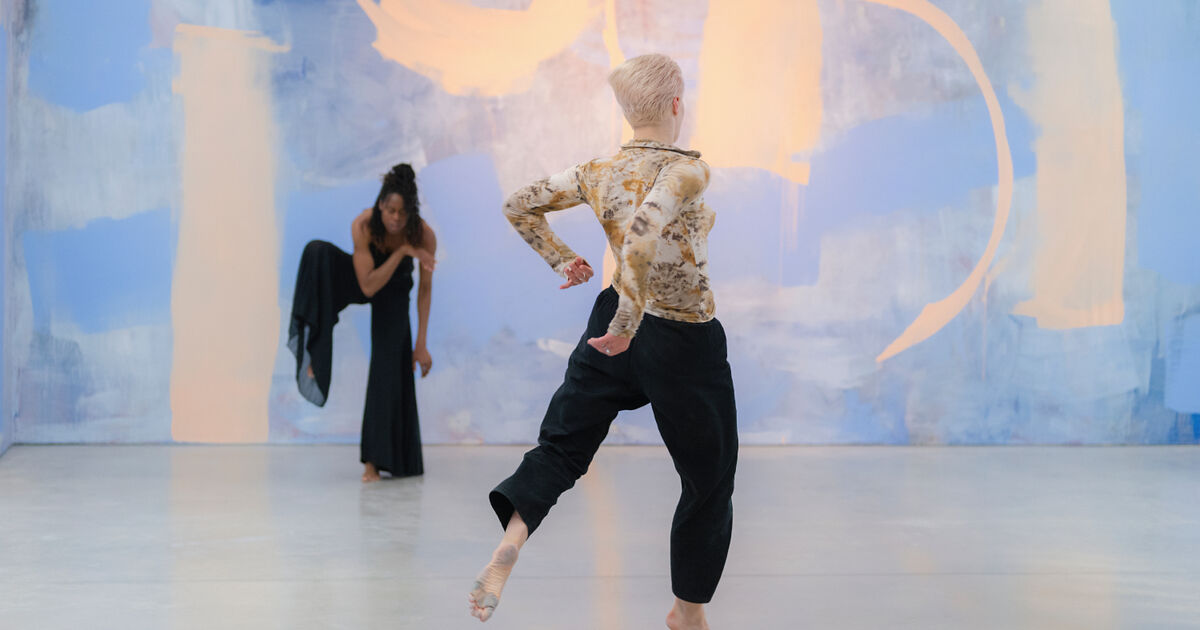
Fellow London-based artist Florence Peake brings movement to life on canvas in a less figurative way than King Oluwatosin and Bartley. A trained dancer who has worked in both painting and choreography throughout her career, Peake’s visual works are often direct outcomes or remnants of live performance. One recent example is a 16-by-16-meter floor painting for Jupiter Artland in Edinburgh, Scotland. The underpainting was created during a performance this summer entitled To Love and to Cherish, which saw two male performers “joined at the lips, snogging in a continuous kiss while [other performers] pour[ed] paint all over them,” according to Peake. The painting was installed in the art space’s newest space, The Glasshouse, which will also serve as a wedding venue. With this in mind, the artist hoped to subvert the concept of traditional marriage vows. For her, the traces of paint left behind serve as a physical reminder or imprint into the ground of queer love.
Peake spent two weeks after the performance layering new marks on top of this base, guided by memories of the “tangled bodies” from the event. In much of her past work, she has created objects that, through dance, continue to evolve. Sometimes her paintings are reused in performances or otherwise exhibited in new contexts. Peake’s performance Factual Actual at the National Gallery in London in 2021, for instance, featured large painted canvases that dancers dragged, folded, and manipulated into sculptural forms. The performance subsequently toured to museums including Fruitmarket Gallery in Edinburgh, Scotland, and The Towner in Eastbourne, England, and the canvases were later displayed at London’s Richard Saltoun in a more static, classical exhibition format in 2023.
Florence Peake, To love and to Cherish , 2025, at Jupiter Artland. Photo by Neil Hanna. Courtesy of the artist.
In contrast, Peake’s floor painting at Jupiter Artland will become fixed, sealed beneath a layer of resin. “I feel terrified of that actually,” she admitted. “The ephemeral nature of dance has always been a safer place for me, this ‘unfixity’ where things continuously unravel. Committing to something material can be very frightening.”
Even painters without formal movement training see parallels between their painting processes and dance. “Over time, I’ve started to explore movement in a very broad sense and have become captivated by the simple awareness that how I moved towards the canvas impacted what came out on the surface,” said Megan Rooney, a London-based Canadian painter known for abstract canvases with gestural brushstrokes. “I do not work with preparatory sketches, so my life in the studio is made up of small performances that no one sees,” she added. This said, Rooney does also stage public performances, frequently collaborating with choreographer Temitope Ajose and dancer Leah Marojevic who develop live dance works inspired by her paintings and narratives.
Today, the relationship between dance and painting has become more fluid than before, artists said. Peake finds the exchange between dance and painting “more liberated now” than in her early years as an artist. “There used to be a real snobbery around [the fact] that I was working with a group of ‘really shambolic’ body art people,” she said. “I used to tie myself in knots. Should I be in this gang or that gang?”
Megan Rooney, Spin Down Sky, 2024. Performance at Kettle’s Yard in collaboration with Temitope Ajose, Leah Marojevic and tyroneisaacstuart. Photo by Camilla Greenwell. Courtesy of Kettle’s Yard.
Berlin-based painter Marcus Nelson agreed that the relationship between dance and painting has become more fluid, citing social media as a crucial tool in creating that change. In 2024, for example, he connected with emerging Scottish choreographer Magnus Westwell through Instagram, sparking a yearlong collaboration. The project culminated in a show of paintings by Nelson and a film by Westwell titled “WEIGHT” at Number 1 Main Road, Berlin, in March.
“Originally, I planned to paint directly from film stills, but I felt I would be losing something because it wasn’t my own body,” said Nelson. His practice usually involves staging elaborate shoots under “stark, chiaroscuro lighting” in which he moves his body to music, namely dramatic film scores. The movement doesn’t just “come out of nowhere,” Nelson says. It’s intensely planned, and he develops sketches, stage plans, and directions before staging his private performances. He exhibited these preparatory materials for the first time collaged together inside two reinforced glass security doors as part of the group show “Polyphonic Views” at Funkhaus, also in Berlin, back in September.
Installation view of Marcus Nelson and Magnus Westwell, “WEIGHT,” 2025, at Number 1 Main Road, Berlin. Photo by Johannes Kremer. Courtesy the artists.
“It’s not easy to do, because I have to be in the right headspace.…they are very emotional,” he said of the performance sessions, which he photographs before he reimagines them on canvas. “In order for that rhythm and sense of movement to come through into the paintings, I have to be willing to embody that in the way that I apply the strokes.”
Building on this approach, Nelson recreated Westwell’s film choreography on what he calls his “strange, alternate” body. “The movements I was recreating were really hard to achieve physically. They took multiple attempts to get right,” he says, noting he hasn’t been trained as a dancer and that it’s “not [his] medium.” When he came to paint these works, though, Nelson found it exhilarating: He was working with new physical configurations he’d never depicted before. This expanded understanding of bodily possibilities was exactly why he had wanted to collaborate with a choreographer in the first place.
Marcus Nelson, Contained (I,II) (composite V), 2021–25, in “Polyphonic Views,” 2025, at Funkhaus, Berlin. Courtesy the artist.
Florence Peake, To love and to Cherish, 2025, at Jupiter Artland. Photo by Neil Hanna. Courtesy of the artist.
Nelson’s experience—marked by both apprehension and exhilaration in approaching a new discipline—highlights how, for artists trained in capturing still images, engaging with movement can open up new spatial, emotional, and physical possibilities. Today, the most compelling results arise when painters collaborate with specialized movement artists rather than pursuing these explorations in isolation. “I always love hauling two different things into each other or to find a relationship,” Peake said. As contemporary artists continue to draw from this contrasting discipline, the tension that emerges from these collisions is pushing painting into new, unexpected directions.
