


In 1900, the events of the 20th century still lay ahead, its horrors and epochal upheavals unknown. But in one European metropolis, signs of that future could be gleaned from the social, political, and artistic unrest that roiled it.
Vienna in the years leading up to World War I was the capital of an unstable dual-state domain, Austria-Hungary, whose decrepit monarch, Emperor Franz Joseph I, presided over a powder keg of ethnic groups. These included Czechs, Slovaks, Croats, Serbs, Bosnians, and Slovenes, among others, each with their own language, traditions, and aspirations to independence. Intermingled among them were the Jews, who lived with the onus of anti-Semitism while also disproportionately populating the cultivated and affluent elite of Viennese society.
The city was the crossroads for individuals who would instigate various convulsions to come: Sigmund Freud, father of psychoanalysis, whose concept of the unconscious utterly altered our understanding of the human condition; Gustav Mahler and Arnold Schoenberg, two composers who radically transformed classical music; and a young Adolf Hitler, who would emerge from a life of failed artistic ambitions and vagrancy on Vienna’s streets to author the Holocaust.
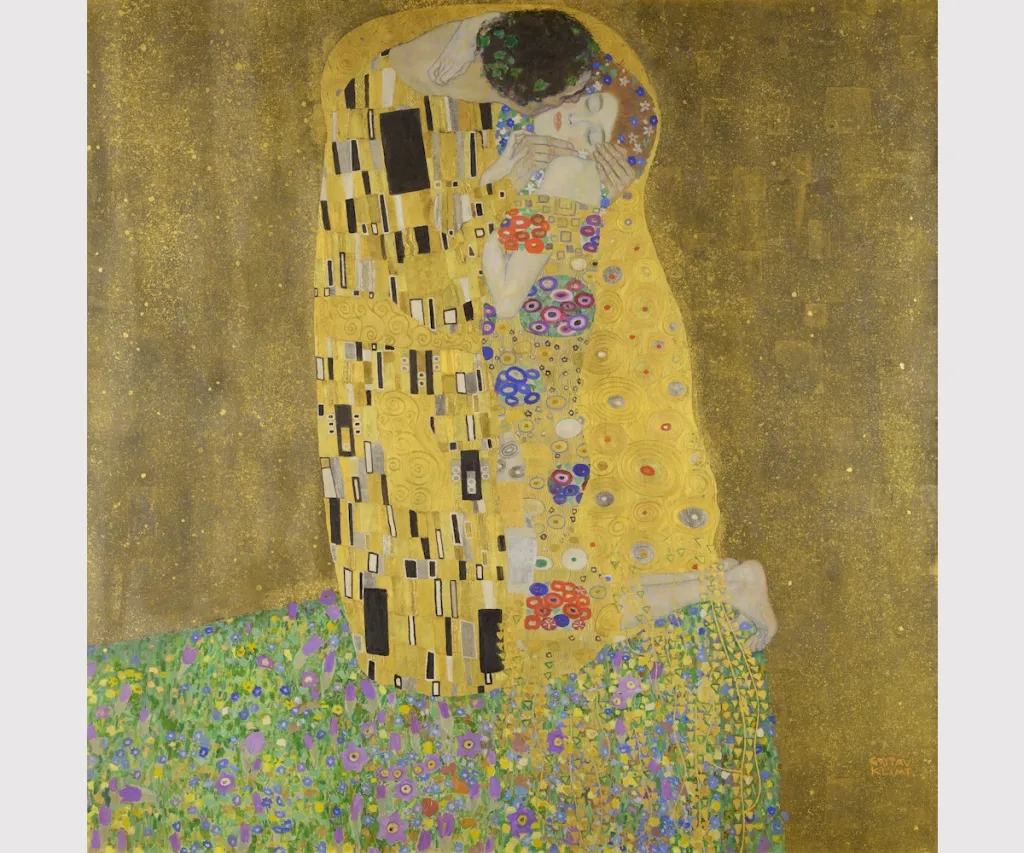
And then there were the painters who fared far better than Hitler—chief among them Gustav Klimt, whose six-by-six-foot composition The Kiss (1907–1908) is one of the most recognizable works in art history. Along with his countrymen Egon Schiele and Oscar Kokoschka, Klimt plumbed the depths of a neurasthenic culture seething with repressed sexual tensions.
Klimt (1862–1918) lived long enough to see the dissolution of the empire in its initial stages, but his work wasn’t so much a harbinger of its immolation by the Great War as it was a snapshot of the decadent fiddling that preceded it. The Kiss, with its melding of lovers dominating the composition as a large, proto-psychedelic form overlaid with elaborate decorative patterns, suggests as much. The head of the man is encircled with a crown of laurels, while together, the embracing couple kneels at the edge of a floral-carpeted precipice, poised as if about to heedlessly tumble into an abyss formed by a gilt backdrop.
Klimt’s work was characterized by the same penchant for fantastical imagery and abandonment to feeling that informed Symbolism, though it was more rooted in graphic design and architecture. Like many European artists of the time, he was inspired by Japanese art, but also by an earlier craze for ancient Egypt that followed Napoleon’s campaign in the land of the pharaohs. Indeed, the figures in The Kiss are as flat as any found in the tombs of the Valley of the Kings, and just as covered in Klimt’s own hieroglyphic vocabulary of geometric and organic shapes.
Klimt also became a pioneer of Art Nouveau’s swooping, swooning style thanks to his role as co-founder, in 1897, of the Vienna Secession along with designer Koloman Moser, architect Josef Hoffmann, and others who embraced the concept of the Gesamtkunstwerk, or total work of art. The Secession derived its name from its break with the Association of Austrian Artists, which promoted traditional aesthetics, and was arguably the first of the interdisciplinary movements (De Stijl, the Bauhaus, Russian Constructivism) that would come to define Modernism.
Women were the primary focus of Klimt’s paintings and murals, as subjects of both portraiture (as in his iconic 1907 likeness of Adele Bloch-Bauer, the wife of a wealthy Jewish banker) and compositions such as Nuda Veritas (1899), a nearly life-size, full-frontal rendering of an unabashedly naked model symbolizing Truth. Klimt went so far as to include her pubic hair, leading to charges that the work was pornographic. Similar outrage greeted three other allegorical figures respectively titled Philosophy, Medicine, and Jurisprudence, created between 1900 and 1907 for the ceiling of the University of Vienna’s Great Hall. The Kiss was positively demure in comparison and far more enthusiastically received, but it, too, scandalized the conservative elements of Vienna’s upper echelons.
Speculation has centered on who the lovers in The Kiss actually were, with some saying the man was Klimt himself. The woman has been variously identified as Emilie Flöge, Klimt’s companion; a model known as “Red Hilda”; and Alma Mahler, wife of the aforementioned Gustav Mahler. Ultimately, nobody really knows for sure, lending The Kiss an air of mystery.
Most agree, however, that The Kiss signals the high point of Klimt’s so-called golden period, during which he enhanced his paintings with gold leaf applied to the canvas—a trope connected, no doubt, to the fact that his father, Ernst, was a goldsmith—to conjure a glittering, otherworldly matrix.
More famously, Klimt’s auric effects were influenced by a 1903 trip to the church of San Vitale in Ravenna, Italy, where he saw the sixth-century Justinian and Theodora Mosaics, which similarly subsumed their content with gilt tiles. Depicting the eponymous Eastern Roman Emperor and his consort surrounded by court and church officials, the mosaics were occasioned by Justinian’s successful reconquest of Italy, which had fallen under barbarian rule following the collapse of the Western Roman Empire during the fifth century. The imagery asserts Justinian’s power over his realm, but also over a heavenly plane drenched in gold. This motif would remain a key element of medieval painting, especially in Italy.
The gilded space of The Kiss is just as ethereal and impenetrable as that of Justinian’s self-aggrandizing propaganda, and no less religious in tone. However, Klimt substituted spiritual rapture with its carnal equivalent, represented as a form of communion consecrated by the act of painting itself. “All art is erotic,” he once wrote, by which he meant that the pleasures of artmaking are indistinguishable from those of sex, whether explicitly expressed or not. Given that Klimt fathered 14 children through numerous affairs (mainly with his models), this outlook is understandable.
The Kiss could have easily slipped into sentimentality but ultimately didn’t thanks to a nesting doll of equilibriums: It exists between sacred and profane, antiquity and modernity, decoration and art, intimacy and monumentality. Like any artistic icon, it is timeless, but also an echo of a place and period that eventually met a violent end.
