


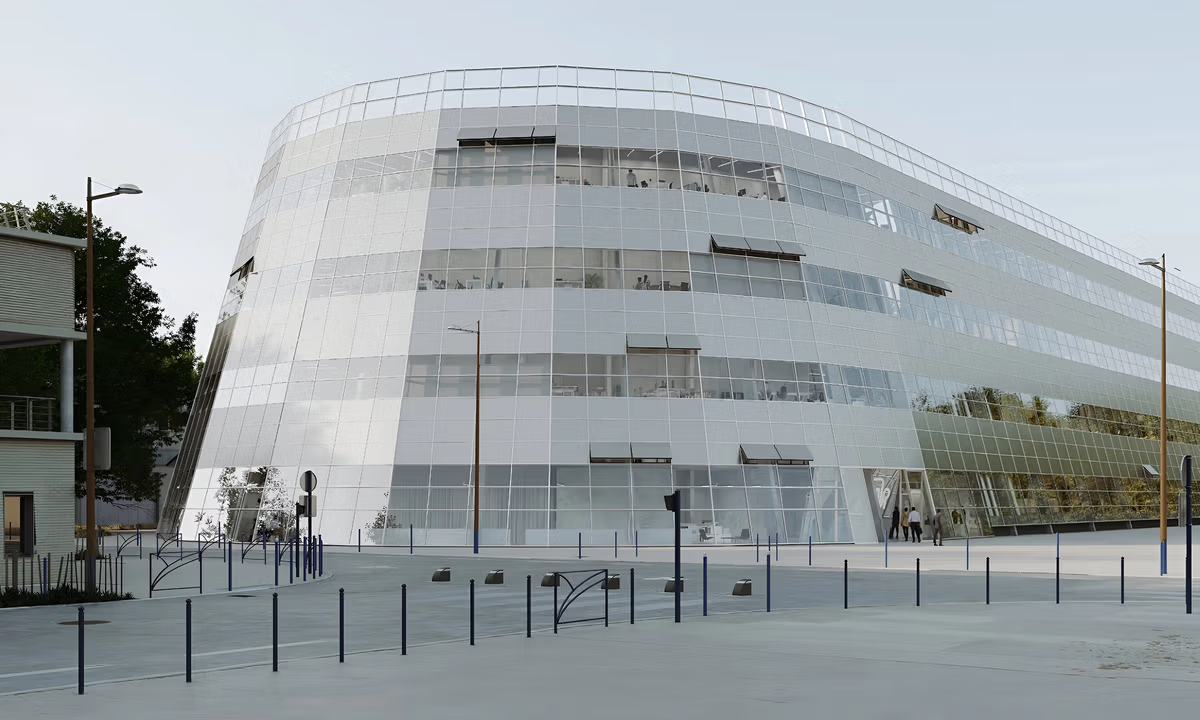
Few members of the public in France, let alone people outside the country, were aware, until quite recently, of the Centre national des arts plastiques (CNAP). Created in 1982, this government agency designed to support living artists in the country and collect their work is, by definition, as fundamental as it is discreet.
In the past six months, however, two government reports have pushed the CNAP into the limelight. Both were prompted by the profusion of private investment, international galleries and rising institutional clout. But they draw diametrically opposed conclusions on its future, which pundits, art professionals and scholars alike say underscores a wider ideological shift in how culture is perceived—and valued—by the state.
As the sociologist Laurent Jeanpierre puts it, “there is a prevailing notion, held in particular by the current Macron administration, and further on the right and far-right, that public expenditure is too high and the state must be slimmed down”. Contemporary art, as is so often the case, is the lens that brings this conflict into focus.
Martin Bethenod has published a white paper for the culture ministry that looks at the CNAP’s acquisitions policy © DPA Picture Alliance/Alamy Stock Photo
In July, the former director of the Palazzo Grassi in Venice, Martin Bethenod, published a white paper for the French ministry of culture in response to culture secretary Rachida Dati’s assessment that, despite the increasing effervescence of the contemporary art scene in France, the country’s own artists seem to have little to show for it. Bethenod concluded that Paris museums including the Centre Pompidou and Palais de Tokyo and the CNAP had central roles to play in this state of affairs. He suggested refocusing the latter’s acquisitions policy with higher quotas of France-based artists and galleries.
By contrast, in November, the Cour des Comptes, the official audit office, published an altogether more scathing report into the CNAP’s finances. Its author, the magistrate and civil servant Julien Aubert, found the agency to be administratively fragile, budgetarily challenged and potentially redundant. Aubert noted that 46,386 of the works of art under its care are in storage and 24,472—one quarter—have never been exhibited. He castigated the disproportionate expenditure on running costs (€12.8m in 2024), relative to investment (€5.4m) and recommended the CNAP be closed by 2030.
‘Not working, nine times out of ten’
Reactions to the second report have been swift and critical. Aubert, the former Les Républicains MP for the Vaucluse département, is known for his conservative stance. In a 2023 interview with the Nouveau Conservateur journal, he called for all state funding to be cut from “le wokisme” in the arts and slated France’s network of regional contemporary art collections as “not working, nine times out of ten”.
In an open letter to Le Monde, around 1,000 art world professionals—including Chris Dercon, the director of the Fondation Cartier in Paris, Guillaume Désanges, the president of the Palais de Tokyo, and Sandra Patron, who heads up the CAPC Musée d’art contemporain in Bordeaux—criticised what they perceived as the Cour des Comptes’ ideological attack not just on the CNAP but the very notion of culture as a public service.
The cultural policy expert Jean-Michel Tobelem points out that the CNAP’s annual budget of €18.4m is small potatoes compared with, say, the Musée du Louvre’s annual costs of around €300m. Shutting the organisation would not help the country’s artists, Jeanpierre says, adding: “The report does not take into account the institution’s long history or its specificity, its efficacy. It presents no research into its successes. It only highlights its shortcomings.”
The CNAP has existed, under a different name and state tutelage, since the French Revolution. Founded in 1791, it is older than the ministry of culture itself, but its dual missions have not changed that much. Its support was most evident during the pandemic, when it provided individual grants of up to €15,000 for research and production. It shepherds what is now known as the Fonds national d’art contemporain, a 200-year-old state collection Jeanpierre says is unlike any other. It operates as a kind of “photographic record of the state of contemporary artistic practice in France, at any given time”. And it is functional. Of the 108,000 works under its care, many populate the nation’s town halls, churches, civic buildings and embassies.
Paradoxically, both reports raise the common complaint that France is not as visible as it should be on the international art scene. But, Jeanpierre says, that was never the CNAP’s responsibility. “This is an institution tasked with nurturing a dense artistic fabric from which can emerge not necessarily famous artists, but, simply put, artistic creation that is not valued on the basis of its international visibility or the art market prices it fetches.”
