


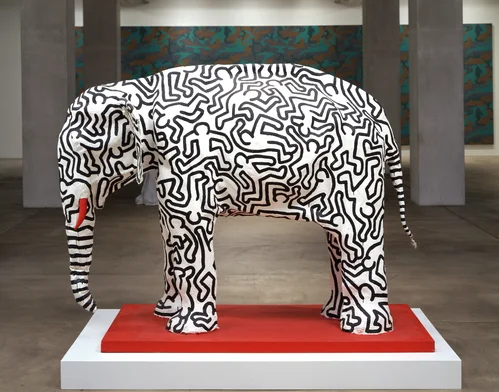
Even in the 1980s, Keith Haring’s distinctively spry drawing style seemed to be ubiquitous. His striking, flat line compositions featured an endless flow of dogs barking, or television and computer screens broadcasting his “radiant baby” figures. Elsewhere, he portrayed UFOs radiating powerful beams of energy, beating hearts, and mythical creatures. These graphics covered every surface imaginable in downtown New York—the city was his home and studio. Working prolifically until his death from AIDS-related illnesses at the age of 31, Haring left behind a huge number of artworks, some of which are only now getting the attention they deserve.
Though he is perhaps best known for the arresting drawing patterns that are familiar cultural touchpoints, he also produced sculptures, though they have received less attention until now. Crystal Bridges Museum of American Art’s new exhibition, “Keith Haring in 3D,” features an expansive chronological and thematic survey of the objects and three-dimensional artworks that the artist claimed with his singular graphic approach. The exhibition, on view through January 25, 2027, is designed to bring out deeper dimensions in the work as well. Standalone cube-shaped rooms hold bodies of work together thematically, and nothing is installed on the walls of the galleries directly. Though the expression lines surrounding his two-dimensional characters give them a lighthearted edge, his subject matter was deeply, radically political. As curator and artist Robert Storr writes in the exhibition catalog, “He made it all look so easy, which is anathema for those who view struggle as the litmus test of consequential talent …” Here are five things to know about this lesser-known side of Haring’s practice.
Every found object was a blank canvas
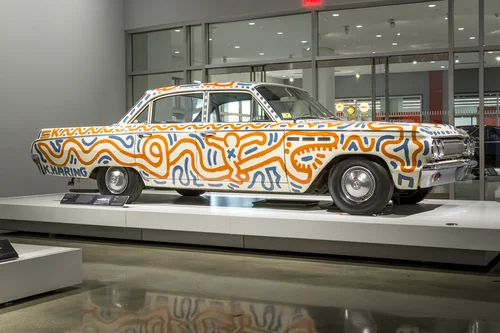
Haring saw the potential for nearly any object to become a canvas: He turned trash cans, plant-store vases, crutches, cribs, high chairs, and thrifted treasures into works of his own. Along with his friends, fellow artists Jean-Michel Basquiat, Kenny Scharf, Fab 5 Freddy, and others, Haring decorated the “fun fridge” in the East Village’s FUN Gallery, a hub for downtown crowds. He also brought his talents to a readymade trophy awarded for “best voguing” at the DIFFA (Design Industries Foundation Fighting AIDS) Love Ball. Another sculpture was made as a sentimental valentine for his gallerist, Patti—a deluxe red heart filled with chocolate bonbons from Godiva, which he then covered in rows of his heart-faced figures and rows of x’s.
Cars held a particular allure for Haring: One of the first objects that he ever covered in his sketches was a side panel of a taxi in 1981, with his frequent collaborator, Angel Ortiz (also known as LA II). By 1986, he graduated to drawing on a 1963 Buick Special, which is completely covered in his orange and blue lines. Haring painted the Buick (signed with a large orange K) for architect Peter Pennoyer in return for the design of the artist’s legendary Pop Shop in SoHo.
Keith Haring was inspired by antiquity
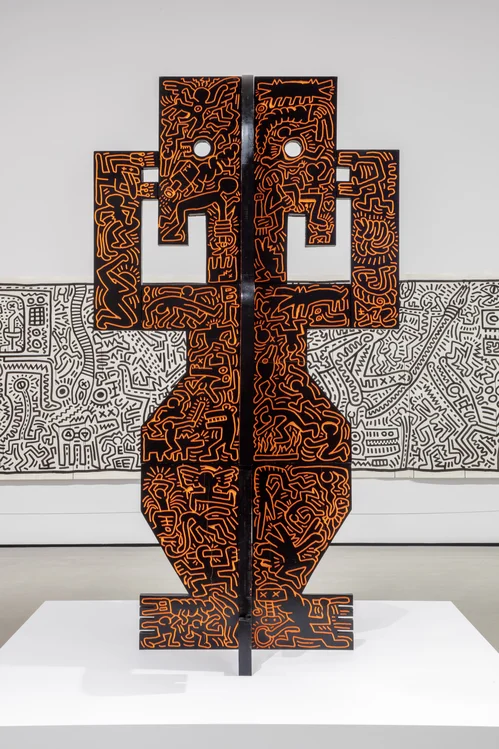
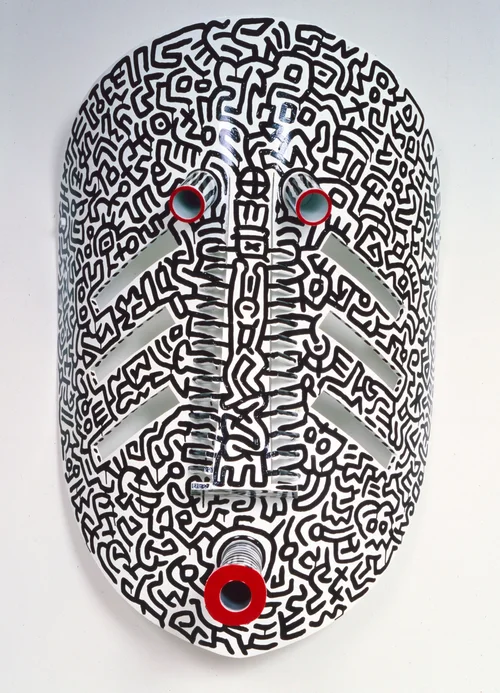
Though deeply informed by the art of Africa, Central and South America, and the Pacific Islands, Haring continued to make what artist Roy Lichtenstein referred to as “pseudo-Greek things.” For example, the exhibition begins with a large cluster of terracotta and fiberglass vases in the Greek black-figure pottery tradition. In Untitled (Vase for Monique) (1989), for example, a line of figures is just outrunning a snake’s tongue, while a ring of figures dances below it, holding hands.
Yet it was ancient Egypt that had some of the greatest influence on his sculptures. Around the same time that he moved to New York City from rural Pennsylvania, the Metropolitan Museum of Art staged “The Treasures of Tutankhamun,” a record-breaking exhibition that reverberated in popular culture at the time. While a student at the School of Visual Arts, Haring filled his notebooks with sketches of Nefertiti and King Tut.
Eventually, Haring had the chance to recreate his sarcophagus in shimmering gold fiberglass and adorned it with LA II’s graffiti tags. He also produced several pyramids in his primary-color-blocked pattern. And although the figures that feature throughout his drawings are often seen as inspired by breakdancers, they also reference the figures that lined ancient Egyptian friezes. In the blue-and-yellow pyramid on view here, Haring’s “radiant pets” are tightly packed into a choreographed jumble among figures lassoed around their waists and necks. Their arms are exaggeratedly outstretched far off their torsos, and morphing into the animal figures around them, referencing the Egyptian animal pantheon.
Haring created living sculptures in performances
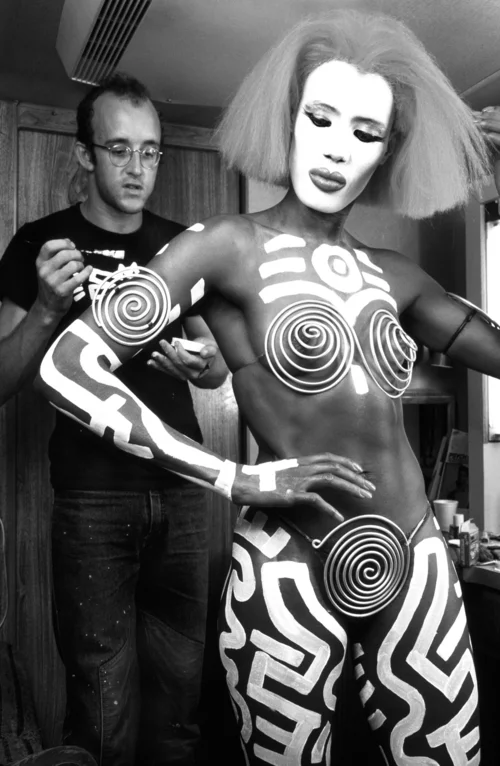
Keith Haring and Grace Jones, “Vamp”, Burbank, 1986
Douglas Kirkland
Fahey/Klein Gallery
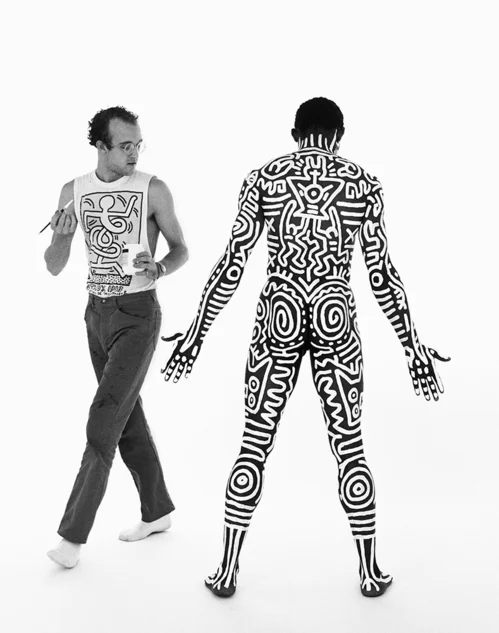
Bill T. Jones Body Painting with Keith Haring, 1983
Tseng Kwong Chi
Yancey Richardson Gallery
Haring experimented in both video and performance with other artists. For Video Clones (1979), he filmed dancer and choreographer Molissa Fenley in movement, capturing the alternating circle and square outlines in which she moved her feet.
His work with choreographer and dancer Bill T. Jones is still instantly recognizable today: For his 1982 performance Long Distance, Haring painted the walls behind Bill T. Jones onstage at The Kitchen. For later projects, Haring painted on Jones’s skin, drawing his signature sketches on him in white acrylic as Jones posed for the camera. In these performances, Haring would eventually turn the paintbrush onto his own body, as captured by Annie Leibovitz. Haring painted Grace Jones (who Andy Warhol introduced him to) in the same manner, adding elaborate, graphic black-and-white towering headdresses. Jones’s portraits as a living “Haring figure” were captured by Robert Mapplethorpe in 1984.
He made outsized fashion for outsized personalities
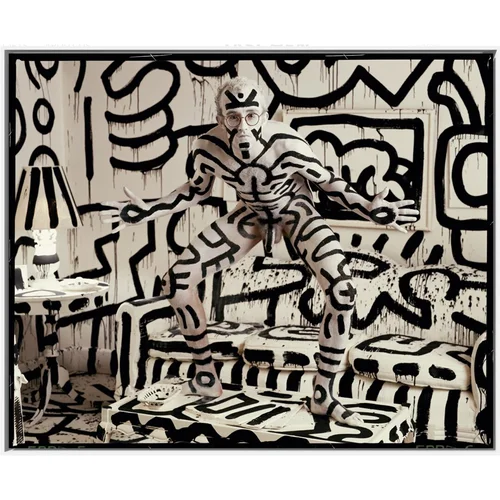
Art Edition No. 1–1,000 ‘Keith Haring’, 2023
Annie Leibovitz
Weng Contemporary
Downtown street culture, the art world, and nightlife all converged at one place for Haring: the club, particularly Palladium, which opened in 1985. Artists were celebrities there, and Haring was given the honor of painting the enormous mural behind the DJ booth at the venue’s grand dance floor. His chromatic, euphorically dancing figures appeared to bring their rhythm to the dance floor in front of them, as if in three dimensions.
For his “Party of Life” birthday party in 1984 at Paradise Garage, guests wore his collaborative designs with Malcolm McLaren and Vivienne Westwood. Haring painted Grace Jones head-to-toe and she climbed a stage flanked by two of Haring’s decorated columns for a completely immersive performance.
Later, in 1986, Haring produced a 60-foot-long skirt for the music video for Grace Jones’s song “I’m Not Perfect (But I’m Perfect For You).” The entire skirt painting was revealed at the end of the song.
Pop Shop was art for everyone
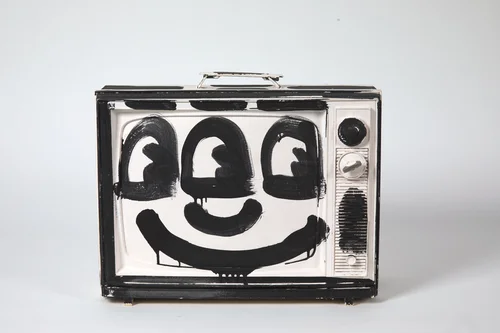
Though Haring’s shaking figures became icons of the New York subway system, he eventually stopped tagging them, as collectors began to take them for themselves from the station walls. Instead, he opened Pop Shop, his own store at 292 Lafayette Street, in 1986. Pop Shop made his Pop art easily accessible to the public, selling novelty pins, clothing, pillows, radios, watches, stickers, and charms, allowing just about anyone to participate in the circulation of his art. Pop Shop inverted the art-viewing experience, turning the exhibition and the gift shop into one experience where everything was for sale and nothing was off-limits.
