


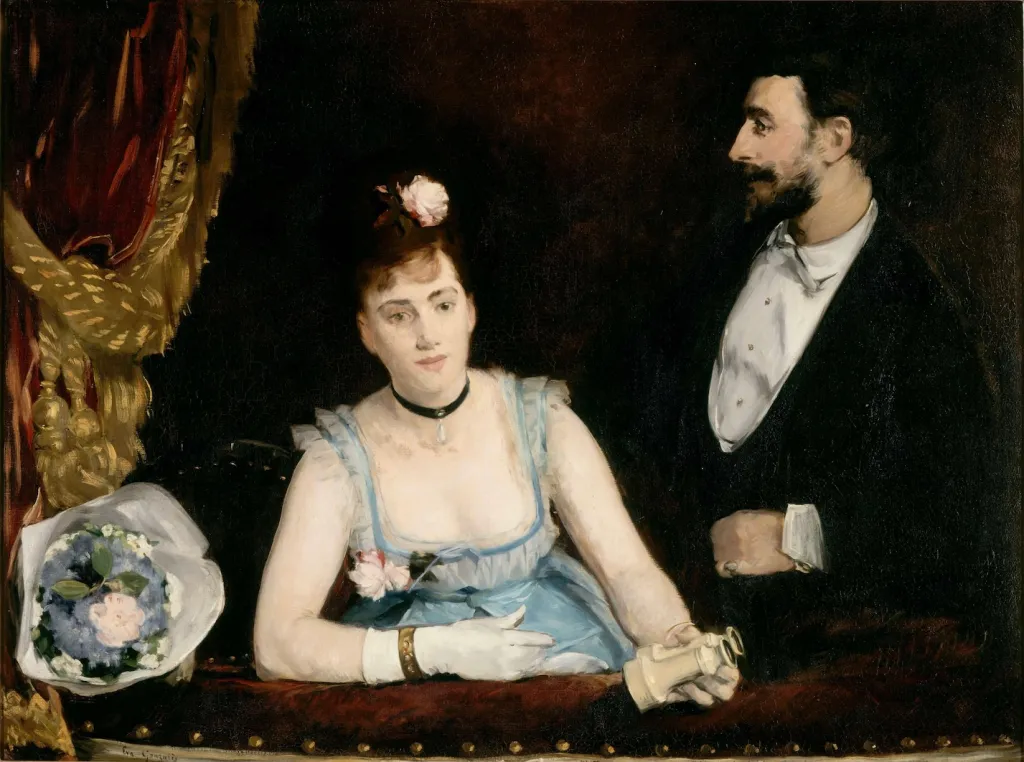
The French painter Eva Gonzalès, much like her mentor, Édouard Manet, did not personally identify as an Impressionist, nor did she participate in the group’s exhibitions.
Her velvety brushstrokes were faithful to the human form, indulged no illusion of perspective, and stated a belief that the female mind was a landscape in its own right—wild, deep, and worthy of veneration. In her 1874 A Loge at the Théâtre des Italiens, an operagoer, one glove missing, leans over a banister, fair skin radiant against the void.
Yet search Gonzalès online and she is almost always grouped with three female contemporaries—Mary Cassatt, Marie Bracquemond, and Berthe Morisot—as painters of unmistakably Impressionist sensibility. They were even billed as the “Four Grandes Dames” in a major 2024 survey tied to the anniversary of the movement at the National Gallery of Ireland. The misnomer has defined, and confined, the painter’s legacy in the nearly two centuries after her death.
Maybe it’s a willful misreading, driven by museum sales or the consequences of woefully outdated scholarship, since Gonzalès’s sole catalogue raisonné appeared in 1990. An update is long overdue, according to the Wildenstein Plattner Institute (WPI), a leading publisher of digital catalogues raisonnés specializing in European artists active from the 18th through the 20th centuries. Last month, the New York–based nonprofit released a comprehensive index of Gonzalès’s oeuvre, including newly reattributed paintings and, for the first time, her sketchbooks (now the property of the National Gallery of Art in Washington, D.C.)
“There are a lot of digital catalog raisonnés projects in the works, and very few of them are on women artists,” WPI executive director Elizabeth Gorayeb told ARTnews that the co-author of the original book, Marie-Caroline Sainsaulieu, approached the organization with an opportunity to continue the work she began. After all, the “very nature” of the printed catalogue raisonné is “iterative”: works are sold and disappear into private collections, fade from institutional memory only to resurface years later, or are outright misattributed—omissions or errors enshrined in print.
“Rather than letting a printed publication from 1990 languish in obscurity and grow increasingly out of date,” Gorayeb said, “we decided not only to update the project, but also to bring to light some of the actors and agents in Eva Gonzalès’s world who may have been overlooked in the past.”
One Gonzales painting, known as Apples in Basket, was listed as missing in 1990; in fact, it had been acquired by the Minneapolis Institute of Art, which had misattributed to the Belgian painter Isidore Verheyden. Gonzalès’s signature, all the while, was hiding in plain sight, painted into a letter within the composition. The apocryphal signature was removed by the museum in 2007. Another new work attributed to Gonzalès is a portrait of Madame Georges Haquette, née Cyrilla de Montgomery Love. The piece was discovered by Pierre Ickowicz, the curator of the Dieppe Museum in 2024. The lovely watercolor suggests a relation between Gonzales and the niche artistic group active in the French seaside town of Dieppe in the late 1880s.
Eva Gonzalès, Pommes d’api, (ca. 1877–78). Image courtesy of the Minneapolis Institute of Arts
Minneapolis Institute of Art
The project rejects the notion that Gonzalès was overlooked in her lifetime. Beginning in 1870, Gonzalès exhibited regularly at the prestigious Paris Salon. On at least one occasion when her submission was rejected, it soon found recognition at the Doyen gallery, run by Madame Doyen—an uncommon example of a female gallery owner in the Belle Époque.
“She was revered by the artists and critics of her time,” Gorayeb said, adding, “One of the most illuminating aspects of this project was linking [the artist] to a wide range of contemporary reviews. When you read them, you see critics remarking on just how masterful her technique was.” Among her admirers was the influential art critic Émile Zola, who praised Gonzalès’s work L’Indolence in 1872. Another was the French feminist writer Maria Deraismes, a history-maker in her own right as the first woman initiated into Freemasonry in France. (These reviews, and more, are available to read in the digitized archive).
Of course, there are critics, and then there is the market.
Gonzalès died in 1883 at age 34 from postpartum complications. Her husband, Henri Guérard, organized a retrospective exhibition at the Salon two years later, followed by a public auction; both were spectacular commercial failures. Of the nearly 80 works by Gonzales shown, only a paltry sold; most were ultimately repurchased by Guérard, and remained in the family.
Beginning in the 1950s Jean-Raimond, her only son, loaned works for exhibition and supported a small monograph penned by a friend. This helped keep her name present in art-historical circulation, but, as Sainsaulieu later noted, “her success was mitigated.” With Sainsaulieu’s 1990 catalogue raisonné, attention returned—first institutionally, then commercially, though in practice the two are difficult to disentangle.
The WPI project opens onto a cultural investigation: does the catalogue raisonné serve art history, or does it orchestrate the market it claims merely to describe? By nature, these books are labor-intensive and expensive, meaning they often depend on guaranteed commercial interest in their subject. The result suggests an insidious feedback loop: artists with fewer institutional supporters—historically, women artists—are less likely to receive catalogues raisonnés in the first place. Ed Ruscha, Pablo Picasso, René Magritte, and Claude Monet are among the artists whose catalogues raisonnés continue to be expanded and updated through major institutional and scholarly infrastructures. By contrast, a Florine Stettheimer archival and catalogue raisonné project is only just getting underway; it’s currently in development at WPI.

Eva Gonzalès, Études d’animaux, carnet, (ca. 1860–65).
Image courtesy of the National Gallery of Art, Washington
“The name itself states a kind of ‘reasoning’ behind the act of cataloging,” Gorayeb said. “You have to think about these publications not only in terms of the information they present, but also who is presenting it. Is it an art dealer? Someone with a financial objective? Someone who inherited the works and is trying to preserve the artist’s legacy in a favorable light?” She cited the common practice of excluding an artist’s immature works during research processes that can easily stretch beyond a decade. WPI, by contrast, has digitized Gonzales’s early sketchbooks for the first time: delicate ink and pencil studies of peacocks and a long-beaked bird resembling an ibis, poised on one leg.
Gorayeb added: “For those who really want to study how culture is shaped, how the cultural economy is shaped, these can be very useful tools.”
