








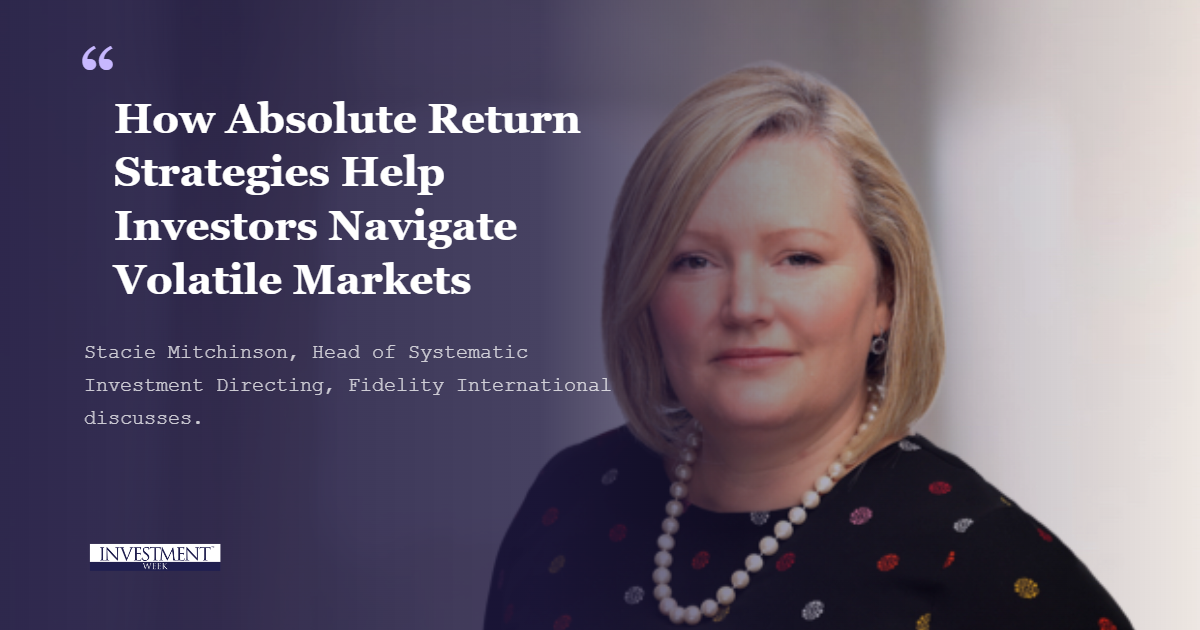
Periods of market volatility can be unsettling for investors. Sharp swings in asset prices, shifting correlations between traditional asset classes and heightened geopolitical and macroeconomic uncertainty can all challenge conventional portfolio construction. In this environment, absolute return strategies offer a compelling alternative – they seek to generate positive returns across market cycles while placing greater emphasis on managing downside risks.
Investing beyond market direction
Unlike traditional long only strategies, which are typically benchmarked to market indices and tend to rise and fall with them, absolute return strategies focus on delivering returns that are largely independent of broader market movements. Rather than trying to outperform benchmark indexes, their primary objective is to preserve capital and generate steady returns over time. This distinction becomes particularly valuable when markets are volatile or range bound, and when the diversification benefits of conventional equity allocations begin to weaken.
One of the defining strengths of absolute return strategies is their flexibility. Managers can typically invest across a wide range of underlying exposures and can take both long and short positions. This allows them not only to participate in rising markets, but also to exploit opportunities created by falling prices of unfavoured stocks. As market regimes shift, this adaptability enables absolute return strategies to respond dynamically rather than remaining exposed to single sources of risk.
Managing risk and limiting drawdowns
Risk management sits at the core of most absolute return approaches, including in the Fidelity Absolute Return Global Equity strategy. Security selection is expected to be the dominant driver of returns, accounting for between 80% and 90% of anticipated alpha, but a strong emphasis is placed on controlling volatility and limiting drawdowns through moderate leverage, careful position sizing and diversification across return drivers. For investors concerned about capital preservation during periods of stress, this focus can help smooth portfolio returns and reduce pressures that can be associated with drawdowns and other unanticipated market events.
Diversification when correlations rise
Volatile markets are often accompanied by rising correlations between asset classes, reducing the effectiveness of traditional diversification. Absolute return strategies can help address this challenge. Because they often rely on idiosyncratic opportunities—such as pricing inefficiencies or security specific fundamentals—their return drivers tend to differ materially from those of conventional equity portfolios. As a result, they can improve the risk adjusted profile of a broader multi asset allocation when diversification is most needed.
Uncertainty around interest rates, inflation and economic growth can increase return dispersion across sectors and individual securities. This environment can be particularly supportive for absolute return strategies, which aim to exploit the widening gap between winners and losers. By balancing long and short positions to minimise overall market exposure, these strategies seek to capture relative performance differences rather than relying on rising markets.
A stabilising role in modern portfolios
Recent market episodes have shown that sharp drawdowns do not have to be an inevitable part of equity investing. In an investment landscape characterised by elevated volatility, inflationary pressures and geopolitical fragmentation, strategies that are not anchored to benchmark performance may help investors remain invested while prioritising resilience and capital preservation. Moreover, when traditional market assumptions are tested, the ability of absolute return strategies to generate returns without being tied to market direction becomes increasingly important. In turn, absolute return strategies can play a valuable role in building more resilient portfolios for investors seeking flexibility, diversification and a smoother return profile during volatile periods.
Important Information
This is for investment professionals only and should not be relied upon by private investors. Investors should note that the views expressed may no longer be current and may have already been acted upon. The value of investments can go down as well as up so you may get back less than you invest. The value of investments in overseas markets can be affected by changes in currency exchange rates. Investments in emerging markets can be more volatile than other more developed markets. Investments in emerging markets can be more volatile than other more developed markets. The Fund may make increased and more complicated use of derivatives, and this may result in leverage. In such situations performance may rise or fall more than it would have done otherwise. The fund may be exposed to the risk of financial loss if a counterparty used for derivative instruments subsequently defaults. Reference to specific securities should not be construed as a recommendation to buy or sell these securities and is included for the purposes of illustration only. The Key Investor Information Document (KIID) is available in English and can be obtained from our website at www.fidelityinternational.com. The Prospectus may also be obtained from Fidelity. Issued by FIL Pensions Management. Authorised and regulated by the Financial Conduct Authority. GCT260424EUR
Read the full article here


