


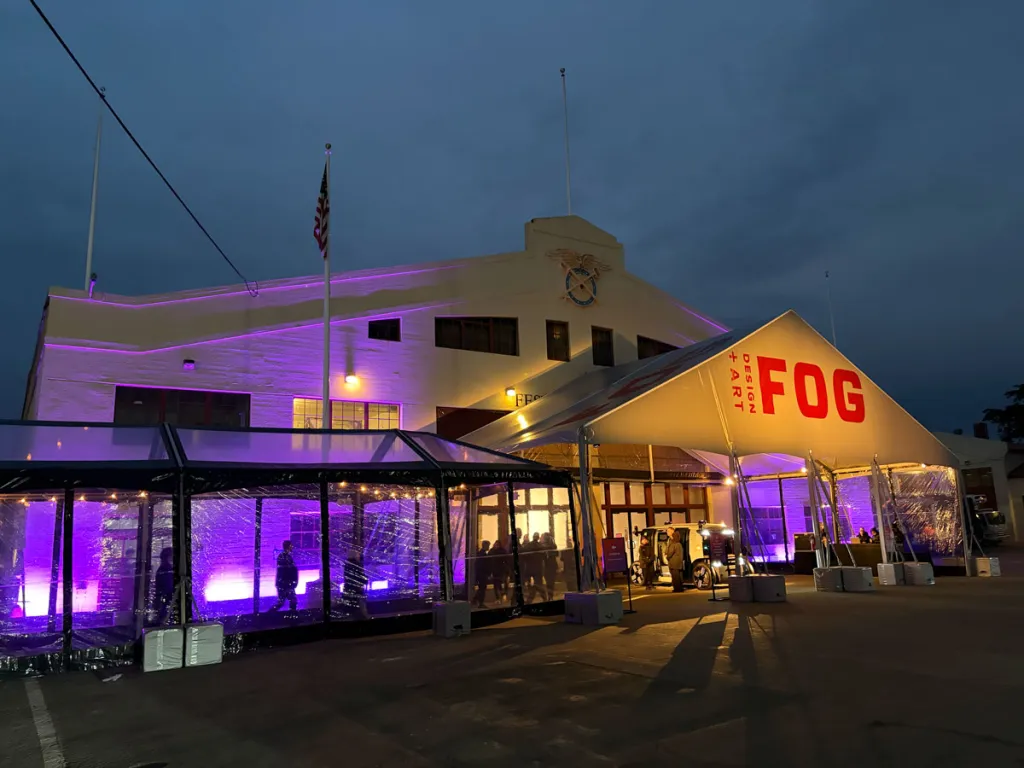
At the FOG Design+Art, a San Francisco art fair set across two piers at the Fort Mason Center, the tone for opening night on Thursday was set by what takes place the event’s environs. There, one can find a slew of valet drivers in white dinner jackets; they’ve returned from picking up cars belonging to VIPs. Inside, drinks flowed, and stationed hors d’oeuvres—including sushi rolls, dim sum, yuzu-glaze salmon over beet couscous, and more—could be found.
This glitzy preview acted as a gala fundraiser for the San Francisco Museum of Modern Art’s education initiatives, with tickets for entry during the first hour, at 4 p.m., starting at $10,000 for just six tickets. The first three hours were relatively calm: well-heeled VIPs making their ways through the aisles, often getting stopped every few paces by old friends. But the serenity at this preview, one of the main social events of San Francisco’s art scene, quickly faded away. By 7 p.m., when tickets dropped to $250 a head, the pier filled to the brim. The party kept going until 10 p.m., making the opening much longer than those for most other fairs.
There was a different energy in the air at this year’s edition of FOG, several dealers told ARTnews. This may be partially to do with the fact that the 2025 edition came only a couple weeks after wildfires devastated Los Angeles, where a large portion of dealers at the fair hail from.
Even still, the unpredictably of world events can often have an impact on the sales at any fair. “Every time you look at a newspaper, you don’t know what to expect,” New York dealer Ales Ortuzar said. His gallery is participating in FOG for the first time, prompted by his artist Suzanne Jackson’s retrospective at SFMOMA. During the first few hours, he sold several works, including three by Jackson. “San Francisco has a great community of collectors—it felt like time to come,” he added.
Several dealers, both local and from elsewhere, told ARTnews during the preview that the quality of Bay Area collectors remains high. “The strength of this fair is its community. The depth and caliber of institutions, collectors and advisers keep us coming back, 11 years and counting,” Junette Tang, managing partner of Marian Goodman Gallery, told ARTnews.
That sentiment seems to oppose the one often heard in the New York–based art press, which frequently reports that galleries have trouble converting tech billionaires from Silicon Valley into regular clients aiming to build substantial collections.
“The tech industry has generated an immense amount of wealth and there are several emerging collectors in the Bay Area,” Sydney Blumenkranz, FOG’s director, told ARTnews toward the end of the night. “They’re interested in buying art and knowing more about art collecting but often don’t know where to begin. That’s where a platform like FOG becomes an opportunity because they can meet galleries who are in town to meet them.”
One local collector who has risen in prominence over the past few years is Sonya Yu, who splits her time between San Francisco and Los Angeles. Yu, who has been listed on ARTnews’s Top 200 Collectors list since 2023, made headlines last month when she gave $900,000 to MoMA PS1 in New York so the institution can go completely admission free for the next three years.
“This is a pivotal moment for San Francisco and our art ecosystem,” Yu told ARTnews. “There are many sophisticated collectors and dedicated patrons who have been committed to cultivating this city’s arts scene. Working collaboratively with municipal leadership and art professionals, the creative community is more robust and diverse than what the doom loop headlines give credit to. We endeavor to shine a spotlight on our local talent while also enthusiastically welcoming a global audience to our unique culture.”
This edition is Blumenkranz’s second as director, though she ran the preview gala for six years before that. Now in its 12th iteration, the fair’s reputation is rebounding, with it receiving the most exhibitor applications in its history this year and its Focus section increasing in size by 40 percent, according to Blumenkranz. “It feels different this year,” she said. “The energy in the art market is back—in the Bay Area at least.”
FOG has 65 exhibitors this year, which makes it a relatively manageable fair compared to Art Basel’s events, which sometimes include more than 200 exhibitors. During the preview, it was noticeable just how many advisers were there to accompany their clients and help them navigate the fair. The number of advisers here will likely increase over the weekend. Dealers told ARTnews that many advisers walk around with their tech clients.
Yamaguchi Kayō, Mori no Hitotachi (Forest People), 1967, at Nonaka-Hill’s booth.
Photo Maximilíano Durón/ARTnews
Several sales did take place between 4 p.m. and 6 p.m., though transactions weren’t wholly the point of the preview night. “The beauty of the opening day of FOG is the collective enthusiasm for the San Francisco art scene being at the center of the art world,” San Francisco dealer Jessica Silverman told ARTnews. “It’s prime time.”
Silverman’s booth features works with all shades of blue in them. On the first day, the gallery sold Loie Hollowell’s Ultramarine Brain over Yellow Waters (2025) for $450,000. Rupy C. Tut’s Holding on to Hopes, Dreams and Desires (2025) for $60,000; Clare Rojas’s Blue Night (2025) for $60,000; Monet’s Pond by Sam Falls for $60,000; Margo Wolowiec’s Light Air (2025) for $45,000.
The night’s priciest work is likely Jack Whitten’s Solar Space (1971), which Hauser & Wirth sold for more than $1 million. The gallery also sold several works in the six figures, including a 2025 mixed-media work by Rashid Johnson for $750,000; a stunning untitled painting, from the 1970s, by Luchita Hurtado, showing the artist’s nude torso, for $ 695,000; a 2025 entry into Charles Gaines’s “Numbers and Trees: Arizona Series” for $595,000; a 2024 Avery Singer painting for $575,000; and two Jeffrey Gibson works for $375,000 and $275,000.
“FOG’s opening day underscores the vitality of San Francisco as a center for art and ideas. The energy, collaboration, and growth we feel here reaffirm our long-term commitment to the region, and we’re proud to be building alongside this extraordinary community,” Amanda Stoffel, a partner and head of sales for California at Hauser & Wirth, said.

Work by Ruth Asawa at David Zwirner’s booth.
Photo Maximilíano Durón/ARTnews
David Zwirner, which did not disclose prices, said it sold two of three sculptures by Ruth Asawa—the late Bay Area artist who was the subject of a retrospective at SFMOMA last year, now at the Museum of Modern Art in New York—from its booth, as well as two works on paper by the artist. Other sales include paintings by Scott Kahn, Walter Price, Lucas Arruda, and Suzan Frecon.
Gladstone sold a Richard Mayhew painting for $350,000, a Robert Bechtle watercolor for $150,000, multiple drawings from Robert Rauschenberg’s “Kyoto” series for $110,000 each, an Anicka Yi tempera work for $110,000, a Wangechi Mutu work on paper for $60,000, and an Aaron Gilbert painting for $55,00.
Within the first hour, Catherine Clark Gallery sold a wall-size textile installation, titled Still Finding My Way Back Home, by Lehuauakea to a US museum for $225,000. Charles Moffett sold out its presentation of LA-based artist Hopie Hill, with works ranging from $8,000 to $16,000. Tina Kim also sold works in the six figures, including a Park Seo-Bo painting for $250,000, a Ha Chong-Hyun painting for $250,000, a Kim Tschang-Yeul painting for $150,000, and a textile work by Lee ShinJa for $120,000.
Highlights around the fair include textile works of products like El Pato and Domino sugar by San Francisco–based artist Jeffrey Sincich at Charlie James; Rember Yahuaracani’s Picaflores Pescadores (Fisher Hummingbirds) at Josh Lilley; and Barbara Stauffacher Solomon’s This is not a Ping Pont Table #4 (1990) at Anthony Meier.
Work by Luchita Hurtado at Hauser & Wirth’s booth.
Photo Maximilíano Durón/ARTnews
One of the evening’s most unexpected works was brought to the fair via Los Angeles–based gallery Nonaka-Hill, which is sharing a booth with Mendes Wood DM. Nonaka-Hill, which recently opened a space in Kyoto, focuses on Japanese art from the 20th century, much of which remains under-exhibited in the United States. For its premiere presentation at FOG, the gallery was showing Yamaguchi Kayō’s 1967 pigment on paper work Mori no Hitotachi (Forest People). A tender depiction of four primates, this modern Nihonga painting is rare; it was placed on reserve for over $380,000.
Gallery Wendi Norris, a San Francisco–based that has been in business for more than two decades, is also debuting at the fair, showing the breadth of its program, which pairs Surrealism with contemporary art. On view in the booth is eight decades of work by nine artists. Among the works that it had placed were Rohini Devasher’s Borrowed Light 7 (2025) for $22,000; Wolfgang Paalen’s Ardah (1945) for $350,000; Marie Wilson’s Spirit of the Desert (1959–60) for $120,000; and Marie Wilson’s Cedarville (1952–54) for $65,000.
Wendi Norris, the gallery’s founder, told ARTnews that she “didn’t know how the booth would be received as we were putting it together.” Those concerns were unfounded, she said. “Sophisticated work resonates here, both with the museum groups in town and the local well-heeled crowd.”
