

Close Menu
  • News
  • Stocks
  • Bonds
  • Commodities
  • Collectables
    • Art
    • Classic Cars
    • Whiskey
    • Wine
  • Trading
  • Alternative Investment
  • Markets
  • More
    • Economy
    • Money
    • Business
    • Personal Finance
    • Investing
    • Financial Planning
    • ETFs
    • Equities
    • Funds

Subscribe to Updates

Get the latest markets and assets news and updates directly to your inbox.

Trending Now

Billionaire Collector Ken Griffin Buys Second Rare Constitution Printing

May 5, 2026

May Book Bag: from a guide on entering the art world to a publication about artists influenced by Ovid’s Metamorphoses – The Art Newspaper

May 5, 2026

Regis, Vault Ink US$7.7 Billion Merger to Create Australia’s Third Top Gold Miner

May 5, 2026
Facebook X (Twitter) Instagram
The Asset ObserverThe Asset Observer
Newsletter
LIVE MARKET DATA
  • News
  • Stocks
  • Bonds
  • Commodities
  • Collectables
    • Art
    • Classic Cars
    • Whiskey
    • Wine
  • Trading
  • Alternative Investment
  • Markets
  • More
    • Economy
    • Money
    • Business
    • Personal Finance
    • Investing
    • Financial Planning
    • ETFs
    • Equities
    • Funds
The Asset ObserverThe Asset Observer
Home»Art Market
Art Market

‘Permabase’ vs ‘flexispace’: which is better for commercial galleries? – The Art Newspaper

News RoomBy News RoomMarch 4, 2026
Share
Facebook Twitter LinkedIn Pinterest Email

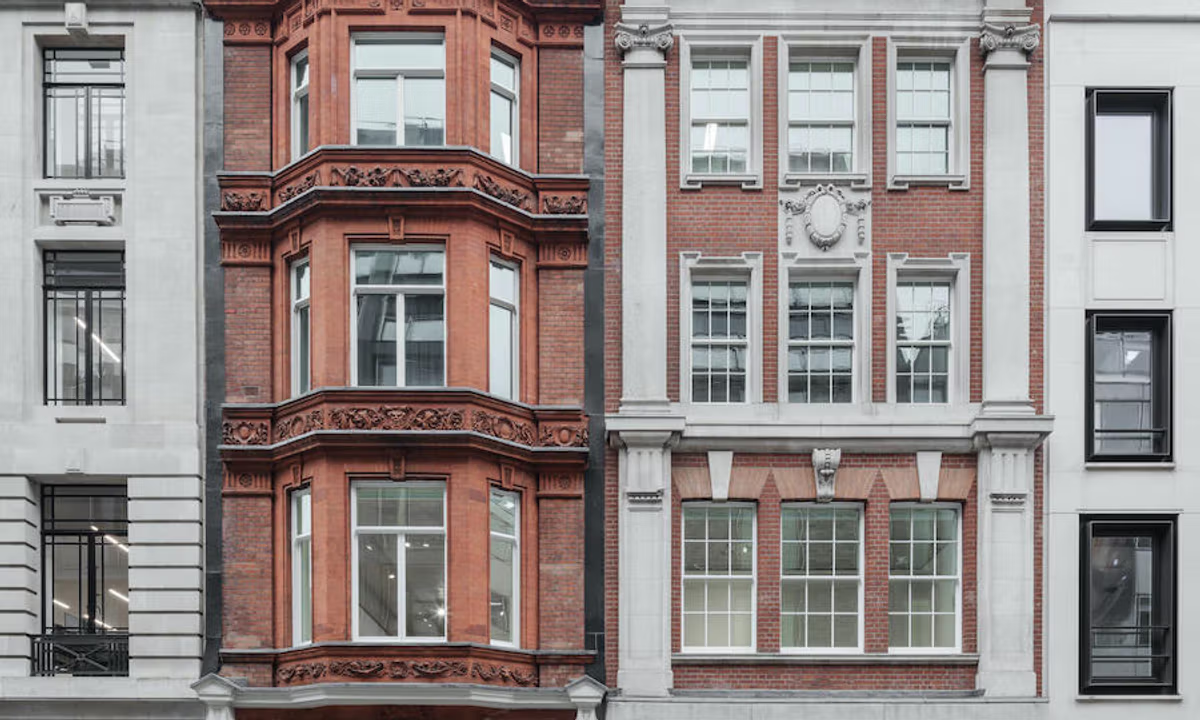
What defines a permanent space? Lehmann Maupin, which in January revealed its new London location in the Frieze gallery hub of No. 9 Cork Street, has a hybrid approach. It will have a permanent gallery on the first floor of the hub, which will serve partly as a base for its secondary market business, while its traditional primary market programme will have shows three to four times a year through a block booking of the hub’s prominent ground floor gallery.

The strategy points to uncertain times. The only thing that most gallerists agree on just now is that the commitment to bricks and mortar is restrictive and expensive. As Isabella Icoz, a partner at Lehmann Maupin, puts it: “The art world and the art market change so quickly, and we don’t want to be stuck… this is a model that we can adapt.”

For the bigger outfits such as Lehmann Maupin, that means picking one base (Icoz is clear that New York is its HQ) while taking opportunities as they arise elsewhere. Lehmann Maupin’s London shows will map the city’s seasonal art highs, including the key September to October period. Meanwhile the secondary market, which seems the steadiest source of gallery income right now, can keep ticking over.

The art fair alternative

Such a strategy works in favour of the many art fairs around the world, though their model is still under pressure. Temporary showings in various locations may mean a one-off hit for galleries, but they don’t require a longer-term financial commitment. When they work, galleries still make a high proportion of their sales at fairs (nearly a third on average, according to the latest stats). And when the purse strings need to be tightened, or when certain geographic regions fall below the radar, galleries can opt out, as has been made clear recently, notably at Art Basel Miami Beach in December.

Simon Fox, the chief executive of Frieze, who has previous experience in the retail sector at HMV Group, says: “For galleries, there’s the valid question of whether to have a fixed overhead 365 days a year.” He is putting his views into practice and has relaxed the application criteria this year for the Frieze fairs. While previously these stipulated a permanent physical gallery space (albeit with some exceptions), that requirement has now gone, with the focus more on specific proposals and the rubric still that the gallery presents “a regular programme of exhibitions”. The new rules kick in for the Seoul and then London events.

Best of both worlds

Meanwhile, Frieze has smartly taken a stake in the new normal through No. 9 Cork Street, and a similar exhibition space in Seoul. It now has the benefit of a long-term commitment from Lehmann Maupin while keeping other galleries in rotation.

Such a strategy did not work for Cromwell Place—where Lehmann Maupin previously had a similar arrangement—although one of Cromwell Place’s misfortunes was the arrival of No. 9 in a better location and with fewer spaces to fill. In diplomatic fashion Icoz says the gallery’s priorities have changed as it has grown in London, and describes its latest location as “much more in keeping with our brand”.

While the outlook remains unclear, galleries are likely to keep negotiating the balance between pop-up and permanence. Flexibility seems to be the mantra for 2026.

Share. Facebook Twitter Pinterest LinkedIn Tumblr Email

Keep Reading

Billionaire Collector Ken Griffin Buys Second Rare Constitution Printing

May Book Bag: from a guide on entering the art world to a publication about artists influenced by Ovid’s Metamorphoses – The Art Newspaper

How Well Do the Met Gala’s Attendees Know Their Art History? We Critique Looks by Madonna, Hunter Schafer, and More

The Egyptian Modernist Inji Efflatoun gains international exposure with new biographical collection – The Art Newspaper

A Pavilion of Ruins: Germany Reconsiders Its Past in Venice

Barry X Ball’s Wild Sculptures Are Perfectly at Home at Venice’s Grand Basilica of San Giorgio Maggiore

Pedro Reyes’s new Lacma commission sparks criticism in Mexico – The Art Newspaper

Venice Diary Day 1: At the Giardini, Artists Refuse to Make Fascism Cozy

Pleasure, parody and propaganda: rethinking the art of illustration in a new history of the genre – The Art Newspaper

Recent Posts
  • Billionaire Collector Ken Griffin Buys Second Rare Constitution Printing
  • May Book Bag: from a guide on entering the art world to a publication about artists influenced by Ovid’s Metamorphoses – The Art Newspaper
  • Regis, Vault Ink US$7.7 Billion Merger to Create Australia’s Third Top Gold Miner
  • How Well Do the Met Gala’s Attendees Know Their Art History? We Critique Looks by Madonna, Hunter Schafer, and More
  • The Egyptian Modernist Inji Efflatoun gains international exposure with new biographical collection – The Art Newspaper

Subscribe to Newsletter

Get the latest markets and assets news and updates directly to your inbox.

Editors Picks

May Book Bag: from a guide on entering the art world to a publication about artists influenced by Ovid’s Metamorphoses – The Art Newspaper

May 5, 2026

Regis, Vault Ink US$7.7 Billion Merger to Create Australia’s Third Top Gold Miner

May 5, 2026

How Well Do the Met Gala’s Attendees Know Their Art History? We Critique Looks by Madonna, Hunter Schafer, and More

May 5, 2026

The Egyptian Modernist Inji Efflatoun gains international exposure with new biographical collection – The Art Newspaper

May 5, 2026

A Pavilion of Ruins: Germany Reconsiders Its Past in Venice

May 5, 2026
Facebook X (Twitter) Instagram
© 2026 The Asset Observer. All Rights Reserved.
  • Privacy Policy
  • Terms
  • Press Release
  • Advertise
  • Contact

Type above and press Enter to search. Press Esc to cancel.