


This May leaves no time for jetlag as the art world comes in hot off the Venice Biennale and cruises straight into a stacked New York Art Week. Get your coffee to go, too, because for the second year in a row, all the fairs—headlined by Frieze, TEFAF, and Independent—are locked into a single week.
And more art is waiting to be discovered beyond the fair circuit. New York galleries are opening their major spring shows while curators and collectors are in town. This season, there’s a mix of discoveries and deep dives, from a primer on the state of contemporary glass with “Glass Class,” a group show downtown at The Hole, to a pitch-perfect pairing of David Hammons and Jannis Kounellis uptown at White Cube.
There are also some can’t-miss New York gallery debuts to check out, with Chicago artists Tony Lewis and Lindsay Adams marking their first New York solo shows at Olney Gleason and Sean Kelly Gallery, respectively. These days, galleries are scattered all over the city, so should art fair malaise take hold, simply find the nearest exit and head out to see some shows.
Here, Artsy highlights 11 of the most noteworthy gallery exhibitions taking place during New York Art Week 2026.
Kelly Akashi
“Heirloom”
Lisson Gallery
May 13–July 25
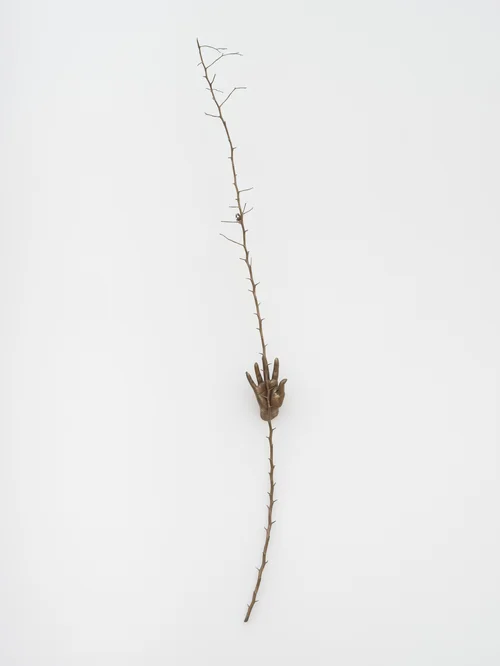
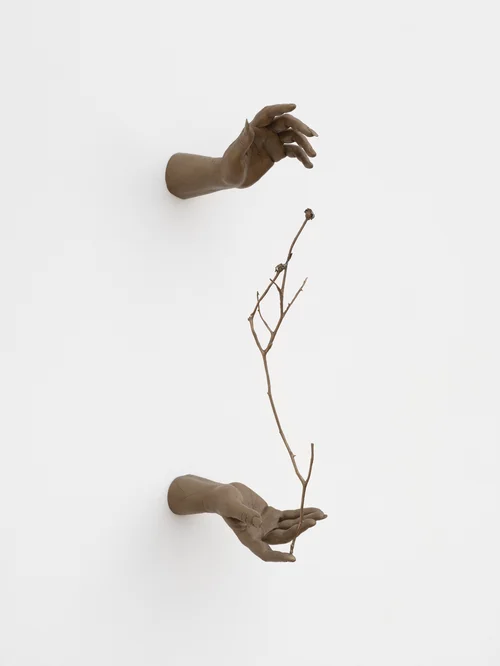
Artist Kelly Akashi lost her Los Angeles home and studio in the devastating Eaton fire that swept through the city in January 2025. The artist, who is a Los Angeles native, escaped with her cat and just a few keepsakes. Returning to the land where her home and studio once stood, only the chimney remained. In “Heirloom,” her New York debut with Lisson Gallery, Akashi debuts new sculptures in glass, bronze, carved stone, and Corten steel, which grapples with grief, inheritance, and loss. Flowers—roses, irises, and branches in bronze—are a recurring motif, a reference to her garden and the scorched earth she has tended since the wildfire. This outing coincides with Akashi’s inclusion in the 2026 Whitney Biennial. There, she has installed a Monument (Altadena) (2026), a ghostly 13-foot chimney and path made of clear glass bricks on the museum’s terrace.
Giuseppe Penone
“The Reflection of Bronze”
Gagosian
Through July 2
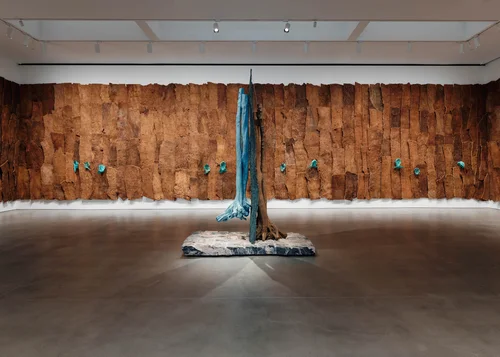
Arte Povera pioneer Giuseppe Penone has been fascinated by trees for decades. In the late 1960s, Penone began exploring natural structures of trees, rivers, and stones—as well as the processes that shape them. His works have spanned sculpture, performance, works on paper, and photography. Now, at 79, Penone turns to bronze, an ancient and lasting material, to create a series of massive new sculptural castings of trees, inspired by the forests near his home in Piedmont, Italy. Gagosian has gone all-in on the presentation, too. Nearly 700 sheets of cork line the walls of one room, absorbing ambient sound, so that the gallery space seems like a woodland oasis.
The show is notably curated by Adam D. Weinberg, former director of the Whitney Museum of American Art, who has said he hopes the exhibition introduces a new generation of American art lovers to Penone’s oeuvre.
Emma Webster
“Rues and Leaves Themselves Alone”
Petzel Gallery
Through June 6
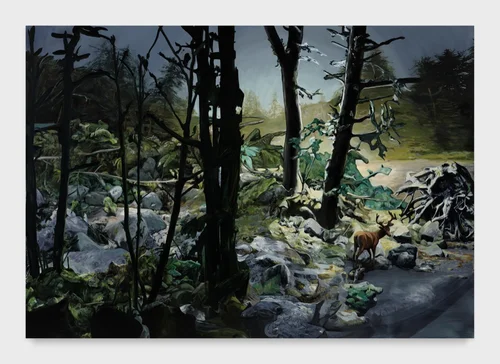
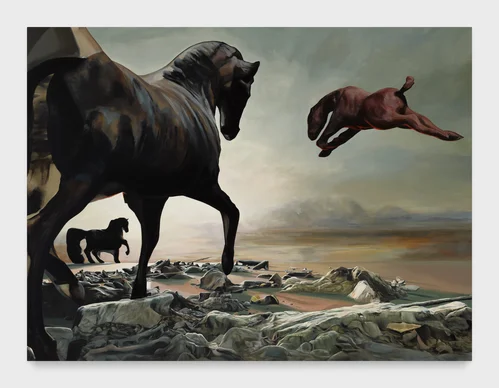
Los Angeles artist Emma Webster brings a new series of her brooding landscapes to her New York solo show with Petzel Gallery. Known for creating paintings with apocalyptic undertones, here Webster presents works that meander through a nocturnal forest filled with animals—deer, horses, cows—that are haunting and strange, appearing like life-size figurines. Webster has a unique process for making these works, involving VR sketches, scanned handmade maquettes, and drawings. Here, she imbues the centuries-old landscape painting tradition with the unstable perception of our own times.
Lindsay Adams
“SOIL”
Sean Kelly Gallery
Through May 30
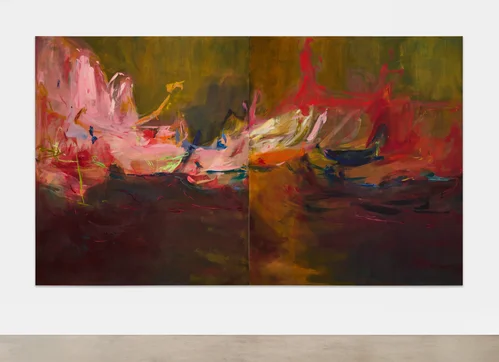
SOIL (Virginia Red Clay), 2026
Lindsay Adams
Sean Kelly Gallery
Chicago-based artist Lindsay Adams makes her New York solo debut at Sean Kelly Gallery with a new suite of abstract oil paintings. Adams describes her works as rooted in a sense of wonder. She uses Lamp Black pigment, an unusually intense noir, to create the background for her compositions. Instead of entirely obscuring this ground, she leaves the black only just perceptible. In this way, darkness seems a generative force beneath her sumptuous marks of pinks, blues, and greens.
Later this year, Adams will be among the 25 artists to have their work unveiled at the Obama Presidential Center in Chicago. Adams’s site-specific installation, Weary Blues, a reworking of a 2024 painting by the same name, will be made of silkscreen panels on fabric and on view in the public café.
Tony Lewis
“Abstract Slavery”
Olney Gleason
Through June 6
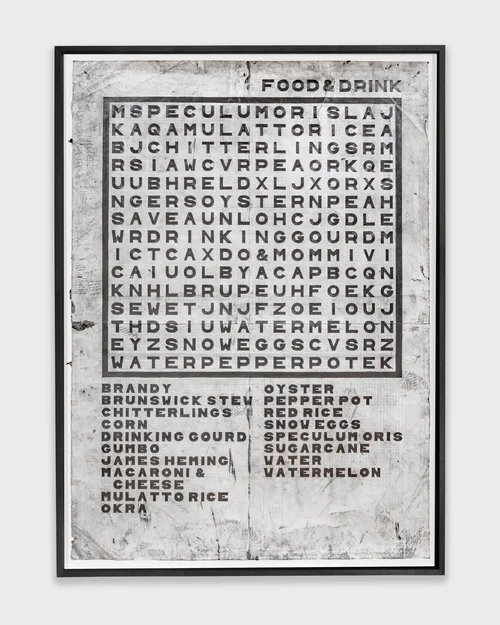
Food & Drink, 2025
Tony Lewis
Olney Gleason
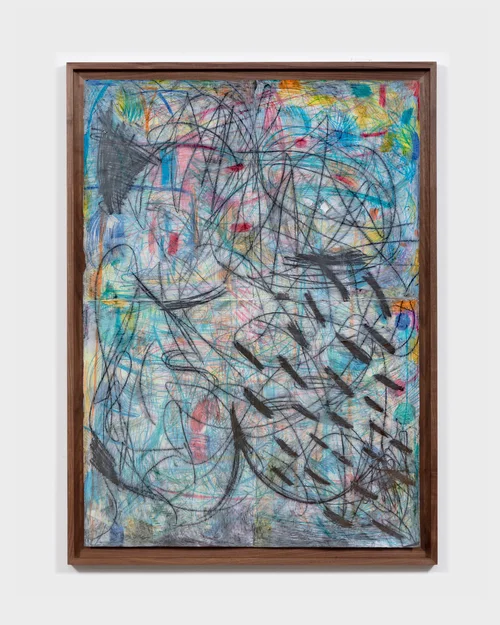
Sugar, 2025
Tony Lewis
Olney Gleason
Over the past 15 years, Chicago artist Tony Lewis has honed a conceptually rigorous drawing practice, working primarily with graphite, colored pencil, and paper. In the past decade, his works have explored alphabets and other written forms of language as modes of abstraction.
Now, in “Abstract Slavery” at Olney Gleason, a long-overdue New York solo debut for the artist, Lewis investigates the history of the Atlantic slave trade through three interrelated series: “Word Search” drawings, “Gregg Shorthand” compositions, and “White Drawings.” Across these works, Lewis both draws and obscures words tied to the slave trade, through the use of puzzles, shorthand marks, and personal scribbles, probing the structure and limits of written language in the face of history’s brutalities.
Firelei Báez
“Feet squelching on wet grass, nourished by uncertainty.”
Hauser & Wirth
May 12–July 31
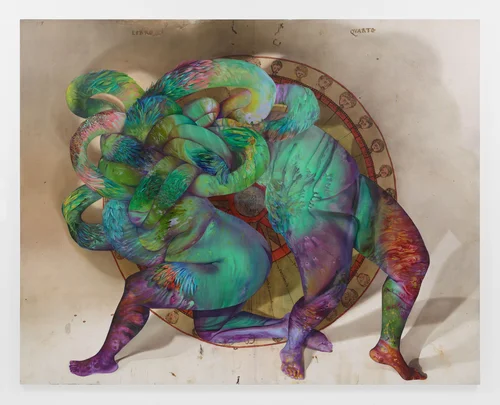
Firelei Báez is celebrated for her fantastical large-scale paintings that draw on Afro Caribbean histories and myths. This week, she makes her eagerly anticipated New York solo debut at Hauser & Wirth. At the center of the show is View of Nature (2026), an eight-panel painting where Báez depicts shifting climate and geography from the tropics near the equator to the icy climes of the Arctic Circle. The colossal work is Báez’s reimagination of an engraving that cartographer John Emslie made in 1852.
Here, Báez is also showing works in bronze, for the first time. Two monumental sculptures of ciguapas, chimerical female tricksters in Dominican folklore, loom over the exhibition, one of which Báez has adorned with plumes of real feathers.
Hyegyeong Choi
“Tethered, Untethered”
Harper’s
May 12–June 20
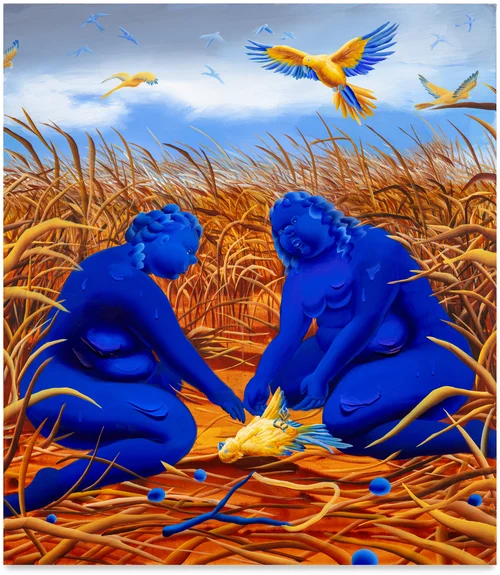
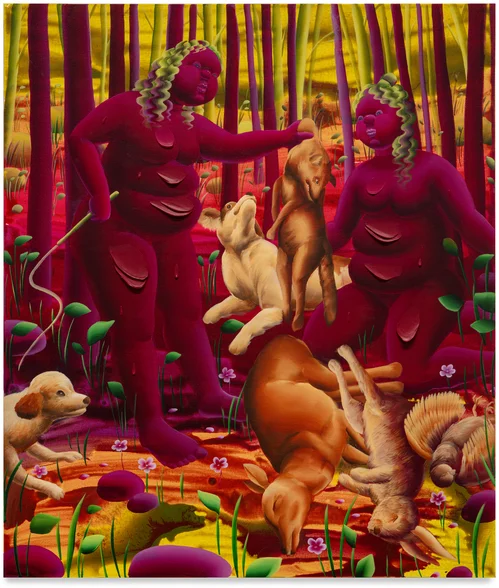
In her third solo exhibition with Harper’s, Brooklyn-based painter Hyegyeong Choi goes in for the kill—figuratively. Choi is known for her technicolor paintings of avatar-like humanoids, and here she brings these fanciful beings into dialogue with the history of hunting paintings. One new painting, for instance, reimagines Gustave Courbet’s Hunting Dogs with Dead Hare (1857), a scene of snarling dogs fighting over their lifeless prey, but with humanoids cast in the role of dogs. In the painting, Venery (2026), meanwhile, Choi depicts a Diana-like huntress who shoots a paintbrush from her bow rather than an arrow; it sails toward an abstract painting in the background, hinting at the element of pursuit that unites both painter and hunter in their quests.
Raven Chacon
“Score for Coming Storms”
Sikkema Malloy Jenkins
May 14–June 20
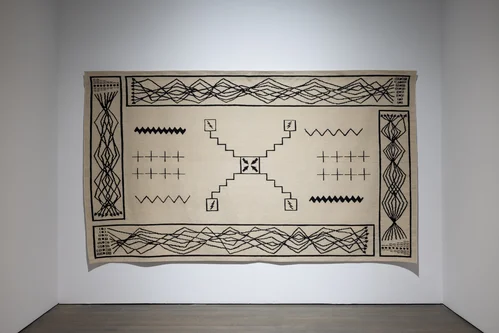
Pulitzer Prize–winning composer, performer, and artist Raven Chacon’s new exhibition, “Score for Coming Storms,” brings together a visual score for performance, a sound installation, textiles, and ink drawings.
Born in the Navajo Nation in 1977, Chacon has spent over two decades centering stories of Indigenous memory and resistance. In 2023, Chacon was awarded the MacArthur fellowship, and in 2024, the Swiss Institute organized “A Worm’s Eye View from a Bird’s Beak,” Chacon’s first major institutional solo exhibition.
Included in the exhibition is Storm Pattern (2021/2024), a sound installation composed of field recordings of flying drones captured at the Standing Rock Oceti Sakowin camp in 2016. The sounds of these drones, operated by both the police and private security, as well as those protecting the Missouri River from the pipeline build, create intertwined soundtracks of surveillance and countersurveillance.
Kim Dacres
“Lost on a Two-Way Street”
Charles Moffett
Through June 20
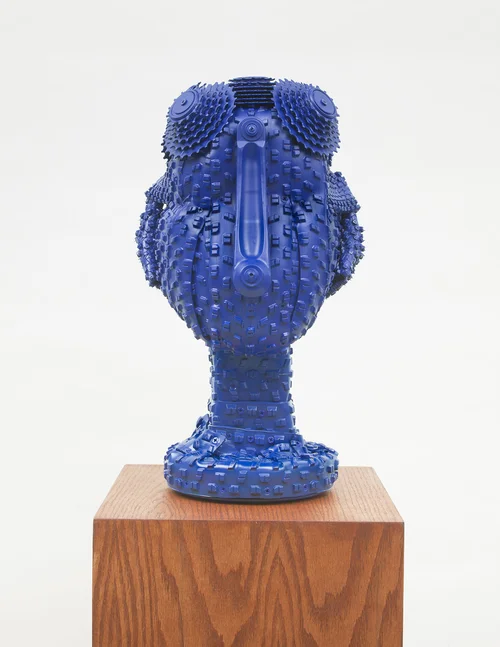
Until the ocean covers every mountain high (Blue Gears), 2026
Kim Dacres
Charles Moffett
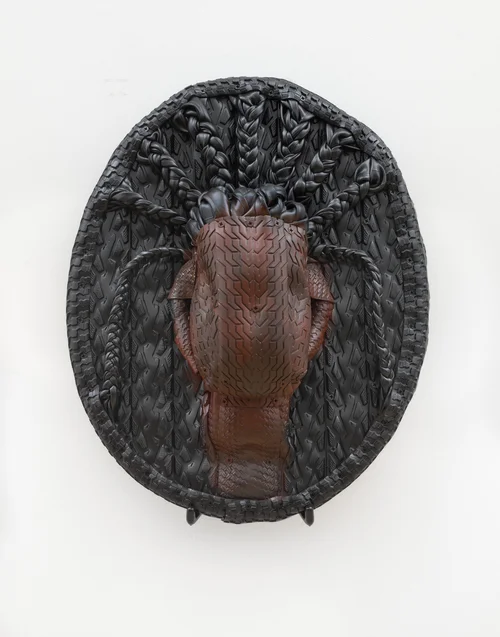
Oval Medallion – Lady with Contained Crash out Braids, 2026
Kim Dacres
Charles Moffett
Living in Harlem and working in the Bronx, artist Kim Dacres salvages rubber tires, computer keyboards, and metal from the city streets around her. She transforms cast-off materials into abstract busts, a sculptural format historically reserved for people in power. Dacres, who is a first-generation American of Jamaican descent, first introduced her busts in her 2023 debut with Charles Moffett. Now, in “Lost on a Two-Way Street,” Dacres adds wall works, which she calls medallions, to her repertoire, a form that is reminiscent of Victorian cameos. In these new works, Dacres weaves tire treads into buns and braids, and uses found metal as jewelry, so that her busts resemble the Black women who live in the very uptown neighborhoods where she sources her materials.
“Glass Class”
The Hole
Through June 28
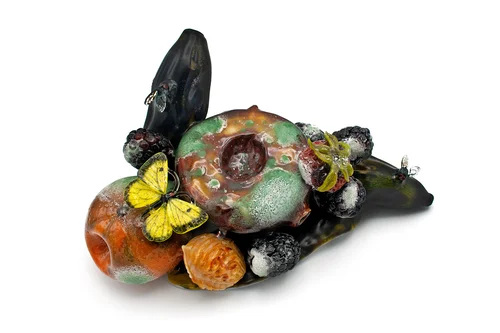
This group show is curated by glass artist and collector Eric Sullivan, and bills itself as a “crash course” in glass art—a medium that remains enigmatic to many even in the art world. The show is a mix of emerging, mid-career, and established artists. Notable artists featured include late German Australian glass artist and educator Klaus Moje, who innovated the influential kiln-formed glass technique, as well as contemporary artist Hannah Hansdotter, whose luminous vessels are rooted in Scandinavian craft traditions, but look deeply futuristic.
David Hammons and Jannis Kounellis
White Cube
Through June 13
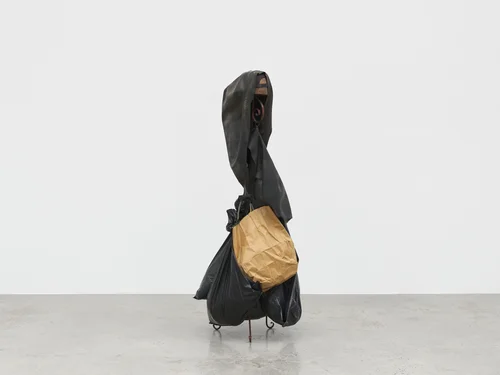
Uptown at White Cube, the works of American artist David Hammons and the late Greek Italian artist Jannis Kounellis come together in an unusually fruitful pairing. The exhibition is curated loosely around the story of their friendship, which sparked in the early 1990s at the American Academy in Rome.
The earliest works in the show are Kounellis’s, from the late 1950s, part of his “Alfabeto” series of stenciled paintings based on signage in the urban environment. The earliest Hammons works on view are his influential body prints, made in Los Angeles in the 1960s using everyday materials like wallpaper and margarine grease. Over the years, both artists resisted the commercialization and aestheticization of the art world. To these ends, Kounellis began incorporating natural materials, like coal and stone, into his works, while Hammons repurposed materials he found on the streets of New York City. The wit and deceptive simplicity of their creations are both memorable and moving.
